A Hyundai Ioniq 6 that sat in Phoenix heat can refuse every button by evening. The screens stay black. The fob does nothing. Handles don’t pop. When a Hyundai Ioniq 6 won’t start like that, check the 12-volt. It’s the usual cause, not an empty drive pack. The sedan shares the same failure other Hyundais hit. It shows up after a hot parked day in the Valley.
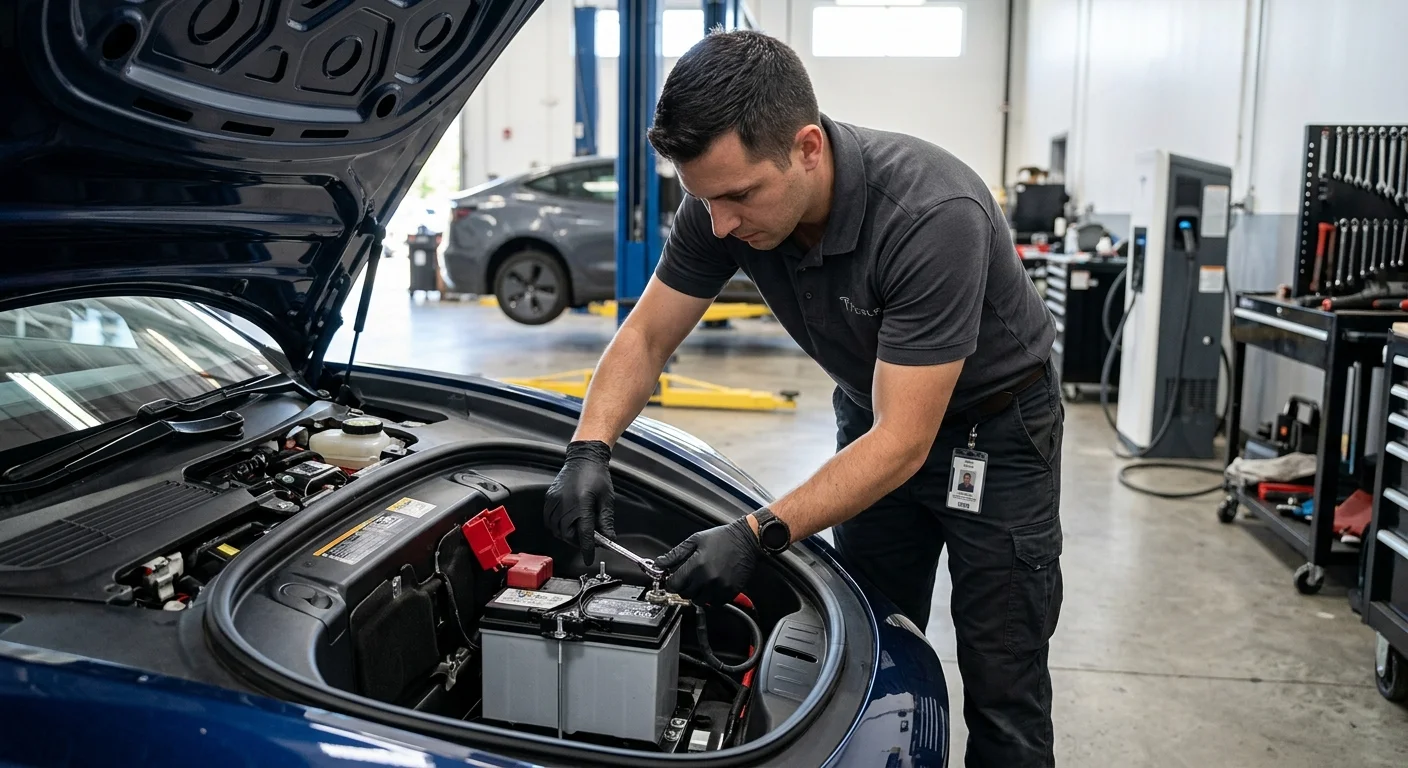
Start with the small battery, not the pack
The Ioniq 6 runs two electrical systems at once. The high-voltage pack moves the wheels. The 12-volt runs computers, locks, lights, and the contactor that connects the pack. Kill the 12-volt and the car can’t boot. A full traction battery sitting inches away doesn’t help.
Hyundai built this car on the E-GMP platform with the Ioniq 5. Both models let the 12-volt sag until the car goes silent. The battery management system can stop topping off that small battery. That happens when the pack is already very low. Then a few parked days finish the job. You can have range left from yesterday and still get nothing today.
Read what happens when an EV’s 12-volt dies in desert heat for the full lockout chain. The same stall on the crossover is Hyundai Ioniq 5 won’t start after sitting in Phoenix heat. Same family. Different hiding place for the battery.
Why a parked Valley day is so hard on it
Phoenix averages about 111 days a year at or above 100F. About 21 of those hit 110F or more, per NOAA normals. July highs sit near 107F. August sits near 105F. Overnight lows in summer often stay in the mid-80s. The 12-volt never gets a cool recovery window after a parked afternoon.
Battery Council International work, via Battery University, timed starter batteries in heat. They last about 47 months in hot climates versus 59 in cool ones. A battery that might go five years elsewhere can fail in two or three here. AAA calls heat the number-one cause of battery failure. It recommends AGM batteries in hot areas. The Ioniq 6 already uses an AGM 12-volt, the absorbed glass mat type. Heat still shortens its life.
The 12-volt only recharges from the car’s DC-DC converter while the car is on or charging. Cabin cooling, cameras, and leftover accessory loads keep drawing after you walk away. Park at Sky Harbor for a week in July. That small battery can be empty on return. That can happen even if you left the pack in a reasonable state.
Range on the big pack is a separate heat story. AAA’s 2026 study found about an 8.5% range loss at 95F versus 75F. Recurrent reported 20 to 30% range loss above about 95F in a set that included 300 Phoenix-area EVs. That’s why some owners arrive home lower than they planned. Darkness is still the 12-volt.
The battery is in the trunk on this sedan
This is the part that wastes time in a parking garage. On the Ioniq 5, the 12-volt sits up front under the hood. On the Ioniq 6, it lives in the trunk on the driver’s side. Look under a cargo trim panel. Pull the floor liner on the left. That AGM unit is the actual battery.
Don’t clamp jumper cables onto those trunk posts. The jump points are under the hood. There’s a fuse box and a red-capped positive terminal.
| Location | What you will find |
|---|---|
| Trunk, driver’s side under the liner | The AGM 12-volt battery itself |
| Under the hood, driver’s side fuse box | Positive jump terminal under a red cap |
| Under the hood, unpainted chassis bolt | Negative ground for the jump |
| Instrument cluster, when the car is awake | Auxiliary battery save setting |
Pop the hood from the interior release. Look for the black fuse box cover on the driver’s side. Lift the red cap for the positive post. Pick a bare metal chassis bolt for ground. Never put the black clamp on the trunk battery’s negative post.
How to jump the Ioniq 6 from the hood
You need a portable jump pack or a running donor car and cables.
- Open the hood from the interior latch.
- Find the black fuse box on the driver’s side of the bay.
- Flip the red cap off the positive terminal.
- Clamp the red lead to that terminal.
- Find a clean, unpainted bolt on the chassis or strut tower.
- Clamp the black lead to that bolt, not the trunk battery.
- If a donor car is helping, connect its battery last, then start the donor.
- Wait a couple of minutes so the Ioniq 6 can take a little charge.
- Press start and give the boot sequence extra seconds.
If it wakes, drive to a charger and let the car sit plugged in. One jump doesn’t rebuild a cooked AGM. If it dies again within the hour, the 12-volt needs replacement, not a second jump. See how to jump start an electric car safely in desert heat for the general method.
Stay off the travel lane while you work. ARS 28-871 says get off the traveled highway when you can. A car that can’t move is exempt. Still leave room and stay visible. ARS 28-775 is the Move Over law. It asks other drivers to change lanes or slow when they see lights. Put your hazards on.
Auxiliary battery save is not a jump
The Ioniq 6 has an auxiliary battery save mode. The Ioniq 5 doesn’t present it the same way. You turn it on from the cluster when the car is already awake. It limits accessory draw while you sit with screens on and the drivetrain off. Typical path is Settings, then Vehicle, then Auxiliary Battery.
It won’t revive a battery that’s already dead. Use it before a long wait, not after a lockout. A Sky Harbor pickup delay is one case. Extra innings at Sloan Park is another. Sitting in the car at Chase Field with the cabin cool is a third.
Valley situations that drain this sedan
A week in a Sky Harbor garage is the classic trap. Terminal 3 and Terminal 4 garages at Sky Harbor bake cars in summer. Level 2 charging is confirmed in the Terminal 3 garage on Level 1 west, Level 3, and Level 7. It’s also in the Terminal 4 garage on Level 4 east in zone B, and at the 24th St. station. That helps a pack that can still accept a plug. It doesn’t wake a car whose 12-volt already died.
East Valley heat soaks the same way. Mesa, Chandler, and Tempe lots hold heat after sunset. Gilbert’s newer tracts often have home charging. The stall happens on the road. A workplace stall that didn’t start, then a dark car after work, is often the 12-volt.
West Valley Loop 101 days add long, hot miles. Glendale and Peoria in Arizona, plus Surprise and Goodyear, sit on the Agua Fria stretch of Loop 101. You arrive home lower than the trip planner promised. The 12-volt may not have been topped off if the pack was already low.
The I-17 climb toward Anthem costs energy. Forum drivers report about 40% more energy going up, and the nav often underestimates that. You can reach a lot with pack left. You can still have a weak 12-volt the next morning.
Event parking that runs long is the other pattern. Mortgage Matchup Center downtown keeps cars sitting after a Suns night. State Farm Stadium in Glendale does the same after a Cardinals game. The save mode helps if you remember it. It does nothing if the 12-volt was already tired.
Watch the early signs before a full lockout. Signs your EV 12-volt needs replacement before it strands you is the checklist to run at home. Slow window motors, sticky handles, and a cluster that boots late are the usual tells.
What the state will do, and what it will not
Arizona does run free motorist help. Arizona DPS Roadside Motorist Assistance can change a tire. It can bring gasoline or diesel, jump a conventional battery, add water, and call a tow. Its published materials don’t mention charging an EV or recovering an out-of-charge car. ADOT’s Incident Response Unit works Phoenix-area freeways from 5 a.m. to 8 p.m. on weekdays. It clears crashes and debris and helps stranded drivers.
A 12-volt jump is closer to what those programs already do. A mobile Level 2 charge to the CCS port isn’t. If the sedan is dark, you may need both. You may need a 12-volt wake, then enough charge to roll home. Independent operators are who carry that combination.
After it starts, treat heat as the real clock
Home charging on APS or SRP lets the DC-DC refill the 12-volt. APS markets the R-EV overnight plan and Take Charge AZ for public and workplace charging. SRP still has existing customers on its Electric Vehicle Price Plan through November 2029. It also runs EV Smart Charge. Confirm which utility serves your block. In this metro the line can split street by street.
Have the 12-volt load-tested if the car is a few years old and parks outside. Heat is the aging factor, not miles alone. The same AGM that passed last summer can fail this July.
If the pack itself is the problem, that’s a different call. A mobile operator can bring a 240V Level 2 source to a CCS Hyundai. That typically adds 10 to 20 miles of range in 15 to 30 minutes of charging time. That’s charging time, not a promise of when someone arrives. The operator quotes you before work starts and bills you directly.
Who to call when the Ioniq 6 stays dark
Charge Pro PHX is a referral line for the Phoenix area. It doesn’t own trucks, employ technicians, or set prices. It matches you with an independent local operator. That operator can jump a dead 12-volt. They can replace one on site when that’s the right fix. They can also charge the pack enough to move. Operators cover Tesla and every major EV brand, including Hyundai. They bring a native NACS plug and CCS or J1772 adapters for non-Tesla cars.
For a CCS sedan like the Ioniq 6, start with non-Tesla EV rescue in the Phoenix area. City-level context for central Phoenix is on the Phoenix EV charging and rescue page. The Kona in the same household fails the same way: Hyundai Kona Electric won’t start after a hot parked day.
If you’re already stuck, call (602) 932-0920. The operator you get matched with quotes the job before they start.
Frequently asked questions
How do you jump a Hyundai Ioniq 6 that won’t start?
Use the positive post under the hood, not the battery in the trunk. Red clamp on the red-capped fuse-box terminal. Black clamp on a bare chassis bolt. Wait a couple of minutes, then try start.
Where is the 12-volt battery on an Ioniq 6?
It sits in the trunk on the driver’s side under the cargo liner. The Ioniq 5 keeps its 12-volt up front instead. Jump points for the sedan are still in the engine bay.
Can the Ioniq 6 refuse to start with range left in the pack?
Yes. The 12-volt wakes the computers that close the high-voltage contactors. If that small battery is dead, a charged pack can’t come online. Heat after a parked Valley day is the usual trigger.