A Hyundai Kona Electric that won’t start after a hot parked day in the Phoenix area is usually the small 12-volt. The drive pack can still hold a healthy charge. The car stays dark anyway. The 12-volt is what closes the contactors that wake the high-voltage system.
Confirm you’re in the battery-electric Kona. Hyundai also sold petrol and hybrid Konas with the same body. A fuel door and a gas engine mean a different fault tree. This page is only for the electric car.
Why the pack can be full and the car still dead
The Kona’s traction battery doesn’t start the car by itself. A small AGM 12-volt battery runs the computers and door latches. It also closes the contactors that connect the pack. After a day in Valley heat, that small battery is the part that quits.
Phoenix averages about 111 days a year at or above 100F. About 21 days hit 110F or more. Those figures come from NOAA normals through NWS Phoenix. July highs sit near 107F. August highs sit near 105F. Overnight summer lows stay in the mid-80s. The under-hood bay never really cools.
The Battery Council International work, via Battery University, found starter batteries last about 47 months in hot climates. In cool climates they last about 59 months. AAA names heat as the top cause of battery failure. It points hot-climate drivers toward AGM batteries. The Kona already uses AGM. Desert heat still shortens its life. A battery that lasts five years in a mild climate can fail in two or three here.
A DC-DC converter only tops the 12-volt while the car is on or plugged in. Parked at Sky Harbor, in a Tempe lot, or on a Chase Field deck, that converter is idle. Cabin modules keep sipping power. You come back, press Start, and get silence.
Heat also cuts range, and that mix-up is how people call the wrong help. AAA’s 2026 study found about a 10% efficiency drop at 95F versus 75F. Range fell about 8.5%. Recurrent, using 345,622 trips from 300 Phoenix-area EVs, reports 20 to 30% range loss above about 95F, and near 31% at 100F. NREL notes cabin cooling is one of the biggest draws. You can lose miles on I-10 or Loop 101 and still have a pack that would start the car. A fully dark dash is not that story. That’s the 12-volt refusing to close the contactors.
For the wider electrical picture, read what happens when an EV’s 12-volt dies in desert heat.
Tell a dead 12-volt from an empty pack
You don’t want a mobile charge for a jump job. You also don’t want a jump when the pack is empty.
A dark cabin with no click and no cluster is almost always the 12-volt. The key fob may not unlock. Interior lights stay out. The charge-port door may not release. The traction pack can still sit at a healthy state of charge.
An empty drive battery looks different. You usually had low-range warnings first. The dash still wakes. You may get a Ready light that then dies after a short roll. The port still takes a cable.
Use this as a curb-side check:
| What you see | 12-volt is dead | Drive pack is empty |
|---|---|---|
| Dash stays fully dark | Yes | No, warnings still show |
| Fob won’t unlock | Yes | No |
| Cabin lights ignore you | Yes | No |
| Ready light never comes on | Yes | Yes |
| Car rolled a few miles, then quit | No | Yes |
| Range warnings before it stopped | No | Yes |
| Charge port takes a cable | Often no | Yes |
Zero response at the Start/Stop button means start with the 12-volt. Some lights plus pack warnings mean you need a charge, not a jump. That’s mobile EV charging.
The same heat pattern shows up on Hyundai’s other EVs. If you drive an Ioniq 5, see Hyundai Ioniq 5 won’t start after sitting in Phoenix heat.
Where the Kona hides that 12-volt
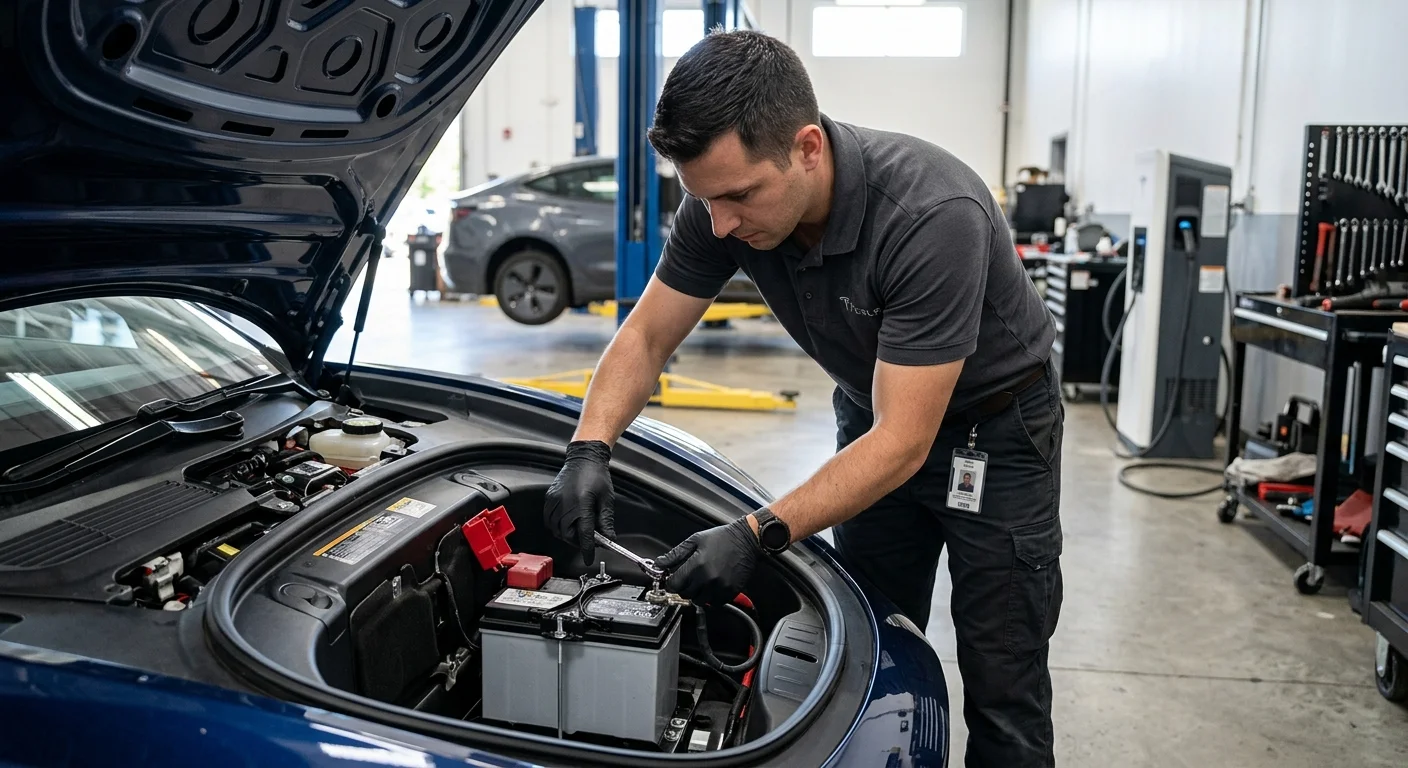
Many EVs bury the auxiliary battery in the frunk. Others put it under the cargo floor. The Kona Electric puts it in the under-hood bay. Look on the driver’s side, toward the rear of the compartment. It’s a standard 12-volt AGM. Size is about the same as a compact gas-car battery.
That location is easier to reach than most EV packs. It’s still tight in July heat. Gloves and eye protection are worth putting on before you lean in.
To get to it:
- Pull the interior hood release. If the 12-volt is fully dead, the electronic latch may not fire. Use the emergency hood release in the owner’s manual. It’s usually a pull near the driver-side fender, through the grille.
- Look to the rear driver’s side of the bay. The battery sits in a plastic tray with a strap or bracket.
- The positive post has a red cap. The negative is bare or under a black cap.
Don’t treat the battery posts as your first jump points. The Kona has dedicated terminals under the hood for that.
How to wake a Kona Electric from the curb
Use a portable jump pack rated at least 400A peak. Jumper cables from a gas car also work. Don’t use a second EV as the donor. EVs aren’t built to source that kind of current. The donor can throw fault codes.
The safe sequence:
- Open the hood with the interior handle or the emergency release.
- Pop the red cap on the positive jump terminal. It sits on the fuse-box cover, driver’s side.
- Pick a clean, unpainted chassis ground. A shock-tower bolt is a common choice. Skip the battery’s own negative post if you can.
- Clamp positive to the Kona’s positive terminal, then to the pack or donor positive.
- Clamp negative to the pack or donor negative, then to the Kona chassis ground.
- Let current flow for two to three minutes before you try Start.
- Foot on the brake, press Start/Stop. The Ready light should come up in a few seconds.
Once it wakes, drive to a Level 2 plug. Leave it connected for at least an hour. Charging is when the DC-DC converter can rebuild the 12-volt. If the car dies again within a day or two, the battery is done. A jump is a bridge, not a repair.
For safety notes that apply across brands, see how to jump start an electric car safely in desert heat.
If you’re on a freeway shoulder, Arizona law comes first. ARS 28-871 says get off the traveled lanes when it’s practical. A vehicle that truly can’t move is exempt. Leave room for traffic to pass. Stay visible 200 feet each way. ARS 28-775 is the Move Over law. Other drivers should change lanes around a car with warning lights. Slow down if they can’t move over. Arizona DPS Roadside Motorist Assistance will jump a 12-volt and call a tow. Its published materials name gasoline and diesel. They don’t advertise bringing an EV a charge. ADOT’s Incident Response Unit works Phoenix-area freeways weekdays from 5am to 8pm. It also doesn’t list EV charging. A disabled Kona on I-10, I-17, or Loop 101 still needs an EV-capable operator if the pack is empty.
The 12V Battery Save setting, and what it won’t do
From the 2019 model year, Hyundai added a 12V Battery Save function on the Kona Electric. Find it under Settings, then Vehicle, then Charge Settings. Then open 12V Battery Save. Menu labels shift a little by year and trim.
When it’s on, the car can pull a little current from the traction pack. That keeps the 12-volt above a cutoff. It’s a rescue mode. It isn’t a substitute for a healthy auxiliary battery.
Know the limits before you count on it. If the 12-volt is already dead, the screen is dark. The setting is gone until you jump. Using it every week means the AGM is aging out. Replace it. After a jump on an older battery, turn Save on for the drive to a charger or a shop.
Short Valley hops make drain worse. A Glendale, AZ run on Loop 101 Agua Fria may not give the DC-DC enough time. A Mesa surface-street loop often doesn’t either. Occasional longer highway miles help. A real Level 2 session does the same job.
Home charging still depends on which wires serve your block. APS markets EV Overnight Charging on the R-EV plan from 11pm to 5am weekdays. It also names a Level 2 smart-charger rebate, APS Smart Charge, and Take Charge AZ. SRP has an Electric Vehicle Price Plan for existing customers. That SRP plan closed to new enrollment after a February 2025 board decision. Existing customers may stay through the November 2029 billing cycle. SRP also lists an Electric Vehicle Export Price Plan for solar homes, a Level 2 rebate through the SRP Marketplace, EV Smart Charge, and BizEV. Mesa Municipal Electric has an E1EV time-of-use rate around downtown Mesa. ED3 serves the city of Maricopa with EV TOU 2-10. Confirm which utility actually serves your address. Phoenix, Chandler, Gilbert, Scottsdale, Tempe, Peoria, Avondale, and Paradise Valley split APS and SRP street by street.
Hot parked days around the Valley
The Kona pattern here is a car that sat. It isn’t usually a car that ran empty on the road.
Airport and trip parking
Phoenix Sky Harbor has Level 2 charging in the Terminal 3 garage. Stalls are on Level 1 west, Level 3, and Level 7. The Terminal 4 garage has charging on Level 4 east, zone B. There’s also charging at the 24th St. station. EVPassport installed those PHX stalls in 2022. The PHX Sky Train links East Economy to the terminals. A week in a hot structure still cooks the 12-volt. The traction pack can be fine. You come back from a trip to a black dash and a mute fob. That’s the classic dead-auxiliary return, not an empty pack.
Phoenix-Mesa Gateway lists hourly, daily, and Ray Road Economy lots, with a free Economy shuttle. Whether Gateway has on-site EV charging is unresolved. The official amenities list doesn’t show it. Check the lot yourself before you count on a stall.
Event decks and workdays
A night at Chase Field is a long bake with the converter off. So is a night at Mortgage Matchup Center downtown. A Cactus League day at Sloan Park in Mesa does the same. Salt River Fields, Camelback Ranch in Glendale, AZ, Peoria Sports Complex, Surprise Stadium, Goodyear Ballpark, Tempe Diablo, and Scottsdale Stadium all mean hours of parked heat. West Valley lots near State Farm Stadium in Glendale, AZ cook a parked Kona the same way. Phoenix Raceway sits in Avondale, not Phoenix, despite the name. Race-day parking is another long sit with the DC-DC off.
A Kona left in a Chandler, Tempe, or downtown Phoenix lot through a 107F afternoon can wake dead. That can happen even if you plugged in the night before. Heat ages the AGM. One failure is a warning. The next one is often a lockout.
Newer East Valley and Pinal housing, in places like Gilbert, San Tan Valley, and Maricopa, often has home charging. The call still happens on the road after the car sat at work or at a venue. Older West Valley streets in Sun City and Youngtown add their own wrinkle: long parked days and heat that never lets the bay cool.
Older 2018 to 2020 cars
Those first electric Konas are now deep into desert age. Hot-climate AGM work points to a two-to-three-year life here. If yours has already gone dark once, plan a replacement. Don’t wait for a second jump. Sleep-mode behavior on early Konas also leaves background modules awake longer than some later EVs. A software update can change that drain. It can’t reverse an AGM that’s already cooked.
If the traction pack is the empty one, the operator who shows up brings a 240V Level 2 source to the car. For a Hyundai that usually means a CCS or J1772 adapter. That typically adds 10 to 20 miles of range in 15 to 30 minutes of charging. That’s charge time at the car. It isn’t a promise of when someone arrives. Charge Pro PHX is a referral line. It matches you with independent local mobile rescue operators. The operator quotes you before starting. They bill you directly.
Non-Tesla EV rescue is the path for a Kona, Ioniq, or other CCS car. For the metro map, start at EV charging across the Phoenix area. Heat care for the pack itself is a separate topic. See how Phoenix heat changes EV battery care.
If a jump doesn’t bring Ready back, the next suspects are simple. The 12-volt may not hold any charge. A fuse in the junction box may be blown. A rarer BMS communication fault can keep the contactors open. Those need a Hyundai dealer or an EV shop. They often need a flatbed. Ask the operator on site whether a tow is actually required. Hyundai factory roadside has had documented trouble getting a dead EV towed. Say you need a flatbed and an EV-capable hookup.
Arizona has no statewide tow-rate cap. Cities and counties may set local maximums under ARS 9-499.05 and 11-251.04. Private-property tows need the owner’s written authorization or a police request. If a garage wants the car moved, get that in writing before a hook hits the Kona.
Monsoon season here runs June 15 to September 30. Haboobs can drop visibility to near zero. Flash floods follow the same window. Don’t drive around barricades into water. ARS 28-910, the Stupid Motorist Law, can bill you for the emergency response. Sit tight. Don’t roll into a wash.
EVs are exempt from Arizona emissions testing in Maricopa County Area A. Hybrids aren’t. Arizona has no annual safety inspection. None of that helps you when the dash is black in a hot lot. The 12-volt still has to close those contactors.
Frequently asked questions
How do you jump a Hyundai Kona Electric after it sits in heat?
Use a portable jump pack on the dedicated positive terminal under the fuse-box cover. That cover is in the driver-side bay. Use a clean chassis ground for negative. Wait two to three minutes. Then press Start/Stop with your foot on the brake. Don’t jump from another EV. After it wakes, plug into Level 2 so the 12-volt can rebuild.
Why does a Kona Electric go dark after a hot parked day?
The drive pack can’t close its own contactors without 12-volt power. Desert heat shortens AGM life. A parked Kona isn’t running the DC-DC converter. Phoenix heat days over 100F pile up. Overnight lows in the mid-80s give the battery no real rest. Short commutes add to the drain.
What does 12V Battery Save actually do?
It siphons a little energy from the traction battery to keep the 12-volt above a floor. You’ll find it under Charge Settings on most 2019-and-newer Konas. It won’t run forever. It won’t appear on a black screen. If you lean on it often, replace the auxiliary battery.
If the Kona is dark and you’re stuck in the Phoenix area, call Charge Pro PHX at (602) 932-0920. An independent operator can jump the 12-volt on site. They can bring Level 2 if the pack is the empty one. They quote before they start.