A Ford F-150 Lightning DC fast charge is listed around 41 minutes from 15 to 80 percent. Home Level 2 is about 8 to 10 hours on Extended Range. In Phoenix heat, both run longer. July highs near 107F make the pack and the public charger derate. How long it takes to charge a Ford Lightning here misses the dash estimate.
Ford’s spec sheet assumes a cool pack
Extended Range DC fast charging, 15 to 80 percent, is listed at about 41 minutes. The Standard Range pack is listed near 44 minutes. Those figures need a stall that can feed peak power. They also need a battery that isn’t already hot. A July afternoon in Phoenix fails both tests.
Phoenix averages about 111 days a year at or above 100F. That’s NOAA 1991-2020 normals via NWS Phoenix. About 21 days hit 110F or more. August highs average near 105F. Overnight summer lows stay in the mid-80s. A Lightning in a Phoenix driveway doesn’t get a cool soak. Neither does a Mesa lot or a Sky Harbor garage.
AAA’s 2026 study found about a 10 percent efficiency drop at 95F versus 75F. Range fell about 8.5 percent in that test. Recurrent reported 20 to 30 percent range loss above about 95F. Loss sat near 31 percent at 100F. That dataset covered 345,622 trips by 300 Phoenix-area EVs. NREL lists cabin cooling among the biggest energy draws.
Standard Range and Extended Range don’t share one clock
The Lightning ships with two packs. Standard Range is about 98 kWh total, about 89.5 kWh usable. Extended Range is about 131 kWh total, about 120 kWh usable. Home charging an empty Extended Range pack takes more hours. On DC fast, that pack also accepts a higher peak rate. The two trucks stay close on a 15 to 80 percent stop. Heat stretches both.
Ford’s Charge Station Pro can deliver up to 80 amps on a dedicated circuit. Extended Range fills in about 8 to 10 hours in mild weather. Standard Range is about 6 to 8 hours. A 48-amp wall unit stretches a full charge toward 12 to 14 hours. Phoenix heat doesn’t rewrite those circuits. It still keeps the pack warm, so the session can start slow. Plug in when you park.
A regular 120-volt outlet still works. Treat Level 1 as a spare. A full fill from empty can take several days.
Overnight charging on APS, SRP, and the smaller utilities
The Phoenix area is split among five utilities. Service can change on the same street. APS serves large parts of Phoenix, plus Surprise, Goodyear, Buckeye, and Queen Creek. SRP serves much of Mesa. It shares Chandler, Gilbert, Tempe, and Scottsdale with APS. Glendale, Arizona, Peoria, Avondale, and Paradise Valley are split as well. Confirm the meter on your own address.
APS markets the R-EV plan as EV Overnight Charging, 11pm to 5am on weekdays. It also names a Level 2 smart-charger rebate, APS Smart Charge, and Take Charge AZ. SRP’s Electric Vehicle Price Plan closed to new enrollment after a February 2025 board vote. People already on it can stay through the November 2029 billing cycle. SRP also names an Electric Vehicle Export Price Plan for solar customers. The Marketplace adds a Level 2 rebate, EV Smart Charge, and BizEV.
Mesa Municipal Electric covers about 5.5 square miles around downtown Mesa. It offers an E1EV time-of-use rate. ED3 serves the city of Maricopa and much of northern Pinal, with EV TOU 2-10. Maricopa the city sits in Pinal County, not Maricopa County. ED2 serves Casa Grande, Coolidge, and Florence. No EV-specific program was found on ED2’s site. Rebate dollars and per-kWh prices couldn’t be confirmed for this page. Ask the utility before you buy a wall unit.
Newer housing in Gilbert and Chandler often already has a 240-volt circuit. Calls from those towns still happen on the road. If the house still needs a circuit, that’s licensed electrician work. Compare that path with Home 240-volt charging versus a mobile 240-volt rescue.
A DC fast stop on a 107F Valley day
Ford’s 41 and 44 minute windows start from a cool pack. The Lightning takes power fastest in the middle of the curve, then tapers. Most drivers stop near 80 percent on a trip. The last 20 percent can eat almost as much clock as the rest.
Heat adds a second taper. The pack protects itself and accepts fewer kilowatts. Many public cabinets derate in the same weather. The stall’s rated peak isn’t what you get at 3pm in July. Your session won’t match the brochure.
Tesla owners see the same stretch in this climate. The chemistry is similar even when the plug isn’t. How long a Tesla charge takes in Phoenix summer heat walks that curve.
Grades spend range before you ever plug in. Phoenix and Sky Harbor sit near 1,135 ft. Northbound I-17 climbs through Anthem, New River, and Black Canyon City. ADOT posts a 6 percent maximum grade on that northern stretch. SR-87, the Beeline, posts 7 percent into Slate Creek Canyon toward Payson. US-60 east, the Superstition Freeway, climbs from Apache Junction toward Superior. Forum reports on I-17 put roughly 481 Wh/mi going up versus 293 coming down. That’s about 40 percent more energy uphill. You roll into the stall hotter and lower than planned.
ADOT’s NEVI plan funds DC fast sites along I-10, I-17, and I-8. Parts of US-60 and SR-347 are designated too. Minimum output is 150 kW, with construction underway in 2026. That’s corridor work, not a promise your stall is open or at full rate. Check a live app before you bet a low pack on one pin. See Charging apps to check before you’re stuck on the shoulder.
Arizona DPS Roadside Motorist Assistance will jump a 12-volt. It can change a tire or bring gasoline or diesel. ADOT’s Incident Response Unit works Phoenix-area freeways weekdays, 5am to 8pm. Neither program advertises charging an empty EV.
When charging time isn’t the problem
A slow charge and a dead charge are different jobs. If the Lightning won’t wake, check the small 12-volt first. A port that never starts a session is the same story. AAA calls heat the number-one cause of battery failure. Battery Council International work, via Battery University, tracked starter-battery life. Hot climates got about 47 months versus about 59 in cool ones. A battery that lasts five years elsewhere can fail in two or three here. A dead 12-volt strands the truck even with a full traction pack. It runs the screens, the latches, and the contactor that connects the main battery. The DC-DC converter only recharges it while the truck is on or charging.
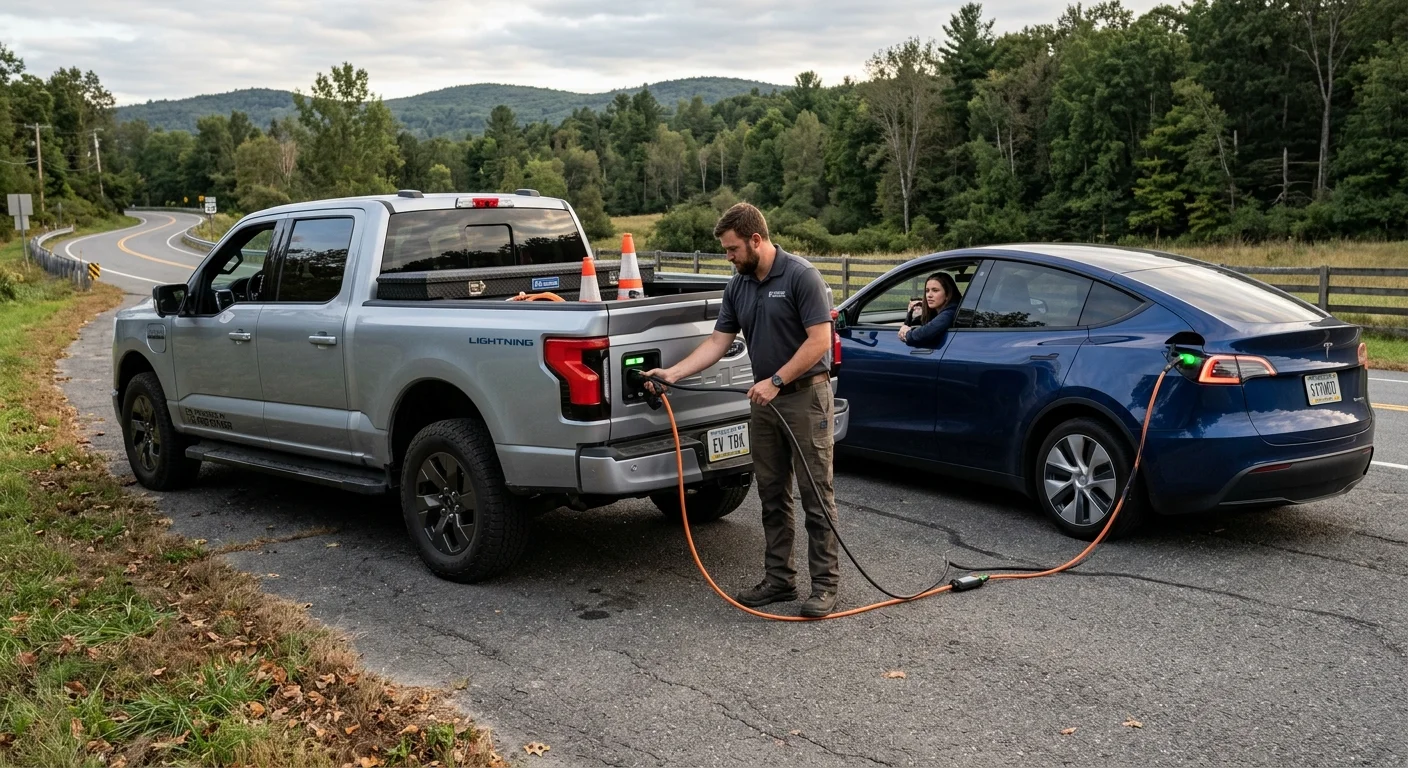
Start with Ford F-150 Lightning won’t start after sitting in desert heat. Pro Power Onboard is covered in Can an F-150 Lightning charge the EV in front of you?.
A week in a Sky Harbor garage is a common 12-volt killer. Level 2 charging is confirmed in the Terminal 3 and Terminal 4 garages. The 24th St. station has it too. Plug in if a stall is open. A full traction pack won’t keep the 12-volt healthy on its own.
If the Lightning is already stopped
ARS 28-871 says get off the traveled lanes when you can. A vehicle that can’t move is exempt. You still leave room for other traffic and stay visible. Arizona’s Move Over law is ARS 28-775. Approaching drivers should change lanes or slow for a stopped vehicle with warning lights. Stay out of the travel lane.
Charge Pro PHX is a referral line for the Phoenix area. It matches stranded EV drivers with independent local mobile rescue operators. It doesn’t hold a trade license, own trucks, or employ technicians. The operator quotes you before starting and bills you directly. The pros we connect you with are licensed and insured. CCS and J1772 Lightnings go through non-Tesla EV rescue. A 240-volt source brought to the truck is mobile EV charging. Operators typically add 10 to 20 miles of range. That takes 15 to 30 minutes of charging. That’s charging time on site, never an arrival clock.
Ford factory roadside tows to the nearest charger, home, or dealer within 50 miles. It doesn’t charge the truck on the shoulder. Empty-pack calls on I-10, Loop 101, and Tempe lots go to a local operator. Call (602) 932-0920 when you want a match.
Frequently asked questions
How long does it take to charge a Ford Lightning at home?
A Level 2 unit like Ford’s Charge Station Pro is the usual home setup. Mild-weather fills run about 6 to 8 hours for Standard Range. Extended Range is about 8 to 10 hours. A 48-amp wall charger can stretch a full charge to about 12 to 14 hours. Phoenix heat can slow the start of that session. A 120-volt outlet can take several days from empty.
Why does a DC fast charge run longer than Ford’s 41 minutes here?
Ford’s 15 to 80 percent times assume a cool pack. They also assume a stall at full rate. That’s about 41 minutes on Extended Range and about 44 minutes on Standard Range. July highs near 107F make both derate. The curve also slows as you climb toward full. Most stops target 80 percent for that reason.
What if my Lightning won’t charge at all?
That’s usually the 12-volt, not the traction pack. Heat shortens 12-volt life in the desert. If the truck won’t wake, jump or replace the small battery on site. If the pack is empty, a local operator can bring Level 2 to the truck.