A Tesla Supercharger stop to about 80% often runs 25 to 40 minutes. Phoenix summer heat still stretches that past the in-car estimate. NOAA normals give the city about 111 days at or above 100F. About 21 of those days hit 110F or higher. Cabin cooling keeps drawing power while you sit in the stall.
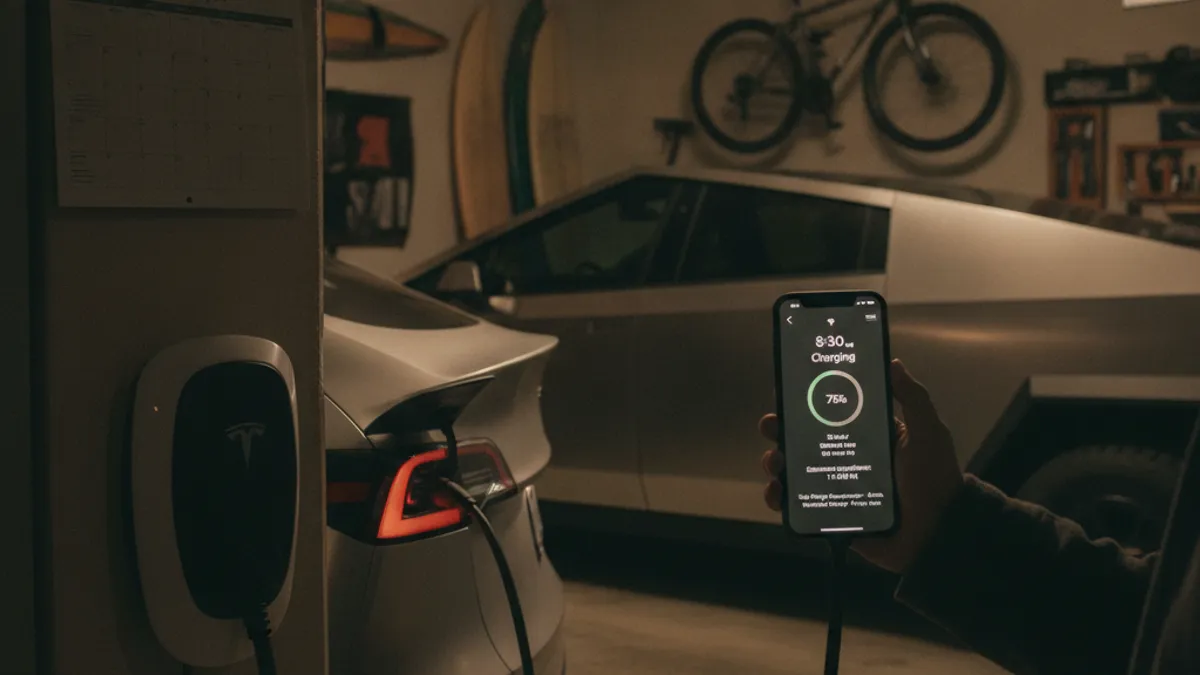
The screen time is a guess, not a Valley clock
The car’s time-to-full starts from pack temperature, charge level, and stall output. July highs here average near 107F, and August sits near 105F. Overnight lows still hang in the mid-80s. The pack rarely cools off in that stretch. Tesla’s thermal system then spends energy holding the cells in a safe band. That work shows up as a slower curve.
Cabin cooling is the other quiet draw. NREL reports climate control as one of the biggest range loads on an EV. You sit in the stall with the air on. The pack is charging and cooling the cabin at once. Recurrent studied 345,622 trips from 300 Phoenix-area EVs. Range loss sat near 31% at 100F. AAA’s 2026 study found about an 8.5% range loss at 95F versus 75F. Those figures are about miles, not minutes. They still change how long you stay plugged in. See how long a Tesla charge lasts through a Phoenix heat day for the day-scale drain.
Supercharger stops in this heat
From around 10% to about 80%, plan on 25 to 35 minutes on a newer stall. Older Model S and Model X cars, and older stalls, run slower. Third-party CCS fast chargers from Electrify America and EVgo also skip the onboard charger.
Past 80%, any DC session slows on purpose. Lithium-ion cells take current fastest in the middle of the range. The car tapers near full to protect the cells. The last 20% can eat nearly as much clock as the first 70.
The pack is already warm from Loop 101, I-10, or a downtown garage. After a Diamondbacks night at Chase Field, the car has baked in a lot. The car may limit incoming power until the coolant loop catches up. Routing to the Supercharger in the nav lets the car precondition.
Overnight at home on APS and SRP
A 240-volt Level 2 circuit is the daily workhorse. It typically adds about 20 to 44 miles of range per hour. The spread depends on the car’s onboard charger and the breaker. From near empty to full, most Teslas need about 6 to 10 hours. See charging levels that actually help when you’re stranded if you’re already low.
The Valley’s utilities shape when that overnight window is cheap. They don’t change how fast the electrons move. APS markets the R-EV plan as EV Overnight Charging. The cheap window is 11pm to 5am on weekdays. That weekday window is only six hours. A deep charge can run longer than six. Confirm your own address, because APS and SRP split many cities block by block. SRP still has an Electric Vehicle Price Plan for customers already on it. New enrollment closed after a February 2025 board vote. Existing accounts can stay through the November 2029 billing cycle. Read how Tesla home charging bills work on APS and SRP for the plan names.
Newer housing in Gilbert, Surprise, and Maricopa often already has a 240-volt circuit. Sun City’s older stock is a different story. Most of it was built before 1980. The charge time is the same once you have Level 2.
A wall outlet is a multi-day plan
A standard 120-volt outlet is Level 1. It adds about 3 to 5 miles of range per hour. A Model 3 or Model Y can sit two to three days on that cord. That’s from near empty, on a 250 to 330 mile pack. It can cover a short local loop if the car stays plugged in. It can’t rebuild a pack after a Sky Harbor week.
Phoenix Sky Harbor has confirmed Level 2 stalls in the Terminal 3 garage. More sit in the Terminal 4 garage and at the 24th Street station. That’s still Level 2 time, not Supercharger time. A car that sat a week in a hot garage may also refuse to wake. The 12-volt battery runs the contactors. Sentry Mode and Cabin Overheat Protection keep drawing while you’re gone. If the screens stay dark, you’re not in a charge-time problem. You’re looking at a 12-volt failure instead.
Grades steal the miles you just bought
Charge time and trip time meet on the climbs. ADOT posts a 6% maximum grade on northern I-17. Anthem sits near 1,860 feet, and New River is near 2,140. Sunset Point is near 3,410 feet on the same climb. Forum drivers on that climb have reported about 481 Wh per mile going up. The nav often underestimates the uphill bite. SR-87 toward Payson posts a 7% grade into Slate Creek Canyon. Unplug at 80% if the screen says you’re fine. The grade can still put you back in a stall sooner. Read how Phoenix heat changes EV battery care for pack stress, not session length.
When you can’t wait at a stall
The pack may already be too low to reach a Supercharger. Charge Pro PHX is a referral line. It matches stranded Tesla drivers with independent local mobile rescue operators. The brand owns no trucks and sends no employees. The operator brings a 240-volt Level 2 source to the car. Teslas take a native NACS plug. A typical on-site session adds about 10 to 20 miles of range. That takes 15 to 30 minutes of charging. That’s charging time, not a promise of when someone arrives. The operator quotes you before work starts and bills you directly.
Arizona DPS Roadside Motorist Assistance will change a tire or bring gasoline. ADOT’s Incident Response Unit works Phoenix-area freeways from 5am to 8pm on weekdays. Neither program advertises an EV charge. Get off the traveled lanes when you can under ARS 28-871.
Out-of-charge recovery is the match for an empty pack. See how a mobile EV charging truck actually helps you for what rolls up.
Call (602) 932-0920 if you need a match. Ask the operator what the session will add before they plug in.
Frequently asked questions
Why does the in-car time run long in Phoenix heat?
The pack is already warm, and cabin cooling keeps drawing power. NOAA’s 111 days at or above 100F make that the summer default, not a rare spike. The first estimate rarely includes both.
How long does a Tesla take on a home 240-volt charger?
Most Level 2 sessions from near empty to full run about 6 to 10 hours. APS’s overnight EV window is 11pm to 5am on weekdays. A deep charge may spill past that window.
Can a regular wall outlet finish a Tesla overnight?
No. A 120-volt outlet adds about 3 to 5 miles per hour. From near empty, you’re looking at two to three days, not one night.