Yes, a Ford F-150 Lightning can charge another EV through Pro Power Onboard. You still need a portable Level 2 EVSE and the right adapter. Most stranded Phoenix-area cars never meet a Lightning with that kit. They still need an independent operator at the bumper.
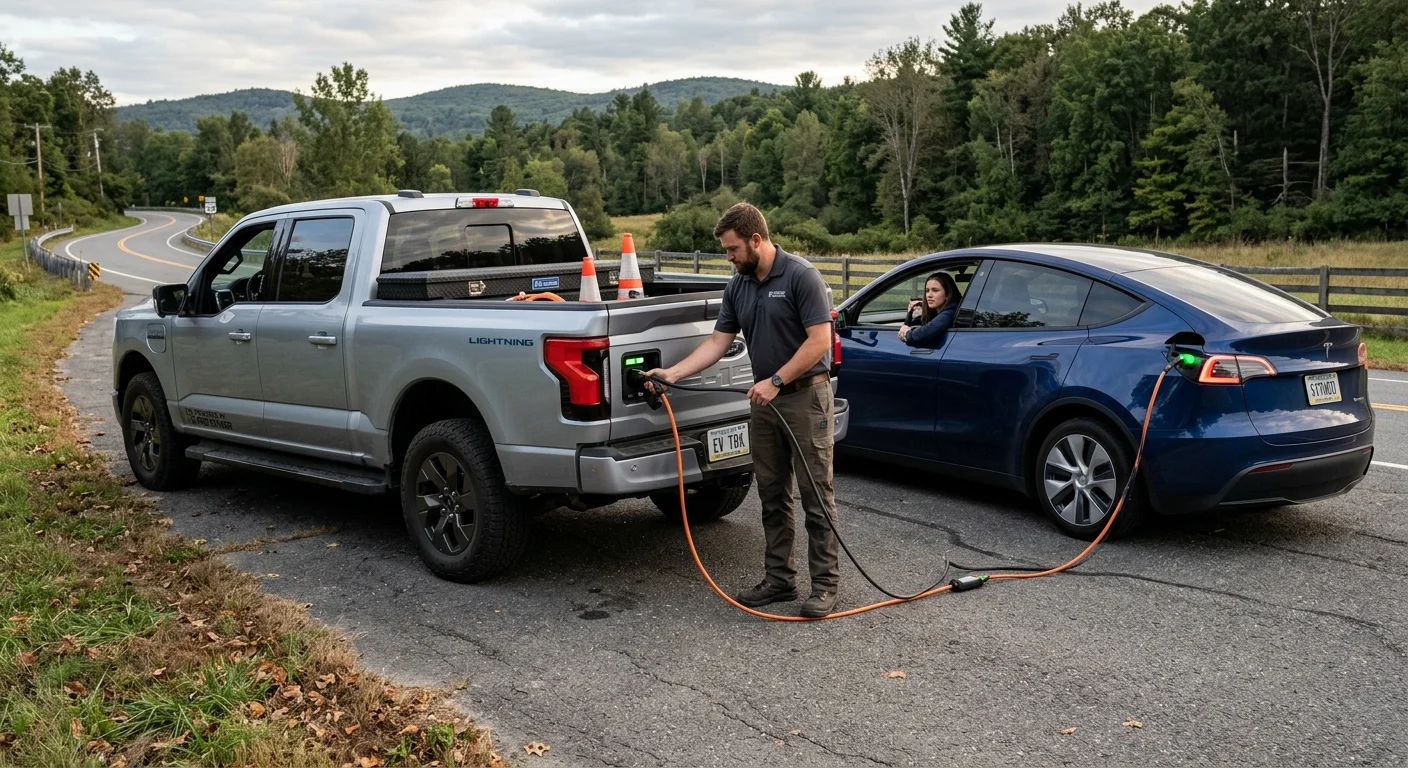
The truck can share power. The shoulder usually can’t wait
Ford built Pro Power Onboard for tools, camp loads, and home backup. Bed and cabin outlets put the traction pack on a 120-volt or 240-volt plug. That’s vehicle-to-load, and it isn’t DC fast charging. The Lightning’s DC charge port stays out of this job.
Ford’s base Pro Power Onboard is 2.4 kW. Higher trims advertise 9.6 kW on the window sticker. Read your owner’s manual and the outlet label. Don’t guess your output from a random forum thread. Another EV needs the 240-volt outlet plus a portable EVSE. Without that brick, you’re only a polite wave from the next lane.
Gear the other driver hopes you packed
You don’t jumper the two charge ports together. You plug a portable EVSE into the Lightning’s 240-volt outlet. Many of those units use a NEMA 14-50 plug. Match the plug to your trim before you offer help.
Then match the stranded car to the right inlet. A Tesla wants NACS, while most other EVs here still expect J1772 on AC. If your EVSE ends in J1772, a Tesla also needs a J1772-to-NACS adapter. A Chevy, Hyundai, Kia, VW, or Mach-E often takes J1772 directly. Operators we match bring a native NACS plug, plus CCS or J1772 adapters. A private truck rarely has that bag in the bed.
This is the same physics as one EV charging another, with Ford’s outlets as the source. Skip a cracked cable and skip an unrated adapter. If either piece is missing, the pack in your bed stays there.
Empty miles, or a cooked 12-volt
Confirm what actually failed before you unroll cable. A full traction pack can still leave the car dark. The small 12-volt runs handles, screens, and the contactor that ties in the high-voltage battery. The DC-DC converter only replenishes that 12-volt while the car is on or charging.
Heat is hard on that little 12-volt battery. Those batteries last about 47 months in hot climates versus 59 in cool ones, per Battery Council International work cited by Battery University. AAA names heat as the top cause of battery failure. Tesla Sentry Mode and Cabin Overheat Protection keep drawing while the car sits.
A week in a Phoenix Sky Harbor garage is a common 12-volt brick. Level 2 charging is confirmed in the Terminal 3 and Terminal 4 garages. It’s also confirmed at the 24th St. station. That still doesn’t stop a 12-volt from dying in parked heat.
Feeding the charge port does nothing if the car can’t close its contactors. That call is a 12-volt jump or replacement, not a Pro Power session. Operators we connect you with do both jobs. They bring 240-volt Level 2 for an empty pack. They also jump or replace a dead 12-volt on site.
Valley roads punish a slow AC sit
A quiet driveway in Gilbert is a fair place to share power. The shoulder of I-10 is not that place. Out of charge on I-10 means heat, traffic, and little room to work. ARS 28-871 says stay off the traveled highway when you can get clear. Leave space for others to pass and stay visible 200 feet each way.
ARS 28-775 is Arizona’s Move Over law for stopped cars. Approaching drivers must change lanes or slow for a stopped vehicle with warning lights. You still spend the whole charge beside moving traffic. Loop 101 is Agua Fria on the west, Pima on the northeast, and Price on the southeast. US-60 is Grand Avenue to the northwest and the Superstition Freeway to the east. Those names aren’t campgrounds, and they aren’t charge bays.
Grade makes a small top-off feel much smaller. Northbound I-17 posts a 6% maximum grade. Anthem sits near 1,860 feet, and New River is near 2,140. Black Canyon City is near 2,000, then the road keeps climbing toward Sunset Point. SR-87, the Beeline toward Payson, posts a 7% grade into Slate Creek Canyon. US-60 east rises past Apache Junction toward Superior. Don’t plan a Lightning trickle as your hill insurance.
Phoenix averages about 111 days a year at or above 100F. About 21 days hit 110F or more. July highs average near 107F, and August sits near 105F. Overnight summer lows still hang in the mid-80s. AAA’s 2026 study found about a 10% efficiency drop at 95F versus 75F. Range loss in that study was about 8.5%. Cabin cooling is a big part of summer range loss.
Arizona doesn’t observe daylight saving time at all. Evenings stay hot after the clock says the commute is over. Monsoon season runs June 15 to September 30. Haboobs can drop visibility to near zero in minutes. Don’t stand between two charge doors in a dust wall.
Factory help and state trucks won’t copy your Lightning
Ford’s published out-of-charge path is a tow. They take the car to the nearest charger, home, or dealer within 50 miles. Tesla won’t charge you on site at all. Tesla tows to the nearest Supercharger or service center, and that tow is billed. Rivian and Hyundai/Kia owners should specifically request a tow. A dead EV is easy to mishandle on a hook.
Arizona’s free motorist programs don’t advertise an EV charge. DPS Roadside Motorist Assistance can change a tire and bring gasoline or diesel. It can jump a 12-volt, add water, and call a tow. ADOT’s Incident Response Unit covers Phoenix-area freeways from 5am to 8pm on weekdays. It clears crashes and debris and helps stranded motorists. It also never lists charging for an empty EV.
That missing EV charge is the referral job. Charge Pro PHX doesn’t own trucks, employ technicians, or set prices. We match stranded drivers with independent local operators. The operator quotes before starting and bills you directly.
When sharing from the bed is the right kindness
Do it only from a safe, legal stop. Think a Surprise driveway, or Sloan Park in Mesa after the Cubs. A quiet lot after a Suns night at Mortgage Matchup Center also works. A driveway in Tempe near the ASU campus also works. You have time, the EVSE, and the right adapter. You can watch your own pack so you don’t join them.
Phoenix Raceway sits in Avondale, not in Phoenix, despite the name. Don’t drain your Lightning to gift a long, slow charge in 107-degree air. How long this truck takes to refill in Phoenix heat is its own problem. Two empty EVs on one shoulder help nobody.
What the operator brings that a good Samaritan usually doesn’t
The mobile EV charging operators we match roll a 240-volt Level 2 source to the car. They carry a native NACS plug and CCS or J1772 adapters. Typical charging time, never travel time, adds about 10 to 20 miles of range. That sit at the car is 15 to 30 minutes. They work Tesla and every major EV brand. They also handle a dead 12-volt on site. How those trucks actually help is a different job from a bed outlet. Charge it, jump it, or wait for a tow depends on what failed. It doesn’t depend on who waved from a Lightning. We don’t set prices, promise an arrival window, or publish hours.
If you’re the car that’s already stopped
Get as far off the traveled way as you can, with hazards on. Check whether the car is empty or just asleep from a 12-volt. Call Ford, Tesla, or your insurer if that’s the plan you already pay for. Then call Charge Pro PHX at (602) 932-0920. Ask to be matched with a local operator, who quotes before starting. Give the city, the road, and whether the car will even wake. We serve every city in the Phoenix area. The network covers Phoenix, Mesa, the East Valley, Scottsdale, and the West Valley.