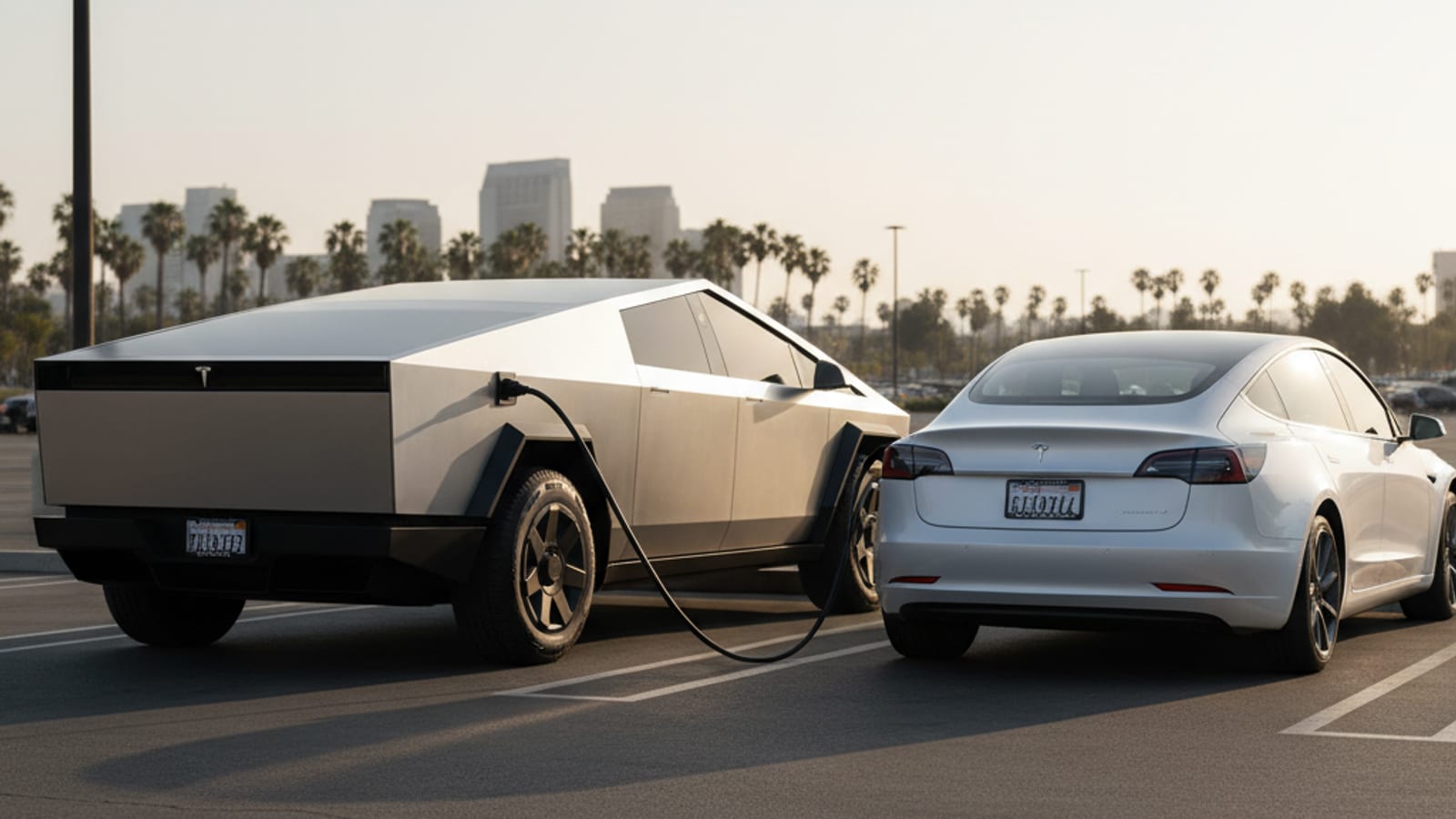
Two Model Ys sit in the Chase Field garage after a Diamondbacks night. Both packs sit in the teens after the game. One driver wants the other car to share miles, and that almost never works here. Most Phoenix-area EVs can’t send traction power to another car. A Model 3 or Model Y has no export outlet. If you’re both low, you still need a mobile Level 2.
Charge Pro PHX is a referral line, not a shop. It matches stranded drivers with independent local operators. Those operators bring a 240-volt Level 2 source to the car. They quote you before they start and bill you directly. They don’t need a second EV in the next stall.
Sharing charge fails when both packs are already thin
One big battery could feed another on paper. You need an inverter that can run in reverse. You need an outlet or adapter that exposes that power. You need a cable the empty car will accept. Most commuter EVs keep that inverter inside the cabin systems. It runs the air and the 12-volt system. It doesn’t feed a socket on the bumper.
Valley heat makes that both-low case common here. Phoenix averages about 111 days a year at or above 100F. July highs average near 107F, and August sits near 105F. AAA’s 2026 study found about an 8.5% range loss at 95F versus 75F. Recurrent reported 20 to 30% range loss above about 95F, from Phoenix-area EVs. Two cars that ran AC through a Suns night can both wake up thin. Mortgage Matchup Center does that after a long game.
Northbound I-17 cuts range again on the climb. ADOT posts a 6% maximum grade on that stretch. Drivers report roughly 40% more energy going up than coming down. If you both left Fountain Hills already low, neither car is a charger.
A dead 12-volt is a different kind of stall. Heat is the top cause of battery failure, per AAA. In an EV, that small battery runs door handles and screens. It also runs the contactor for the main pack. A full traction pack still leaves you stuck if the 12-volt is dead. Sky Harbor has confirmed Level 2 charging in the Terminal 3 and Terminal 4 garages. A week in a hot airport lot can still drain the 12-volt.
Which EVs can actually export power
A few trucks, plus some Hyundai and Kia models, can send power out.
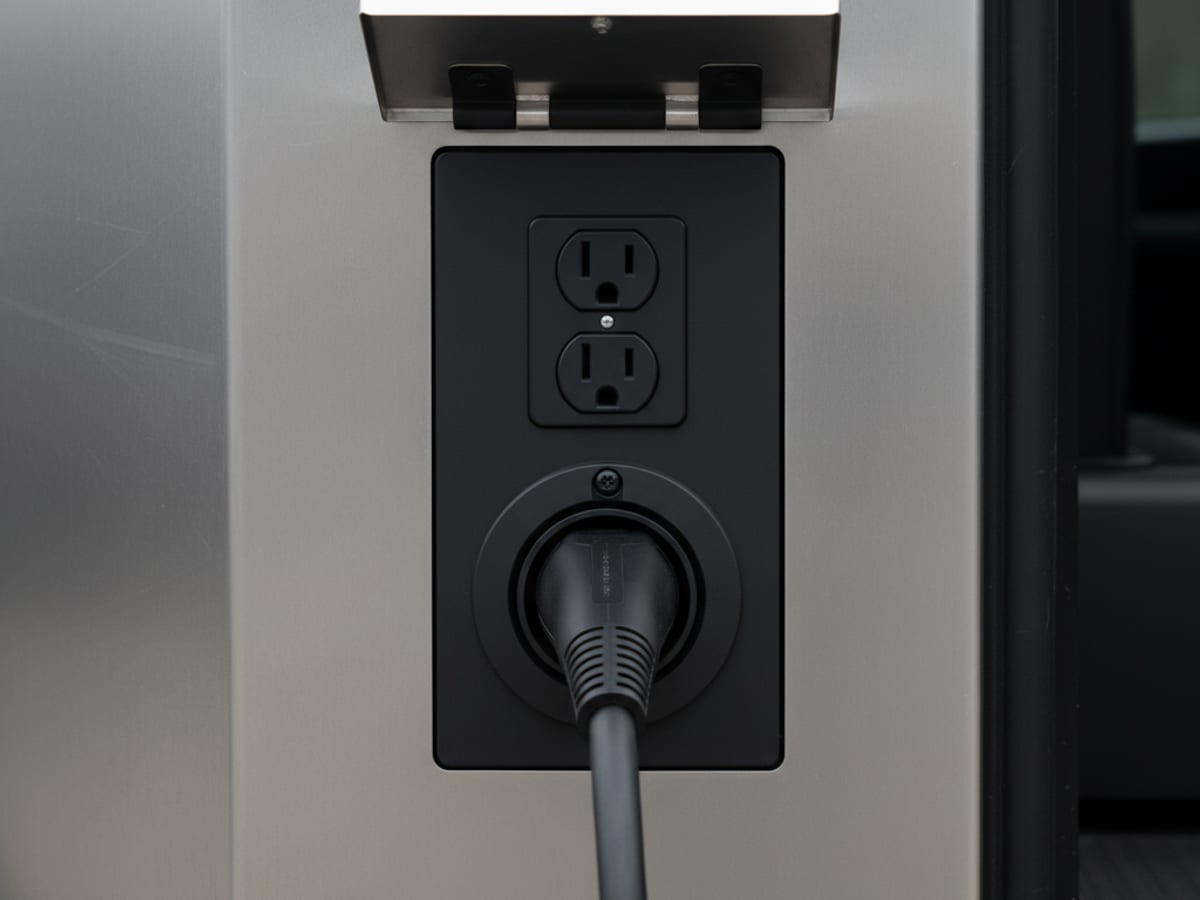
Ford’s F-150 Lightning uses Pro Power Onboard from the bed. The extended setup reaches 9.6 kW from bed and cab outlets. See Can an F-150 Lightning charge the EV in front of you? for that truck. The Cybertruck has Pro Power outlets in the bed and frunk. The bed wall includes a 240-volt NEMA 14-50 rated up to 9.6 kW. The Chevrolet Silverado EV lists Power Takeoff around 10.2 kW.
Hyundai Ioniq 5, Kia EV6, and Kia EV9 use a V2L adapter. That adapter sits on the charge port at about 3.6 kW. Rivian R1T and R1S Camp Package outlets are 120-volt at about 1.4 kW. That’s a camp kettle, not range on I-10.
Tesla Model 3, Y, S, and X can’t export. The Mustang Mach-E and Polestar models take charge, and they don’t give it. Arizona had about 141,800 battery EVs as of 2025, per DOE AFDC. Most cars on Loop 101 and I-10 are commuter models, not export trucks.
Why a regular Tesla still can’t feed another Tesla
Those Teslas have an onboard charger for incoming AC. It converts AC from a wall or Supercharger into DC for the pack. That hardware doesn’t reverse at useful power for another car. The 12-volt pigtail at the tow hook can help wake a dead 12-volt. It isn’t a 240-volt feed for a traction pack. Cars already on Phoenix, Mesa, and Scottsdale streets don’t ship bidirectional hardware. Two Model Ys in a Tempe apartment lot still can’t share miles.
When a Cybertruck can help, and when it can’t
The Cybertruck bed outlet is a real 240-volt NEMA 14-50. A Level 2 cable can run from that outlet to the stranded charge port. The stranded car’s own onboard charger then takes AC and fills the pack. At 9.6 kW, that’s roughly 30 miles of range per hour of charging. That only works if the Cybertruck still has energy to spare. A donor truck in the teens can’t give much. Sentry Mode and Cabin Overheat Protection already pull from parked Teslas. Don’t treat a second EV as the plan.
How fast car-to-car charging really is
Charge speed follows the outlet on the donor car. A Cybertruck or Lightning at 9.6 kW adds about 30 miles per hour of charging. Independent operators bring a 240-volt Level 2 source to the car. They typically add 10 to 20 miles during 15 to 30 minutes of charging. That’s charging time on the cable once it’s connected. It isn’t a promise of when anyone arrives. An Ioniq 5 or EV6 on V2L is closer to 10 miles per hour. A Rivian 120-volt outlet is around 4 miles per hour. A Supercharger still sits in the 150 to 250 kW range. That’s many times faster than any car-to-car setup on the road now.
See Charging levels that actually help when you’re stranded for the three levels. For a stall, Level 2 is the useful middle.
Why a mobile Level 2 is still the Valley call
At Camelback Ranch in Glendale, Arizona, the next EV is probably a Model 3. Arizona DPS Roadside Motorist Assistance will change a tire. It brings gasoline or diesel and jumps a 12-volt. Its published materials don’t mention charging an empty EV. ADOT’s Incident Response Unit works Phoenix-area freeways from 5am to 8pm weekdays. That unit also doesn’t advertise an EV charge. Independent operators handle the on-site charge those programs don’t offer.
Charge Pro PHX connects you with those operators. An operator quotes you before any work starts. Distance, time of day, and how much range you need all move the quote. The brand doesn’t set prices, own trucks, or employ technicians. The operator’s truck brings a 240-volt Level 2 source. It uses a native NACS plug, plus CCS or J1772 adapters for non-Tesla EVs. How a mobile EV charging truck actually helps you covers that gear. If the pack is empty, start with mobile EV charging or out-of-charge recovery. Tesla factory roadside won’t charge you on site. It tows to the nearest Supercharger or service center. If you want the car charged where it sits, that’s a local operator.
APS and SRP both run named home EV rate plans. APS markets EV Overnight Charging on the R-EV plan, 11pm to 5am weekdays. SRP still has existing customers on the Electric Vehicle Price Plan. Confirm the utility listed on your own address. Service in Phoenix, Chandler, Gilbert, and Tempe can split block by block.
Don’t string a dryer cord between two cars
High-power AC between vehicles isn’t a hardware-store project. Grounding, connector rating, and the car’s own protection all matter. An off-the-shelf extension plus a portable Level 2 unit isn’t a specced export setup. Leave that work to people trained for it. If you’re already on a highway shoulder, Arizona law is ARS 28-871. Get off the traveled lanes when you can. Leave room for other traffic to pass you. You must stay visible 200 feet in each direction. The Move Over rule in Arizona is ARS 28-775. Other drivers must move over a lane or slow down for warning lights. Don’t stand in a live lane to hold a cable. See What roadside Level 2 charging can add when you stall for session details.
What to do when both of you are low
Check whether the car is empty or just asleep. A dark screen with a healthy traction gauge is a 12-volt problem. An empty gauge with a live screen is an out-of-charge problem. Don’t mix those two up, because it wastes time. If you need miles, a mobile Level 2 session is the usual fix. The operator adds enough range to reach real charging. Stuck drivers can call (602) 932-0920 for a match. Charge Pro PHX matches you with an operator who quotes first.