People who type battery backup Cave Creek usually mean a house wall pack. That pack can keep a Tatum Ranch kitchen on through a blink. It can’t reach an empty EV on Cave Creek Road or SR-74.
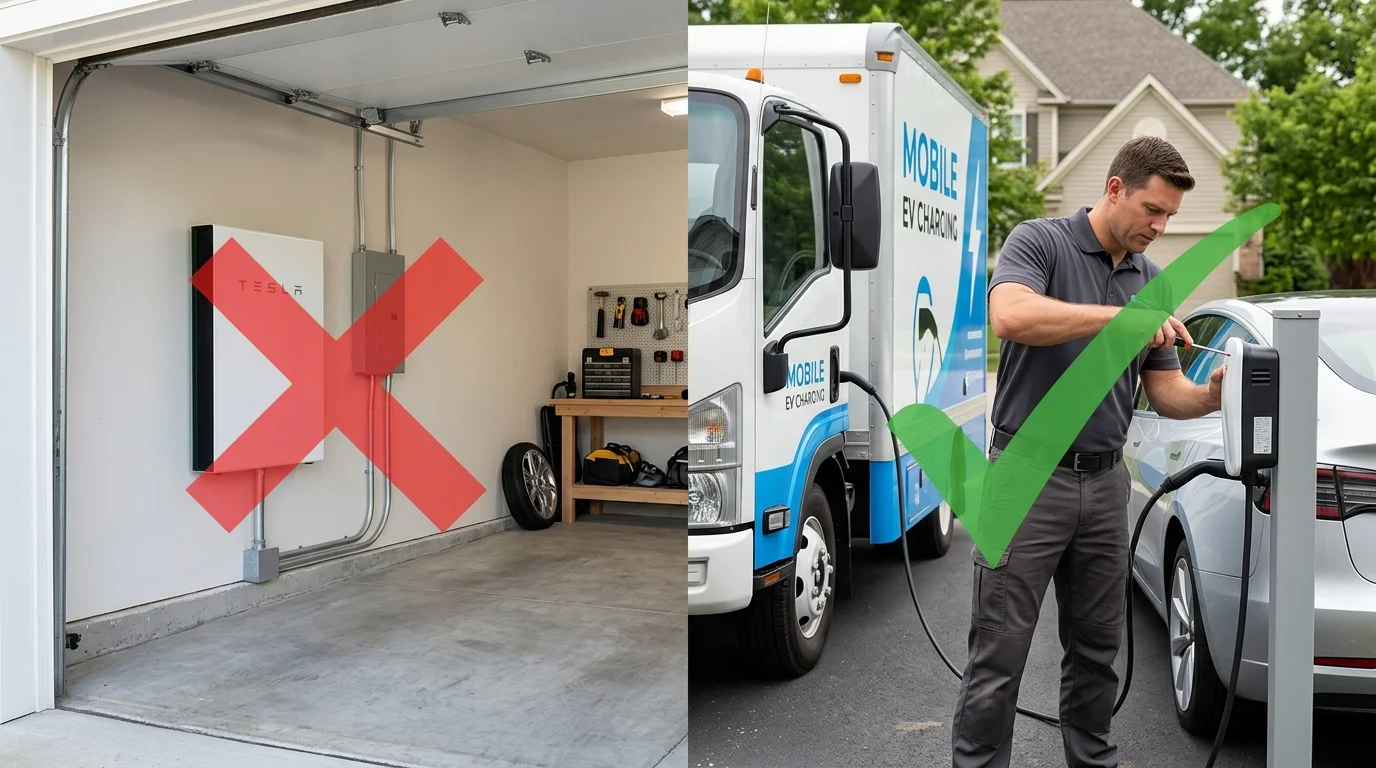
Home storage and a stranded EV are different jobs
A home battery stores solar or grid power for lights and HVAC. A stranded EV needs power at the charge port. Mixing those searches sends you to the wrong shop.
If the house is dark and the car still drives, call a solar shop. Charge Pro PHX doesn’t install those wall systems. We match stranded drivers with independent mobile rescue operators. The operator quotes you before any work starts. Then that operator bills you directly.
What a Cave Creek home battery is for
This town covers about 37.7 square miles on the northeast desert edge. Census figures put the population near 5,091 people. Most addresses sit in ZIPs 85331 and 85086. Only 15.8 percent of housing predates 1980, so much of the stock is newer. Newer homes in Dove Valley Ranch often add solar and a garage charger. Rancho Manana and the Cave Creek townsite see the same garage upgrades.
Units like a Tesla Powerwall or an Enphase Encharge mount on a garage wall. They tie into the electrical panel. They’re a permitted residential upgrade. Licensed electricians and solar shops handle that work. Charge Pro PHX doesn’t. A wall pack backs up the house. It doesn’t roll down Cave Creek Road. A downtown stop that drains the pack gets no help from that wall.
For the garage circuit versus a truck at the bumper, read Home 240-volt charging versus a mobile 240-volt rescue. Heat and monsoon days change the tradeoffs. That comparison lives in Mobile EV charging vs a home battery during Phoenix heat and monsoon.
Why the wall pack can’t follow you
You can leave home full and still run short. Cave Creek sits a little higher than the Phoenix basin. Roads here roll across desert grades. Recurrent tracked 345,622 trips from 300 Phoenix-area EVs. That set shows 20 to 30 percent range loss above about 95F. Loss sits near 31 percent at 100F. Cabin cooling is a large draw. NREL flags climate control as one of the biggest range hits.
Cave Creek Road is the spine through town. SR-74, the Carefree Highway, runs west toward I-17. Those are long, exposed miles. Weekend visitors park at Old West downtown, then underestimate the return. A wall pack at the house can’t push power to that curb.
Public charging exists across the Valley. Confirm which stalls are live in the apps before you count on them. We don’t estimate how far the next working stall sits from your pin. If the car is already at zero, you need power at the bumper.
A dead 12-volt looks like a dead car
Plenty of battery-backup searches aren’t an empty main pack. They’re a 12-volt that cooked in the heat. AAA calls heat the number-one cause of battery failure. Battery Council International work, via Battery University, measured starter-battery life. Hot climates averaged about 47 months. Cool climates averaged about 59. A battery that lasts five years elsewhere can fail in two or three here.
The 12-volt runs door handles, screens, and the pack contactor. When it dies, the car stays silent even with miles left. The DC-DC converter only recharges it while the car is on or charging. Tesla Sentry Mode and Cabin Overheat Protection keep drawing while you park.
Operators we connect you with can jump or replace that 12-volt on site. They handle Tesla and every major EV brand. That visit isn’t the same as filling an empty traction pack.
What a mobile Level 2 stop actually does
Independent operators bring a 240V Level 2 source to the car. Teslas take a native NACS plug. Other EVs use a CCS or J1772 adapter. Typical charging adds 10 to 20 miles in 15 to 30 minutes. That clock is charging time, not an arrival time. Charge Pro PHX doesn’t promise when someone shows up.
Ten to twenty miles is often enough to reach a charger or get home. It’s not a full fill. Tesla’s published roadside path is a tow to a Supercharger or service center. Tesla doesn’t charge on site.
Arizona DPS Roadside Motorist Assistance will change a tire. It will bring gasoline or diesel and jump a conventional battery. Its published pages don’t mention charging an empty EV. ADOT’s Incident Response Unit works Phoenix-area freeways from 5am to 8pm on weekdays. It also doesn’t advertise an EV charge. A mobile operator is the path that brings 240 volts to the port.
ARS 28-871 says get off the traveled lanes when you can. That applies on a highway outside a business or residence district. A vehicle that can’t move is exempt. Leave room for others to pass. Stay visible 200 feet in each direction. ARS 28-775 is Arizona’s Move Over law. Other drivers must change lanes if they can. If they can’t, they must slow down for warning lights.
Northeast Valley roads that empty a pack
Cave Creek sits in the Scottsdale and Northeast Valley belt. Carefree, Paradise Valley, and Fountain Hills sit next door. Low density means longer hops between homes, ranches, and trailheads. Tatum Ranch to downtown isn’t a short city block. Desert trails and ranches add more long exposed miles in the heat.
We serve Cave Creek and the rest of the Phoenix area. Local notes live on the Cave Creek EV charging page. The same roads show up in Premium EV rescue in Cave Creek on long northeast valley roads.
How to choose the call
Match the problem to the right call.
House dark, car still drives: call a solar or electrical contractor. Car silent in a Rancho Manana driveway: start with the 12-volt. An empty pack on Cave Creek Road needs mobile EV charging at the car.
Charge Pro PHX is a referral line. We own no trucks and employ no technicians. We set no prices and publish no hours. The pros we connect you with are licensed and insured. The operator quotes you, then bills you.
A garage charger and a rescue call solve different problems. Home charger install versus calling a mobile EV rescue lays out both.
When you need a match, call (602) 932-0920. Say where you’re parked and whether it’s a Tesla. Tell the operator if the car is silent or just empty.