Your EV reaches zero in a Gilbert parking lot or along a busy arterial. A working public charger may be close, yet the car can’t reach it. Mobile charging may add enough range to get you moving again.
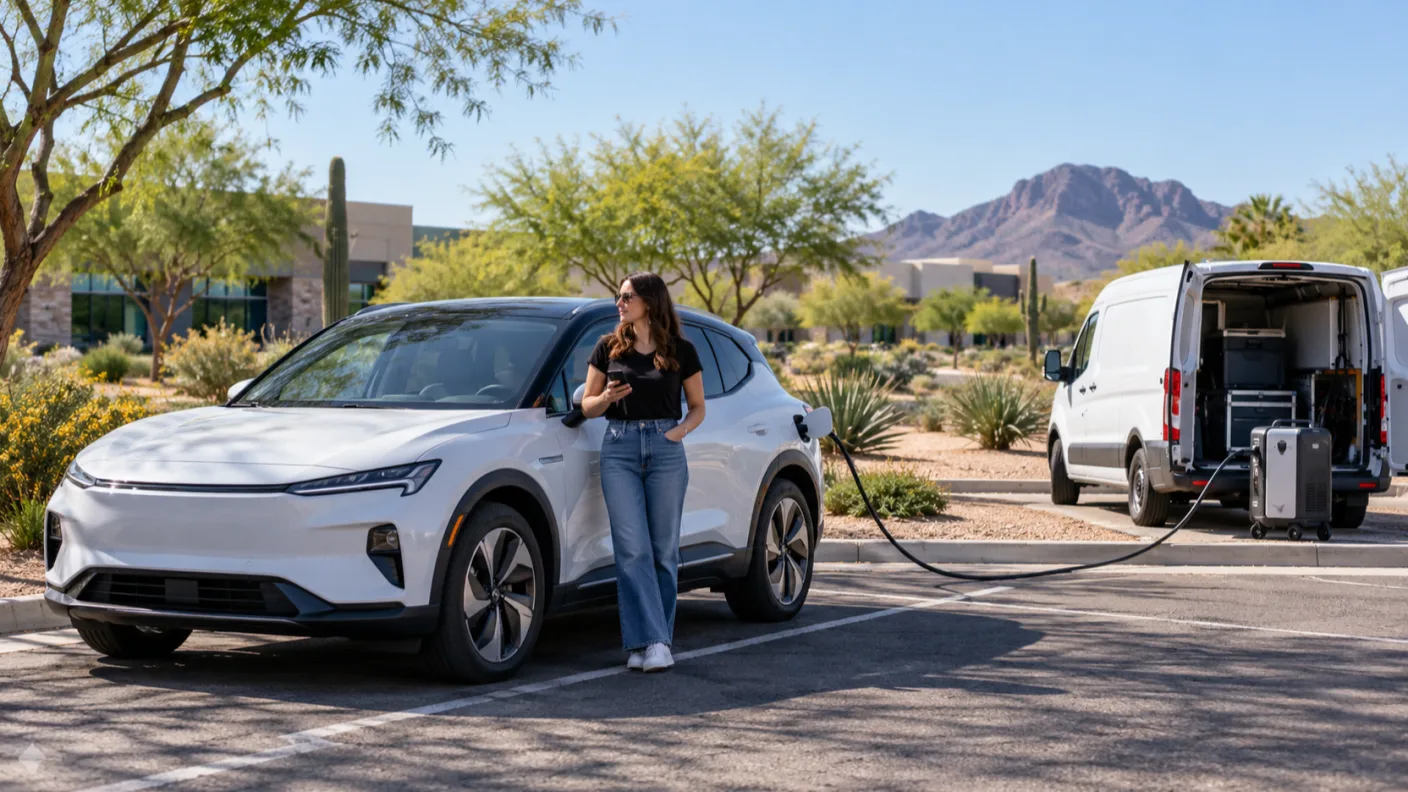
Where Gilbert EVs actually stall
Gilbert’s rescue pattern is shaped by newer development and spread-out daily driving. Only 4.1% of its housing was built before 1980. That makes a road or parking-lot stall after home charging falls short more relevant here than an older-building charging problem.
A driver might run short near SanTan Village after several errands. Another may reach an East Valley workplace lot with almost nothing left. Gilbert Regional Park, Mercy Gilbert Medical Center, and the surrounding commercial corridors create other possible stopping points. These examples describe situations, not confirmed charging locations.
The first detail that matters is where the EV stopped. A parking space, curb, access-controlled garage, and freeway shoulder present different access conditions. Share the nearest street, entrance, level, or visible landmark. A dropped map pin can help an operator understand the location.
If the vehicle is on the traveled part of a highway, Arizona law says drivers should get off that area when practical. A vehicle that can’t be moved is exempt. The law also requires room for traffic to pass and visibility from 200 feet in each direction.
Charge Pro PHX is a referral service. We connect drivers with independent local EV rescue operators. We don’t own charging equipment, send a company truck, set prices, or promise an arrival time.
Our mobile EV charging service is meant for a stranded vehicle that can accept a useful charge where it sits. Broader EV roadside assistance in Gilbert may fit when the problem isn’t clearly an empty main battery.
Loop 202 Santan, Val Vista, and the San Tan run
Loop 202 Santan crosses Gilbert and connects daily travel across the East Valley. Val Vista Drive and Gilbert Road carry drivers between homes, workplaces, medical facilities, shopping areas, and the San Tan corridor. A low battery can become a full stall before the driver reaches a planned charger.
Location changes the rescue decision. A vehicle sitting in a workplace lot may be accessible for charging. A vehicle stopped near moving traffic may need another plan. The matched operator must decide whether on-site charging is suitable after hearing the actual conditions.
Don’t describe the location only as “Gilbert.” Give the road, direction of travel, nearest cross street, and whether you’re before or after an interchange. If you left Loop 202, name the exit and the lot you entered. If you’re near Val Vista Drive or Gilbert Road, include the closest business or public landmark without assuming it offers charging.
Gilbert also borders US-60. That matters when a driver’s route started in Mesa or continued toward another East Valley city. The operator needs the current vehicle location, not the city where the low-battery warning first appeared.
Drivers crossing the municipal line can compare the local pattern with mobile EV charging after a Chandler stall. Gilbert’s page focuses on Loop 202 Santan, the San Tan corridor, and local parking-lot access.
Phoenix-area heat can also affect the available range. AAA’s 2026 study found about an 8.5% range loss at 95°F compared with 75°F. Treat the dashboard estimate as current information, not a promise that the remaining miles will cover the route.
Public charger failed versus the pack hit zero
A failed charging stop and a fully depleted EV aren’t the same situation. Tell the operator what happened immediately before the stall. That account helps them assess whether a mobile charge is a sensible next step.
At a public charger, report what the vehicle and charging unit displayed. Note whether the connector seated, charging began, or the session stopped. Don’t assume the main battery is empty merely because one charging attempt failed. The issue could require different roadside help or a tow, depending on the vehicle and symptoms.
If the dashboard counted down toward zero while driving, say so. Mention whether the vehicle entered a reduced-power state, stopped moving, or shut down after parking. Don’t keep retrying unfamiliar procedures from memory. Use the current owner’s manual for the exact model and model year.
Connector compatibility also matters. J1772 and J3400, also called NACS, are used for AC charging. A CCS inlet includes a J1772 section for AC and separate pins for DC fast charging. A DC adapter alone doesn’t establish AC compatibility.
Provide the vehicle’s year, make, and model. Tell the operator which charging inlet the car has and which adapters are physically present. If you aren’t sure, send a clear photo instead of guessing.
A typical rescue charge can add 10 to 20 miles of range through 15 to 30 minutes of Level 2 charging. That duration describes charging, not operator arrival. The actual result depends on the vehicle and conditions, so it shouldn’t be treated as a guaranteed range gain.
If charging can’t solve the immediate problem, out-of-charge recovery can help you consider the next route. Non-Tesla drivers can also review the separate Gilbert non-Tesla rescue guide for connector and vehicle details.
How a mobile charge is quoted by local operators
Charge Pro PHX doesn’t publish or set an operator’s price. The independent operator provides the quote, performs the accepted service, and bills the driver directly. No verified Gilbert market rate is available in the approved claims ledger.
Ask for the full quoted amount before accepting service. Confirm what situation the quote covers and what could change it. If the operator needs more information, provide it before agreeing to the work.
Useful quote details include:
- Your exact location and access instructions
- The vehicle’s year, make, and model
- The charging inlet and available adapters
- The displayed battery level and warning messages
- Whether the vehicle can shift, steer, or move
- Whether you’re in a lot, garage, curb space, or roadside position
- Whether your goal is a nearby charger, home, or another destination
Describe barriers early. A gate, garage height limit, reserved workplace lot, or blocked parking space may affect whether the operator can reach the vehicle. Don’t assume a charging vehicle can enter every structure or stop in every lane.
Also ask what charging method the operator plans to use. A Level 2 unit can range from 2.9 to 19.2 kW. Most residential Level 2 chargers operate at up to 30 amps and deliver 7.2 kW. Those figures describe equipment output, not a guaranteed rate for your car.
High ambient heat may reduce charging power. The vehicle can request less current when thermal headroom is limited. That’s another reason to discuss the needed outcome instead of demanding an exact number of minutes.
If the quote doesn’t match the situation you described, pause and clarify it. The operator, not Charge Pro PHX, controls the quote and service terms.
What the matched operator needs from you
Start with the vehicle. Give its model year, make, model, charging inlet, and displayed battery percentage. If the screen is blank, say that plainly. A vehicle with no visible power may need assessment before anyone assumes the main pack reached zero.
Next, give a precise Gilbert location. “Near Loop 202” covers too much ground. State the direction, exit, cross street, lot entrance, and nearby landmark. For a Val Vista Drive workplace lot, include the building or entrance. For SanTan Village, identify the section of the parking area.
Tell the operator whether the car is safely parked or exposed to traffic. Mention passengers, pets, extreme heat, access restrictions, and anything blocking the charging side of the vehicle. These details help the operator evaluate the request. They don’t create an arrival promise.
Have the correct adapter information ready. Don’t identify an adapter only by color or shape. Send a photo of the inlet, adapter labels, and both ends when needed. Keep the vehicle’s current manual available because procedures differ across models and years.
Explain what you need from the charge. A nearby compatible station may require less added range than a trip across Gilbert. Don’t request a range number without naming the planned destination. The operator can then explain what service they’re offering.
Keep payment and authorization questions operator-side. Ask who will perform the work, who will collect payment, and what the quoted service includes. Charge Pro PHX makes the referral but doesn’t perform or warrant the work.
Finally, stay reachable at the number you provide. If your location changes or someone moves the EV, tell the operator directly. Clear updates prevent the rescue request from being based on an old map pin.
When to call us
Call when an EV is stranded in a Gilbert lot or roadside position and a mobile charge may provide enough range to leave. If the car can’t accept a charge safely, the matched operator can discuss other available options.
Call us at (602) 932-0920 and we’ll connect you with a local EV rescue operator.