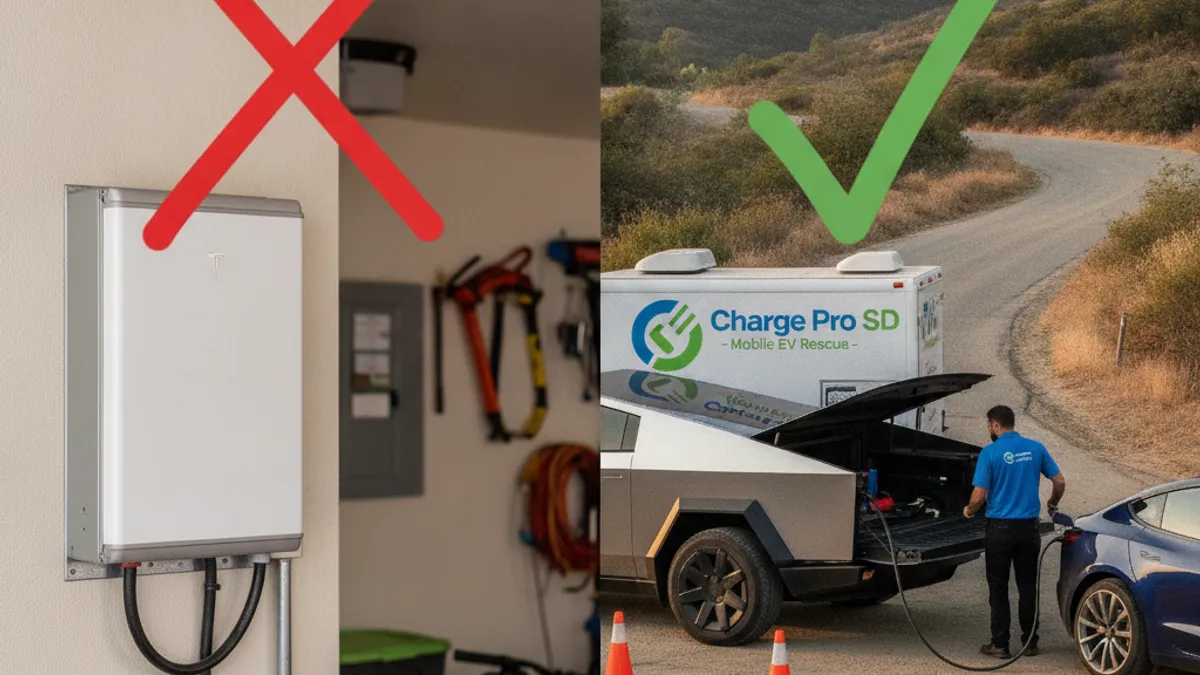
If your EV died on a Gilbert commute, you need help at the car. The overnight charge at home already did its job. The stall happened on Loop 202, US-60, or the last miles into work. EV roadside assistance in Gilbert is a mobile charge or a 12-volt jump. It’s not a new wall charger.
Why Gilbert calls start on the commute
Gilbert is a young East Valley city of about 280,000 people. Only 4.1 percent of its housing was built before 1980. Nearly every house has a garage. Drivers in Val Vista Lakes, Power Ranch, Agritopia, Seville, and Layton Lakes plug in overnight as a habit.
APS and SRP both serve Gilbert, often on neighboring blocks. APS markets the R-EV plan as overnight charging from 11 p.m. to 5 a.m. on weekdays. Confirm the utility on your own address. Home charging is how most Gilbert EVs start the day.
That’s why the dead-car call is a commute call. The pack wasn’t empty in the driveway at dawn. It ran down on the way to Tempe, Mesa, Chandler, or Phoenix.
How the East Valley run uses the last miles
The Loop 202 Santan Freeway is Gilbert’s main east-west spine. US-60 Superstition Freeway sits on the north edge. Loop 101 Price is close enough that many trips hop it. These aren’t mountain grades. Summer heat still burns range.
The Valley averages about 111 days a year at or above 100F. July highs sit near 107F. AAA’s 2026 study found about a 10 percent efficiency drop and an 8.5 percent range loss at 95F versus 75F. Recurrent, using trips from 300 Phoenix-area EVs, reports 20 to 30 percent range loss above about 95F.
Cabin cooling is a real draw. So is a late leave from a closed garage in Power Ranch. You can leave Agritopia with a buffer and still watch the estimate fall on the Santan. A stop at SanTan Village or Mercy Gilbert Medical Center can finish what the commute started.
If you’re already on the freeway, our Loop 202 East Valley guide covers the shoulder. The US-60 Superstition page covers the north-edge run.
Empty pack or dead 12-volt
Both failures leave the car stuck. They aren’t the same job.
If the screens still work and the car reports low range, the traction pack is empty. An independent operator brings a 240-volt Level 2 source to the car. Teslas take a native NACS plug. Other brands use a CCS or J1772 adapter. Typical charging time adds about 10 to 20 miles in 15 to 30 minutes. That’s time on the charger, not a promise of when someone arrives.
If the car won’t wake, start with the 12-volt. Dark screens and dead handles point the same way. That small battery runs the computers and the contactor that connects the main pack. A full traction battery does nothing if the 12-volt is dead. Heat shortens those batteries. Starter batteries last about 47 months in hot climates versus 59 in cool ones, per Battery Council International work via Battery University.
Operators can jump or replace a 12-volt on site. See Tesla 12-volt jump for that visit. For the empty-pack case, mobile EV charging is the match.
What a Gilbert roadside visit actually is
Charge Pro PHX is a referral line. We match stranded drivers with independent local operators. We don’t own trucks, employ technicians, or set prices. The operator quotes you before starting and bills you directly.
The operator comes to the car. That can be a Heritage District driveway, a Santan shoulder, or a lot at Gilbert Regional Park after a walk at the Riparian Preserve ran long. The goal is enough range to reach a charger you already meant to use, or enough to get home.
A tow still has a place. A crash, a damaged car, or a pack that won’t take a charge needs a flatbed. ARS 28-871 says get off the traveled part of a highway when you can. A vehicle that can’t be moved is exempt. Get as far right as you can and keep the hazards on.
Arizona DPS Roadside Motorist Assistance will change a tire, bring gasoline or diesel, and jump a conventional battery. ADOT’s Incident Response Unit works Phoenix-area freeways on weekdays and clears debris. Neither program advertises bringing an EV a charge. That’s the gap an independent mobile operator fills.
Arizona’s Move Over law is ARS 28-775. Move over a lane if you can. Otherwise slow down for a stopped vehicle with warning lights.
When the garage is why you left short
Gilbert’s other local pattern is a hot garage. Charger handles and batteries derate above about 100F. An overnight charge that normally takes four hours can stretch past seven in July. You unplug thinking you’re full. You’re not. By the time you notice, the car is already on Loop 202.
A panel change or a different rate plan is a later talk with a licensed electrician and your utility. APS and SRP both publish EV programs by name. We don’t install home chargers. We match you with roadside help.
If the car never left the driveway, that’s a different job. Home 240-volt charging versus a mobile rescue sorts those two calls. If you’re already on the road, stay with the roadside match.
What to do on the shoulder
Get the car as far off the travel lane as you can. Keep hazard lights on. If you’re on the Santan or US-60, treat it as a freeway stop. Don’t walk the shoulder unless you have to.
Check the screens. Dark screens usually mean the 12-volt. Zero miles usually means the pack. Either way, a mobile operator can work at the car.
Call (602) 932-0920 when you need that match. Have a location ready: neighborhood, nearest cross street, or the mile marker you can see. The operator quotes before any work starts.
Frequently asked questions
Does overnight home charging in Gilbert prevent a roadside call?
No. Most Gilbert homes already charge in the garage. The common stall is on the East Valley commute after that charge, especially in summer heat.
Will Arizona DPS charge my EV on Loop 202?
DPS Roadside Motorist Assistance publishes gasoline, diesel, tire changes, and conventional jumps. It doesn’t advertise EV charging. An independent mobile operator is the EV-specific option.
What should I do if my EV dies on the Santan Freeway?
Move off the travel lane if you can. Keep hazard lights on. Stay in the car if that’s safer. Ask for a mobile operator at the vehicle, not a home-charger visit.