EV roadside assistance in Cave Creek is help at the car on those long northeast Valley roads. Charge Pro PHX matches you with independent mobile operators across the Phoenix area. Those operators bring a 240-volt Level 2 source to Cave Creek Road, SR-74, and the ranch loops toward I-17. They quote you before they start. They bill you directly.
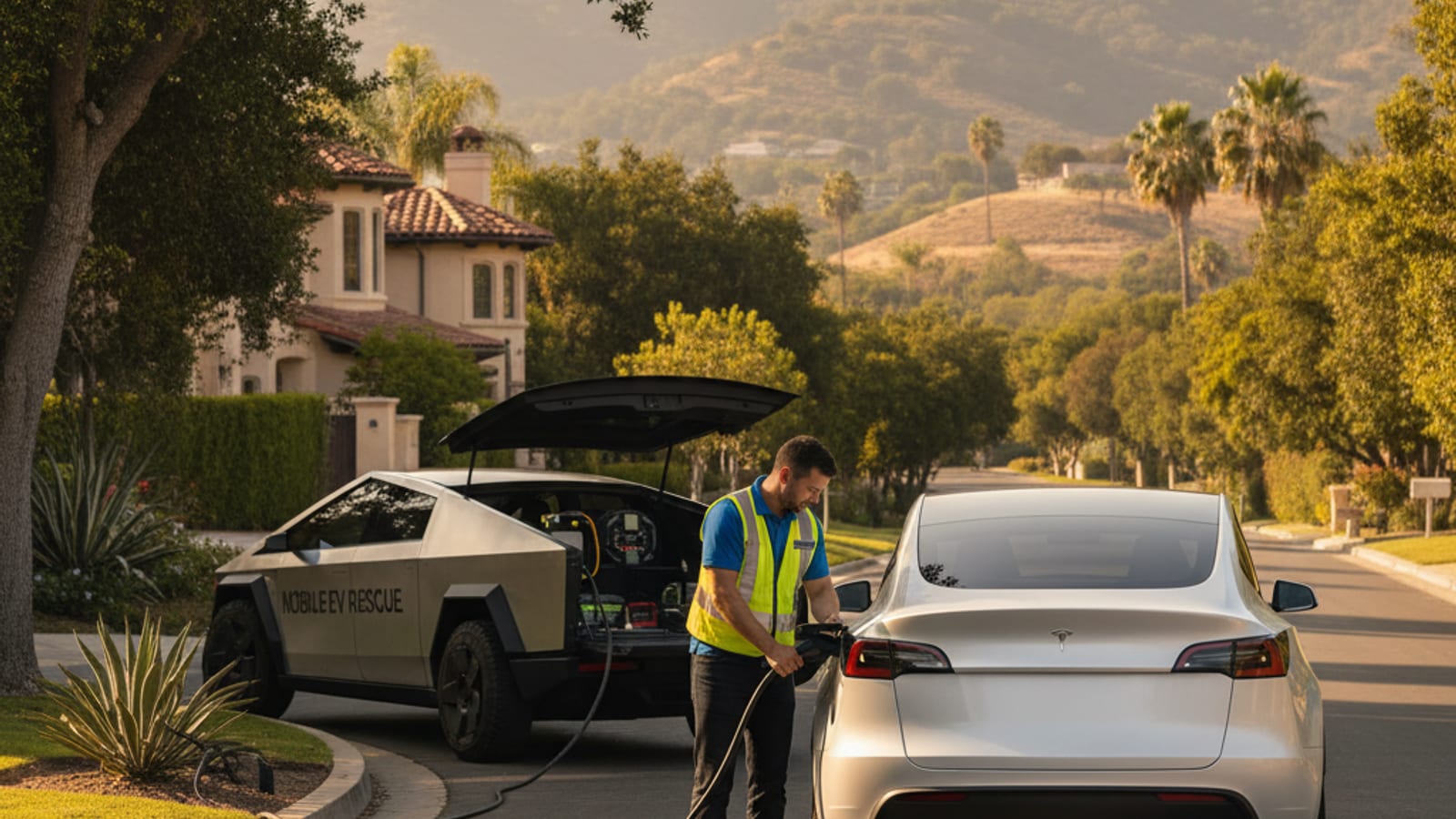
A stalled Tesla, Lucid Air, Rivian, Mercedes EQS, or Porsche Taycan still needs the same two checks. Either the traction pack is empty, or the small 12-volt is dead. Either one leaves a luxury EV sitting. In Cave Creek the geography makes that stall feel different from a dead car in central Phoenix. About 5,091 people live across 37.7 square miles, per ACS 2020-2024. The town sits in the Scottsdale and Northeast Valley belt. Neighbors include Carefree, the town of Paradise Valley, Fountain Hills, and Scottsdale. The miles between Tatum Ranch, Dove Valley Ranch, Rancho Manana, and the Cave Creek townsite add up fast when the pack is already low.
Long desert roads, not a tight city grid
Cave Creek Road is the spine through town. SR-74, the Carefree Highway, is the east-west tie toward I-17. North-desert roads keep going from there. This is ranch and trail country on the far northeast edge of the Valley. Old West downtown draws weekend visitors who park and walk the townsite. Then they get back into a car that has been sitting in full sun.
You’re not on a short central Phoenix block. You’re on rolling desert grades with long sight lines and long exposed roads. Cave Creek runs Valley heat at a slightly higher desert elevation. Phoenix averages about 111 days a year at or above 100F. It sees about 21 days at or above 110F. Those are NOAA 1991-2020 normals via NWS Phoenix. July highs average near 107F. August sits near 105F. Overnight summer lows stay in the mid-80s. The record high is 122F, set June 26, 1990. That’s a hot, dry, exposed driving climate.
Summer range loss of 20 to 30 percent is the working number for Valley heat. Recurrent Auto put that figure on a dataset that included 345,622 trips by 300 Phoenix-area EVs. Loss ran near 31 percent at 100F. AAA’s 2026 study found about a 10 percent efficiency drop at 95F versus 75F. Range loss in that study was about 8.5 percent. Cabin cooling is a real draw. NREL has said climate-control loads cut EV range in a meaningful way. None of that is a Tesla-published range claim.
So a loop that looked easy on a February map can land you low in July. That’s the local pattern. It’s heat, grade, and distance working together.
Tatum Ranch, Dove Valley, and the townsite
Tatum Ranch and Dove Valley Ranch sit on the south and west side of this map. Rancho Manana and the townsite sit closer to the Old West core. ZIPs 85331 and 85086 cover those pockets. A driver who underestimates the return from downtown toward Tatum Ranch is a common shape of call. So is a visitor who came up from Scottsdale, parked, and then watched the estimated miles fall on the way back.
A wall charger at the house doesn’t fix any of that. Newer housing is common here. Only 15.8 percent of units were built before 1980. Plenty of households can charge overnight. That still leaves you stuck if the car dies on Cave Creek Road. We already wrote the home-battery version of this town. This page is the road version. Read Cave Creek home batteries won’t save you on the road if the failure started in the garage.
Scottsdale has 243,821 residents. Cave Creek has about 5,091. That density difference is the driving difference. Short hops in Scottsdale aren’t the same as a ranch road here. This research didn’t confirm a named public charging site in Cave Creek we could list. Check a live app for the stall you plan to use. Don’t treat a blog as a station finder.
Get the car out of the travel lane first
Get off the traveled lane if you can. ARS 28-871 covers a stop outside a business or residence district. You may not sit on the traveled part of the highway if it’s practical to get off it. A vehicle disabled so badly it can’t be moved is exempt. Leave room for other traffic. Stay visible 200 feet in each direction.
Turn on your hazards. If an operator is working the shoulder, other drivers have a Move Over duty under ARS 28-775. They move over a lane if they can do it safely. Otherwise they slow down. That law exists for a reason. A person standing by a car on Cave Creek Road is easy to miss in heat and dust.
Stay with the car if it’s safe. Arizona has no toll roads and no toll express lanes. ADOT confirmed that. You’re not sitting on a paid lane. You’re sitting on a public desert road. If monsoon water is across the pavement, don’t drive around barricades. ARS 28-910, the Stupid Motorist Law, lets the state bill you for the emergency response when you do. Haboobs can drop visibility to near zero in this same season. Official monsoon dates run June 15 through September 30.
If the dash is dark and the doors won’t wake, treat it as a 12-volt job first. If the car is awake and the range is zeros, treat it as an out-of-charge job.
Empty pack on Cave Creek Road and SR-74
Out of charge is the EV-specific stall. You misread remaining miles, traffic crawled, or the A/C ran hard. The nav was optimistic on a rolling grade. None of that’s rare in the northeast Valley.
The operator we send doesn’t need you to limp somewhere else first. They bring mobile EV charging to the bumper. It’s a 240-volt Level 2 source. Teslas take a native NACS plug. CCS and J1772 adapters cover the rest. Typical on-site charging time adds about 10 to 20 miles of range in 15 to 30 minutes. That’s charging time. It’s not an arrival time. It’s enough, in most cases, to reach a public charger you already had in the plan. It can also get you home if home is the closer plug.
If you were pointed at I-17, read Out of charge on I-17: Anthem toward Black Canyon City. From Cave Creek, the Carefree Highway is the westbound way onto that corridor. Anthem sits near 1,860 feet. New River is near 2,140. Black Canyon City is near 2,000. Sunset Point rest area is near 3,410. ADOT posts a 6 percent maximum grade on the northern I-17. Forum drivers have reported about 481 Wh/mi going up versus 293 coming down. That’s roughly 40 percent more energy uphill. The nav often underestimates it. Don’t start that climb on a thin pack and hope the estimate holds.
Factory Tesla roadside won’t charge you on the spot. Tesla tows to a Supercharger or a service center. Ford’s playbook is a tow to a charger, home, or dealer. Rivian and Hyundai/Kia owners have had trouble even getting a dead EV towed. The practical advice is to ask for a tow in plain words. An independent operator’s Level 2 visit is the other path. You stay with the car. You don’t make a flatbed the first move if a charge will roll you.
Weekend downtown, then a low battery warning
Old West downtown Cave Creek is a real weekend magnet. People park and walk the townsite. The car sits in full sun. On Teslas, Cabin Overheat Protection and Sentry Mode keep drawing the 12-volt and, indirectly, the main pack. You come back to worse estimated range than when you left. The drive south toward Scottsdale is still ahead.
Don’t sit in a travel lane while you fight the trip planner. Pull off. Check whether the car is actually in drive-ready state. If it is, and the number is just low, a mobile charge at the curb is the clean fix. If it won’t wake, skip the pack math and go to the 12-volt.
The 12-volt that bricks a full pack
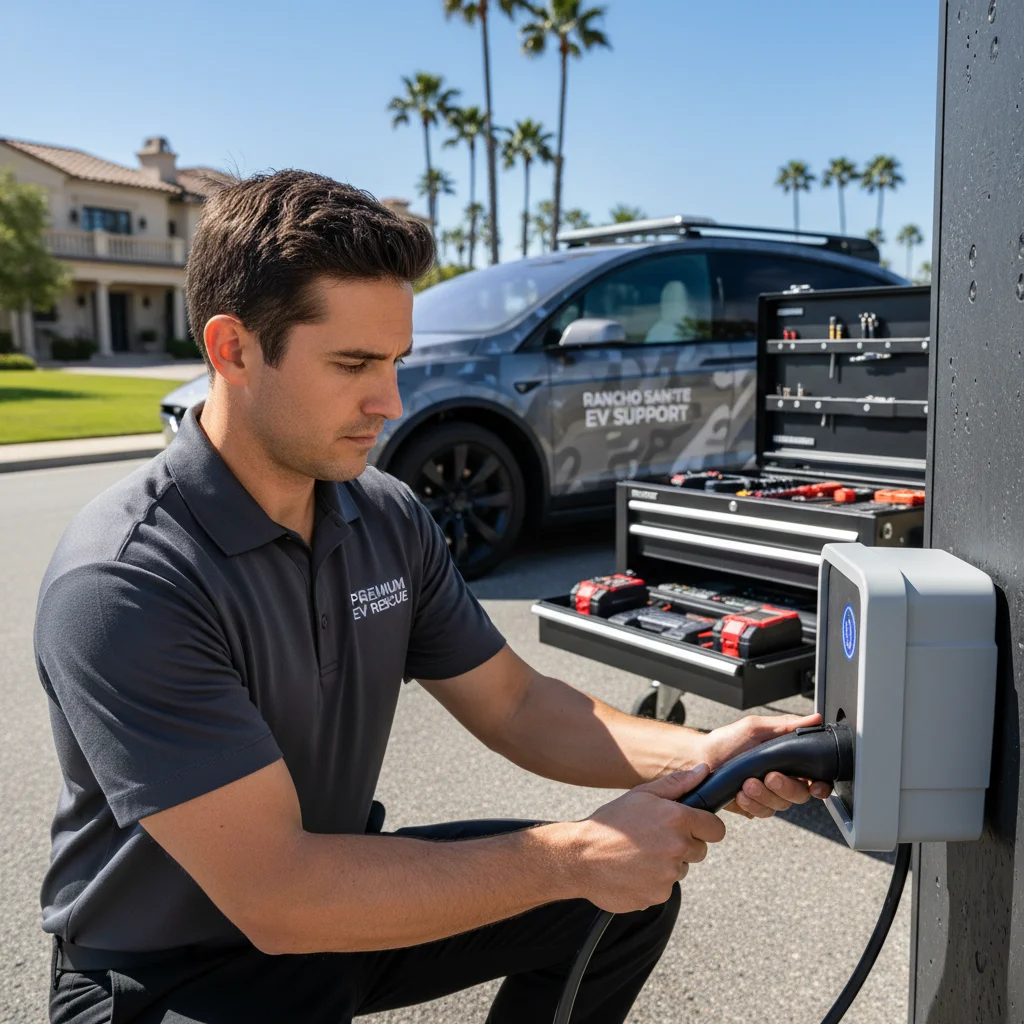
Every major EV still depends on a small 12-volt battery. It closes contactors, wakes screens, and pops handles. A full traction pack does nothing if that little battery is dead. Heat is the usual reason it dies early. The Battery Council International work, via Battery University, is clear on heat. Starter batteries last about 47 months in hot climates versus 59 in cool ones. A battery that might go five years in a mild city can fail in two or three here. AAA calls heat the number-one cause of battery failure and points hot-climate owners toward AGM.
Cave Creek is a parked-car town as much as a driving town. Ranch lots, downtown curb parking, and long days at a trailhead all cook that 12-volt. Phoenix Sky Harbor is the other Cave Creek story. Level 2 charging is confirmed in the Terminal 3 garage, the Terminal 4 garage, and at the 24th St. station. EVPassport installed charging at PHX in 2022. The car can still come home from a week in a hot garage with a dead 12-volt. The traction pack may be fine. The car still won’t wake.
The operators we send can jump that 12-volt on site. They can replace it when a jump won’t hold. That’s the Tesla 12-volt battery jump path. It’s the same small-battery logic on a Lucid, Rivian, EQS, Taycan, or any other EV. A DC-DC converter only replenishes the 12-volt while the car is on or charging. Sitting with Sentry Mode does the opposite.
If the car dies again after a jump, the 12-volt is done. Stop repeating jumps. Get it replaced at the car if the operator can do that. Then get the car to a shop on its own power.
Arizona will bring gas. It won’t bring you a charge.
Arizona actually runs free motorist help. Two programs cover the Phoenix metro. Neither one advertises EV charging.
Arizona DPS Roadside Motorist Assistance, or RMA, is statewide. It changes tires, brings gasoline or diesel, jump-starts batteries, adds water, and calls tows. In 2018 it helped 75,235 motorists statewide. Its published materials name gasoline and diesel. They say nothing about charging an empty EV. Hours and specific corridors weren’t published in a form we could verify.
ADOT’s Incident Response Unit works Phoenix-area freeways from 5am to 8pm on weekdays. It’s a 14-member unit, sponsored by State Farm since 2020. It has logged 10,400-plus responses since October 2019. It clears crashes and debris, changes tires, and helps stranded motorists. No EV-specific mention there either.
Use them for a tire or a crash scene. Don’t expect them to plug in a Model Y on Cave Creek Road. That program gap is why independent mobile operators exist. Police can also order a disabled, obstructing vehicle removed under ARS 28-872. Owners pay tow and storage before release. Arizona sets no statewide tow-rate cap. Cities and counties may set their own maximums. This research didn’t confirm a Cave Creek or Maricopa County private-tow maximum we could cite. Confirm the operator’s quote before you sign.
What a Cave Creek mobile rescue actually is
Charge Pro PHX doesn’t own trucks. We don’t employ technicians. We don’t hold a trade license for this work. We’re a referral line. We connect you with local independent operators. The pros we connect you with are licensed and insured. The EV roadside assistance page is the service overview. The Cave Creek EV charging and rescue city page is the local hub.
What those operators typically do is simple. They bring 240-volt Level 2 power to the car. Native NACS for Tesla. CCS or J1772 adapters for everyone else. About 10 to 20 miles of range in 15 to 30 minutes of charging. They jump or replace a dead 12-volt on site. They work Tesla and every major EV brand. They quote before they start, then bill you. We don’t set the price. We don’t promise when they’ll arrive.
That last point matters on 37.7 square miles of desert town. Dispatch distance is real. We won’t invent a clock.
If you want the mechanical picture of the truck, the short version is a pickup with a 240-volt source in the bed. It isn’t a Supercharger on wheels. Level 2 at the bumper is a recovery, not a full fill.
Luxury EVs still fail in ordinary ways
A Taycan and a Model 3 share the same two roadside failures. Empty pack, or dead 12-volt. Jacking points, software, and tire compound differ. The recovery doesn’t. Don’t let a generic wheel-lift hook an all-wheel-drive EV and drag it. If a tow is truly required, it should be a flatbed, and the operator should know it’s an EV. The first check is still whether a charge or a 12-volt jump removes the need for a tow.
Incorrect towing can damage motors, the battery, or the parking pawl. We’re not going to walk through a tow procedure here. The useful rule is charge or jump first when that will move the car.
Nearby towns and the same desert belt
Cave Creek sits with Carefree on the north desert edge. If you stalled a few miles over the line, the Carefree version of this problem is Luxury EV stranded in Carefree: mobile charging on desert roads. Scottsdale is the big neighbor to the south. The town of Paradise Valley and Fountain Hills sit on the same northeast map. A drive that starts in Cave Creek often ends in one of those places, or starts there and dies on the way in.
Arizona had about 141,800 battery EVs and 33,900 plug-in hybrids as of 2025, per DOE AFDC. That’s about 175,700 plug-ins statewide. The state ranks about 10th. Arizona doesn’t publish a Cave Creek count, and it doesn’t publish a Maricopa County count either. Don’t trust a page that invents one. Statewide plug-in stock grew more than 250 percent over the five years through 2024, per Experian via the Arizona Technology Council.
ADOT’s NEVI plan is adding DC fast-charging along designated interstates, including I-17. Construction is underway in 2026. That’s a corridor program. It doesn’t change what you do this afternoon if the car is already sitting.
How the call works from Cave Creek
Call Charge Pro PHX when the car isn’t going to move on its own. Tell the matcher the street, the cross street, and whether the car is awake. Say Tesla or not, because the plug changes. Say whether you think it’s a pack problem or a 12-volt problem. If you’re not sure, say that too. The operator will look at it.
The number is (602) 932-0920. We pass the call to an independent operator. That operator quotes the job. You accept or you don’t. Nothing about that quote is a promise of arrival. Nothing about this page is a promise of arrival.
If the car is in a travel lane, get it out of the way before you pick a charging plan. ARS 28-674 covers minor crashes. It tells you to move the vehicle off the traveled roadway when it’s safe and no serious injury is apparent. The same instinct applies to a silent EV. Get it out of traffic first.
We serve Cave Creek and the rest of the Phoenix area. That includes the townsite, Tatum Ranch, Dove Valley Ranch, Rancho Manana, and the desert roads toward Carefree and I-17.
Frequently asked questions
What if my EV runs out of charge on Cave Creek Road?
Call for a mobile Level 2 charge at the car. The operator brings 240-volt power with a NACS plug or a CCS or J1772 adapter. Typical charging time adds about 10 to 20 miles in 15 to 30 minutes. That’s usually enough to reach the charger you already intended to use, or to get home. Factory Tesla roadside tows. It doesn’t fill the pack on site.
Can an operator jump a 12-volt in Cave Creek heat?
Yes, they can. A dead 12-volt is the usual reason a luxury EV won’t wake even with a full pack. Heat shortens that battery’s life. The operators we send jump it on site and can replace it when a jump won’t hold. If the car dies again after a jump, treat the 12-volt as failed.
Do you send help for non-Tesla EVs in Cave Creek?
Yes, they do. Charge Pro PHX matches Tesla and every major EV brand. The operator’s truck carries a native NACS plug plus CCS and J1772 adapters. Lucid, Rivian, Mercedes EQS, and Porsche Taycan use the same two recoveries. That’s a Level 2 charge, or a 12-volt jump.