A luxury EV can look fine in the Carefree townsite. It can still stop on the next desert mile. The pack hits empty on Carefree Highway. The 12-volt dies after a parked afternoon. You need EV roadside assistance in Carefree that comes to the car.
Carefree is a desert-road town, not a garage stall
Carefree sits on the Northeast Valley rim, next to Cave Creek. The Census Gazetteer puts the town at about 8.8 square miles. ACS 2020-2024 counts about 3,683 residents. ZIP codes are 85377 and 85331. Scottsdale sits south of town. Paradise Valley and Fountain Hills share this Northeast Valley pocket.
This town is small and upscale. The Carefree Desert Gardens and the sundial are the local landmarks. Homes cluster in the Boulders, the townsite, and toward Tonto Hills nearby. About 31.9% of housing was built before 1980. Cars sit in heat for hours. That’s how a lot of 12-volt calls start.
The pavement is the other half. Carefree Highway follows the SR-74 corridor. Cave Creek Road runs through town. Pima Road comes up from north Scottsdale. Those are long, open desert connectors. Cabin cooling spends range the whole way.
Charge Pro PHX is a referral line. We don’t own trucks or equipment. We don’t employ technicians. We match you with independent local mobile rescue operators. The operator quotes you before work starts. They bill you directly. The pros we connect you with are licensed and insured.
Heat, elevation, and why the estimate lies
Carefree still takes Valley heat, at a higher desert elevation. Phoenix averages about 111 days a year at or above 100F. About 21 days reach 110F or more. Those are NOAA 1991-2020 normals via NWS Phoenix. July highs average near 107F. August highs average near 105F. Overnight summer lows hang in the mid-80s. The record high is 122F, set June 26, 1990.
Range loss in that heat is documented. Recurrent reports EVs can lose 20 to 30% of range above about 95F. Loss near 31% showed up at 100F. That dataset included 345,622 trips by 300 Phoenix-area EVs. AAA’s 2026 study found about a 10% efficiency drop at 95F versus 75F. Range loss in that study was about 8.5%. A 250-mile car did just under 230. NREL reports climate-control loads can cut EV range. Cabin cooling is one of the biggest draws.
Geotab found faster pack aging in hot climates. Cars that spend more than 35% of days above 27C age faster. Geotab put that extra degradation near 0.4% per year versus mild climates. That’s a years-long traction-pack story. The roadside surprise is often the small battery. A buffer that looked safe leaving Scottsdale can vanish on SR-74.
Arizona had about 141,800 battery EVs as of 2025, per DOE AFDC. Plug-in hybrids added about 33,900. That’s about 175,700 plug-ins statewide. Arizona ranks about 10th among states. The state doesn’t publish a Carefree EV count. There’s no verified county figure either. What we can say is the street mix. Luxury packs are the cars these roads are built around.
Two Carefree failures that feel like one
You ran the traction pack to zero
You came up Pima Road with the AC on. Cave Creek Road looked short on the map. Carefree Highway felt empty and fast. Then the car slowed and stopped. That’s an empty pack, not a fuel can.
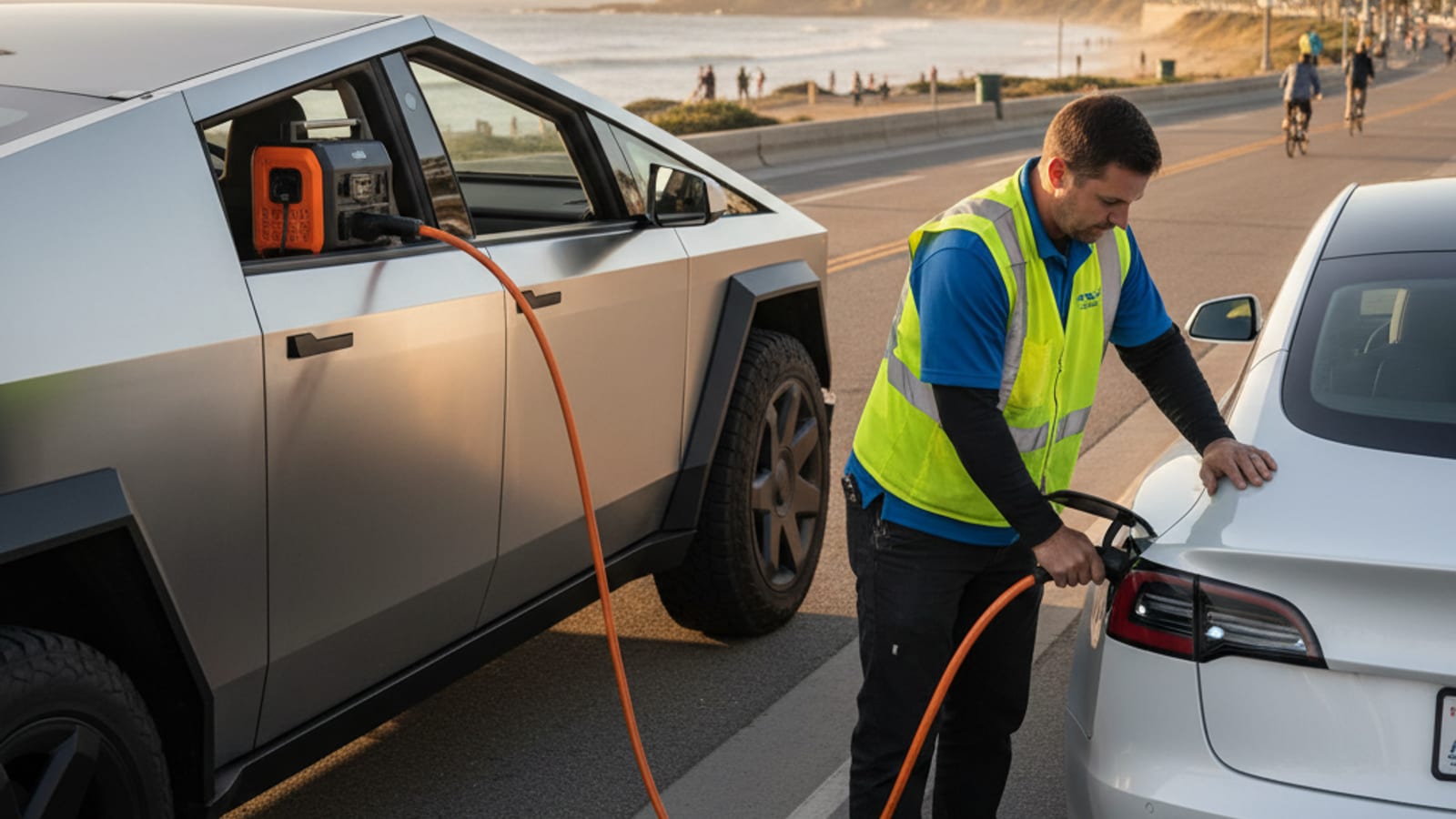
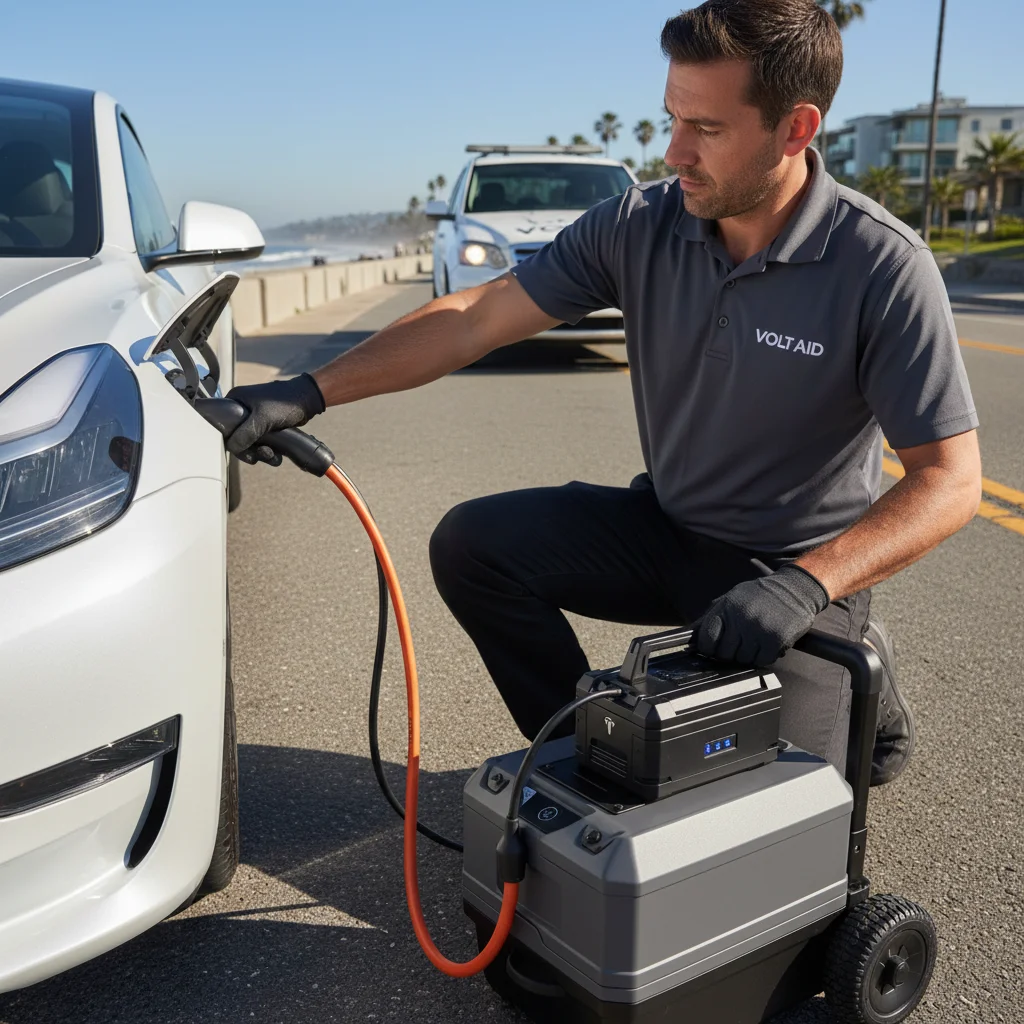
The operator brings a 240V Level 2 source to the car. Tesla gets a native NACS plug. Other EVs get a CCS or J1772 adapter. Typical on-site charging adds about 10 to 20 miles. That takes about 15 to 30 minutes of charging. That’s charging time only. Nobody here publishes an arrival clock.
Mobile EV charging is that visit. You stay with the car. You don’t need a flatbed first. That’s if the car can take a charge and roll.
The car is dark and the pack is still full
Many owners don’t know the 12-volt still matters. It powers latches, screens, and the contactor. That contactor ties in the high-voltage pack. Kill the 12-volt and the EV can sit dead. Doors may not open. Screens stay black. A full main pack doesn’t help until the 12-volt wakes the system.
Heat shortens that battery. Battery Council International work, via Battery University, tracked starter-battery life. Hot climates averaged about 47 months. Cool climates averaged about 59. A five-year battery elsewhere can fail in two or three in the desert. AAA names heat as the number-one cause of battery failure. AAA recommends AGM batteries for hot areas.
A DC-DC converter recharges the 12-volt only while the car is on or charging. Parked cars don’t top it up. Tesla features like Sentry Mode and Cabin Overheat Protection keep drawing power. A week at Sky Harbor makes this worse. Phoenix Sky Harbor has confirmed Level 2 charging in the Terminal 3 garage. There’s also charging in the Terminal 4 garage and at the 24th St. station. A car that sat hot still comes home with a tired 12-volt. The failure shows up in the Boulders driveway, not at the airport.
Operators can jump or replace a dead 12-volt on site. That’s a different job from filling the traction pack. When Tesla 12-volt batteries fail in desert heat covers the Tesla version of this stall.
Factory roadside versus a truck at the bumper
Tesla won’t charge you on site. The published path is a tow to the nearest Supercharger or service center. Ford tows to the nearest charger, home, or dealer within 50 miles. Rivian and Hyundai/Kia owners should specifically request a tow. A dead EV is easy to mishandle on a hook.
Tesla roadside rescue that puts 240V on the bumper is the independent operator. Same for Lucid, Rivian, Porsche, Mercedes, and the rest. Charge Pro PHX matches the call. We don’t perform the work.
Improper towing can hurt an EV drivetrain. Many EVs need a flatbed. That’s a real reason to charge in place when the car will accept it. We don’t sell tows. If the operator says the car needs a rollback, listen.
What the state will do on the shoulder
Arizona runs two free motorist programs. Neither advertises charging an empty EV.
Arizona DPS Roadside Motorist Assistance is statewide. It was originally funded by the Maricopa Association of Governments. Crews change tires. They provide gasoline or diesel. They jump-start dead batteries, add water, and call tows. In 2018 the program assisted 75,235 motorists statewide. Hours and corridors aren’t published. Materials name gasoline and diesel. They don’t mention EV charging or out-of-charge recovery.
ADOT’s Incident Response Unit covers Phoenix-area freeways. It runs 5am to 8pm weekdays. The unit has 14 members. State Farm has sponsored it since 2020. It has logged 10,400-plus responses since October 2019. It clears crashes and debris. It changes tires and helps stranded motorists. There’s no EV-specific mention.
Those programs still matter for a tire or a traffic hazard. They aren’t a published Level 2 charge. Independent EV roadside assistance operators do that work.
Arizona has no toll roads and no toll express lanes. ADOT confirms it. SB 1340 took effect January 1, 2024. It bars the state from adding tolls without a new legislative vote. Texts about unpaid Arizona tolls are scams. You don’t owe a Carefree Highway toll.
HOV solo access for alternative-fuel plates ended September 30, 2025. The federal exemption expired. Don’t plan a Carefree-to-Scottsdale rush-hour lane on that old rule.
Move Over still applies. ARS 28-775 says approaching drivers should move over a lane if they can. Otherwise they slow down. That’s for your hazards and for the operator’s lights.
How matching works, and what the truck carries
Call Charge Pro PHX. We match you with an independent operator who covers this edge of the metro. Carefree is a longer dispatch than central Phoenix. That’s geography, not a published ETA.
The operator quotes before starting. You hear their quote. You decide. They bill you. We don’t set the price.
They typically bring a 240V Level 2 source. They carry a native NACS plug. They carry CCS or J1772 adapters. They handle Tesla and every major EV brand. They can jump or replace a 12-volt. They don’t turn the shoulder into a DC fast-charge plaza. They add enough range to move.
Read how a mobile EV charging truck actually helps you for the visit itself. Don’t confuse this with a home wall unit. A home 240-volt circuit is for overnight. A rescue charge is for the shoulder, a gate, or a lot.
Utility rate plans don’t roll to you on SR-74. APS markets R-EV as EV Overnight Charging from 11pm to 5am weekdays. It also names a Level 2 smart-charger rebate. APS Smart Charge and Take Charge AZ are the other named programs. SRP’s Electric Vehicle Price Plan closed to new enrollment after a February 2025 board decision. Existing SRP customers may stay until the November 2029 billing cycle. SRP also names an Electric Vehicle Export Price Plan for solar customers. There’s a Marketplace Level 2 rebate, EV Smart Charge, and BizEV. Carefree’s utility by address couldn’t be confirmed. Confirm your own meter with APS or SRP.
There’s no Arizona EV rebate or tax credit. The federal 30D and 25E credits ended for vehicles acquired after September 30, 2025. Arizona has no annual EV registration surcharge. A proposed fee in HB 2866 didn’t pass. EVs skip Maricopa County Area A emissions testing. Hybrids don’t. Arizona has no annual safety inspection at all. None of those policies put electrons in a stalled car.
If you’re already stopped in Carefree
Pull off the traveled way if you can. ARS 28-871 covers stops on the traveled part of a highway. Outside a business or residence district, get off it if you can. A vehicle disabled so badly it can’t be moved is exempt. Leave room for others to pass. Stay visible 200 feet in each direction.
Hazards on. NHTSA publishes general roadside safety tips at nhtsa.gov. Stay with the car if it’s safe.
Drop a pin. Add a landmark. Name the sundial, Carefree Desert Gardens, or a Boulders entrance. Cave Creek Road and Carefree Highway work as location cues too. The town is small. Desert shoulders still look the same at night.
Tell the operator the make and model. Say whether the car is dark or just empty. A 12-volt brick and a zero-percent pack are different kits.
Don’t drive around flood barricades. Monsoon season is June 15 to September 30. Haboobs can drop visibility to near zero. Flash floods follow. ARS 28-910 is the Stupid Motorist Law. Drive into a flooded area around a barricade and you can be billed. Wait the storm out.
Police may order a disabled or obstructing vehicle removed under ARS 28-872. Owners pay reasonable tow and storage costs before release. Arizona has no statewide tow-rate cap. Cities and counties may set local maximums under ARS 9-499.05 and 11-251.04. Private tows need the property owner’s written authorization or a police request. Confirm any tow price with the company on the hook. If the car will take Level 2 and roll, that’s usually the cleaner path. The operator tells you if it will.
Nearby towns, and what isn’t Carefree
Cave Creek is the next town over. The desert-road pattern matches. Premium EV rescue in Cave Creek is the companion piece. Read it if your week straddles both towns.
North Scottsdale feeds Pima Road. Fountain Hills sits toward the Beeline. Paradise Valley the town isn’t the Paradise Valley urban village inside Phoenix. Say which one when you call.
HonorHealth Thompson Peak, Osborn, and Shea are Scottsdale hospitals. Mayo Clinic Hospital is in northeast Phoenix. Banner University Medical Center Phoenix is downtown. Don’t treat a hospital garage as a confirmed charger unless you’ve checked that site.
Fort McDowell Yavapai land sits northeast of Scottsdale. Salt River Pima-Maricopa land sits between Scottsdale, Tempe, Mesa, and Fountain Hills. Those nations have their own government and police. They aren’t Carefree, and they aren’t a Phoenix suburb.
Arizona doesn’t observe daylight saving time. The Navajo Nation does. The Hopi don’t. Carefree stays on MST, UTC-7, all year.
ADOT’s NEVI plan is built for designated interstates. It aims for up to 69 DC fast-charging sites. The minimum is 150 kW, at least every 50 miles. Construction was underway in 2026. Designated corridors include I-10, I-17, I-8, I-19, I-40, and parts of US-60 and SR-347. Carefree Highway isn’t on that published interstate list. Don’t invent a station map from that plan. Check a charging app for live stalls. Then call if the car already can’t move.
The City of Phoenix cited about 1,065 public charging locations statewide in July 2023. It cited about 2,966 ports, most in Maricopa County. Those counts are dated. The DOE AFDC station API couldn’t be reached in research. A Carefree stall count couldn’t be confirmed.
Frequently asked questions about EV roadside assistance in Carefree
Does Tesla roadside put a charge on the car in Carefree?
No. Tesla’s published path is a tow to a Supercharger or service center. An independent operator can bring 240V Level 2 with a native NACS plug. You get a quote first. They bill you. Charge Pro PHX only makes the match.
How many miles does a mobile Level 2 session add?
Operators typically add about 10 to 20 miles in 15 to 30 minutes of charging. Heat, speed, and the car’s efficiency change that. Ask for an estimate for your model before they start. That window is charging time, not a clock on when the truck appears.
Can DPS or ADOT charge an empty EV on Carefree Highway?
Not in anything they publish. DPS lists gasoline, diesel, tire changes, water, jumps, and tow calls. ADOT’s freeway unit lists crash and debris work, tires, and stranded-motorist help. Those freeway hours are 5am to 8pm weekdays. For a Level 2 charge at the bumper, you want a mobile EV operator.
A dead luxury EV in Carefree is a desert-road problem. Empty pack or a cooked 12-volt, the fix still comes to the car. Charge Pro PHX matches you with an independent operator. Call (602) 932-0920 when you’re stopped and you need that match.