A Tesla sitting dark on a Valley freeway is a disabled vehicle under Arizona law. It’s not a stalled sedan you can nudge along. ARS 28-871 says stay off the traveled lanes when you can. Leave room for traffic to pass and stay visible 200 feet in each direction. The Move Over law is ARS 28-775. Other drivers must change lanes or slow down while your lights flash. That legal frame is how you tow a Tesla with no power here. First you’re a hazard on the shoulder. Then you decide whether the car even needs a bed.
Get the car onto the shoulder first
If the Tesla still rolls, ease it fully onto the shoulder. Arizona exempts a vehicle that can’t move from the no-stop rule. That exemption doesn’t let you sit in a live lane. Keep the hazard lights on and leave a gap so traffic can get by. Stand behind a barrier if one exists, not beside the fender.
When you call, give the mile marker, the direction, and the freeway name. The Stack is I-10, I-17, and US-60. The Mini Stack is I-10, SR-51, and Loop 202. Loop 101 is Agua Fria on the west. Pima runs northeast and Price runs southeast. Loop 202 is Red Mountain, Santan, and South Mountain. US-60 is Grand Avenue going northwest and the Superstition Freeway going east. Those are different stretches of one route. Mixing them up sends the wrong truck.
Arizona has no toll roads. Loop 202 South Mountain is free. Texts about unpaid Arizona tolls are scams. Don’t wait in an HOV lane during weekday rush hours. Solo HOV access for alternative-fuel plates ended September 30, 2025.
If the shoulder is Gila River land south of Chandler, tribal police may be the authority. Salt River Pima-Maricopa land sits between Scottsdale, Tempe, Mesa, and Fountain Hills. Those nations have their own government and police.
Monsoon season runs June 15 to September 30. Haboobs can drop visibility to near zero. Flash floods close shoulders. ARS 28-910 is the Stupid Motorist Law. Drive around a barricade into flood water and the state can bill you for the emergency response. Stay with the car if the shoulder is dry. Don’t walk into running water.
If you were in a minor crash, ARS 28-674 still applies. Move the vehicle off the traveled roadway when it’s safe. You’re not at fault merely for moving it.
What DPS and ADOT can do from the shoulder
Arizona DPS Roadside Motorist Assistance will change a tire. It can bring gasoline or diesel, jump a 12-volt, add water, and call a tow. In 2018 it helped 75,235 motorists statewide. Its published pages name gasoline and diesel. They say nothing about charging an EV.
ADOT’s Incident Response Unit covers Phoenix-area freeways from 5 a.m. to 8 p.m. on weekdays. It’s a 14-member unit, sponsored by State Farm since 2020. It’s logged 10,400-plus responses since October 2019. It clears crashes, debris, and stranded cars. It doesn’t advertise a charge for a Tesla pack.
A patrol stop can make the shoulder safer. It won’t refill the high-voltage battery. An independent mobile operator can bring a charge. A flatbed is for a car that shouldn’t be driven.
Decide what actually died
A black screen isn’t proof the traction pack is empty. Phoenix averages about 111 days a year at or above 100F. About 21 of those days hit 110F or more. Heat is the leading killer of 12-volt batteries. Battery Council International work, via Battery University, put starter life at about 47 months in hot climates. Cool climates see about 59 months. In an EV, that small battery runs the door handles and the screen. It also runs the contactor that connects the main pack. When it dies, the car is stuck even with range left.
Tesla features such as Sentry Mode and Cabin Overheat Protection keep drawing power while the car sits. A week in a Sky Harbor garage is a classic 12-volt failure. So is a long park after a Diamondbacks night at Chase Field. A Suns game at Mortgage Matchup Center can do the same.
If you watched the range fall to zero on I-10 or I-17, treat it as an empty pack. If the car was fine, sat in heat, and now won’t wake, start with the 12-volt. How to tell a Tesla 12-volt is dead lists the signs before you request a tow.
A jump at the front bumper terminals can wake the computer. It doesn’t charge the main battery. It may be enough to open Transport Mode. It may even let you drive if the pack still has energy. How to jump a Tesla from the bumper tow hook shows where the cover sits.
Why a Tesla can’t roll while it’s off
A gas car can often coast in neutral. A Tesla can’t. The motors connect to the wheels through a single-speed gearbox. Spin those wheels with the car off and the motors generate electricity. That current has no managed path. Windings overheat and inverters take damage. Regenerative braking can snatch the hubs without a live computer to govern it.
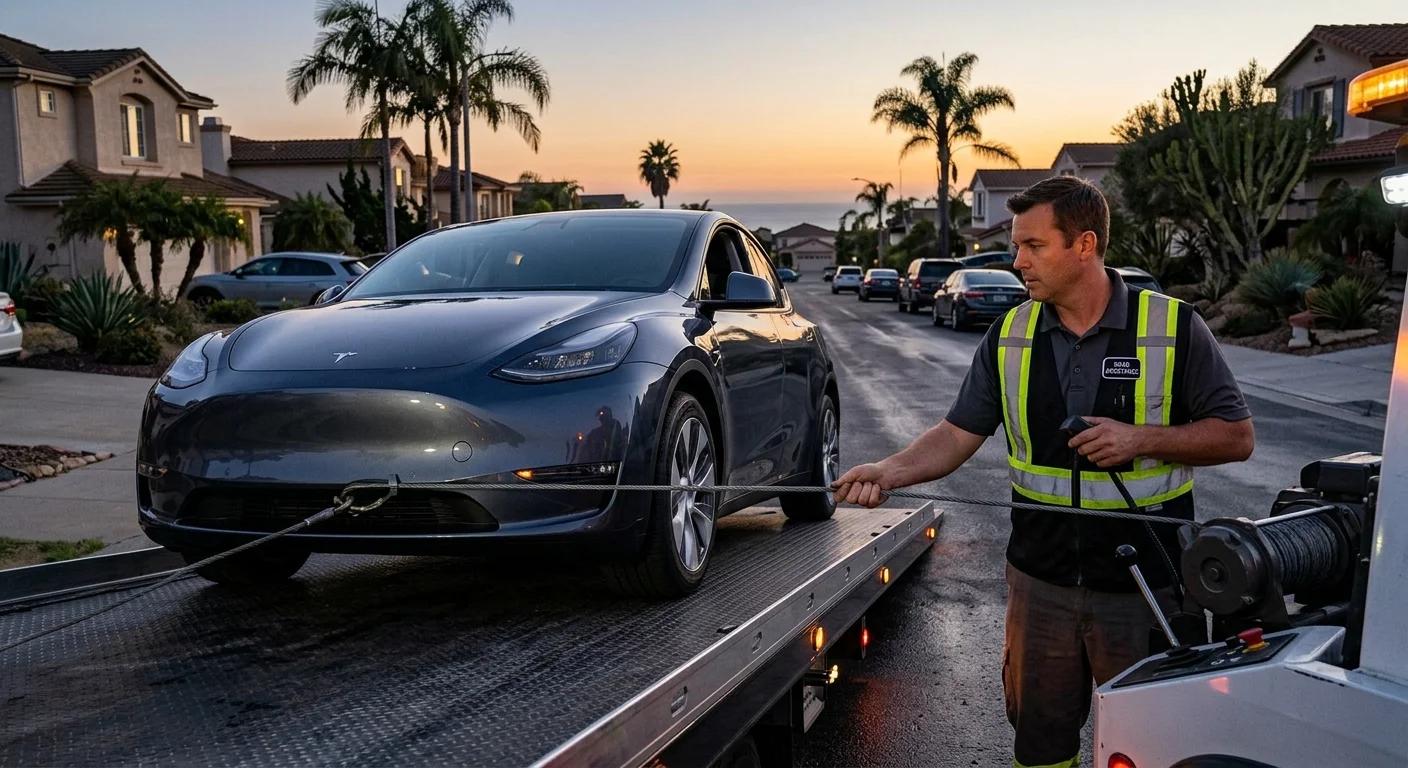
Most Teslas in the Valley are all-wheel drive. A dolly that lifts one axle still leaves a motor on the ground. A hook-and-chain drag is worse. The only safe move is a flatbed with all four wheels off the road. Don’t let anyone pull it a few feet by dragging the tires. A few feet is enough to hurt the powertrain.
Transport Mode when there is no power
Transport Mode releases the parking brake and lets the wheels turn without loading the motors. On a car that still has 12-volt power, you open Controls, then Service, then Transport Mode. When the screen is black, that menu is gone until low-voltage power returns.
On many Teslas the front passenger-side tow-eye cover hides the 12-volt jump points. A jump pack there only feeds the electronics. Once the screen wakes, turn on Transport Mode before a winch cable moves. If you’re locked out, a 12-volt lockout rescue is the next step. Dragging the car isn’t.
The operators we connect you with can jump a Tesla 12-volt on site. They quote before they start and bill you directly. Charge Pro PHX doesn’t perform the work, own trucks, or set the price.
Brief the operator before any hookup
Say the words out loud: it’s a Tesla. It needs a flatbed, not a dolly. Transport Mode is on, or it isn’t, because the 12-volt is dead. Use Tesla’s designated tow points only. Chains on control arms or the underbody can bend the structure.
Keep the wheels straight. The winch should pull the car in a smooth line onto the bed. If Transport Mode won’t enable, stop. The operator should confirm the recovery steps for your model before the car rolls. Don’t approve a method that spins the motors on the pavement.
ARS 28-872 lets police order a disabled or obstructing vehicle removed. Owners pay reasonable tow and storage costs before the yard releases it. Arizona has no statewide tow-rate cap. Cities and counties may set local maximums. Confirm the quote with the operator before the truck leaves.
Tesla factory roadside won’t charge you on the shoulder. It tows to a Supercharger or a service center. If you want a charge where you sit, that’s a local mobile call, not the factory script. What towing a dead EV in the Phoenix area actually involves covers the tow path in more detail. For a Tesla-specific rescue match, see Tesla roadside rescue.
When charging on the shoulder is the better call
An empty pack in an otherwise healthy car often doesn’t need a tow. A mobile Level 2 source can add about 10 to 20 miles of range. That takes 15 to 30 minutes of charging. That window is charging time, never an arrival time. Tesla takes a native NACS plug. You then drive to a Supercharger or home. You skip Transport Mode, the flatbed, and a storage invoice.
A dead 12-volt with a healthy pack is a jump or a replacement on site. You may drive away without a bed at all. Tow instead when crash damage, a motor fault, or a car that shouldn’t be driven is the issue. Don’t charge a Tesla that belongs on a bed.
Mobile EV charging or a tow is the decision page. Grades make empty-pack calls more common than people expect. Northbound I-17 climbs from Phoenix near 1,135 feet toward Anthem, New River, and Black Canyon City. ADOT posts a 6 percent maximum grade on the northern I-17. The Beeline, SR-87, posts a 7 percent grade into Slate Creek Canyon toward Payson. US-60 east rises through Apache Junction toward Superior. AAA’s 2026 study found about an 8.5 percent range loss at 95F versus 75F. Recurrent reported 20 to 30 percent loss above about 95F, from a dataset that included Phoenix-area trips.
Plan the rescue for the shoulder you’re on. Don’t guess how far a charger sits. Check the car’s nav or a charging app while you still have signal.
Frequently asked questions
How do you tow a Tesla with no power?
Use a flatbed and raise all four wheels. Enable Transport Mode if the 12-volt can be woken. Don’t drag the car on its tires.
What if Transport Mode won’t turn on?
Don’t force the wheels to roll. Tell the operator Transport Mode is unavailable. They should confirm the recovery procedure for your model before they winch.
Does a dead 12-volt mean the Tesla has to be towed?
Not always. A temporary jump may restore the screen and the contactors. That jump doesn’t refill the main pack. It may let you enable Transport Mode or drive to a charger if range remains.
Charge Pro PHX is a referral line for the Phoenix area. We match stranded Tesla drivers with independent local operators. We own no trucks and we don’t do the work. If you need a 12-volt jump or an on-site charge, call (602) 932-0920 and we’ll connect you.