A Tesla stall in Tempe can leave you choosing between factory roadside help, a tow, and an on-site charge. The right choice depends on where the car stopped and which battery lost power.
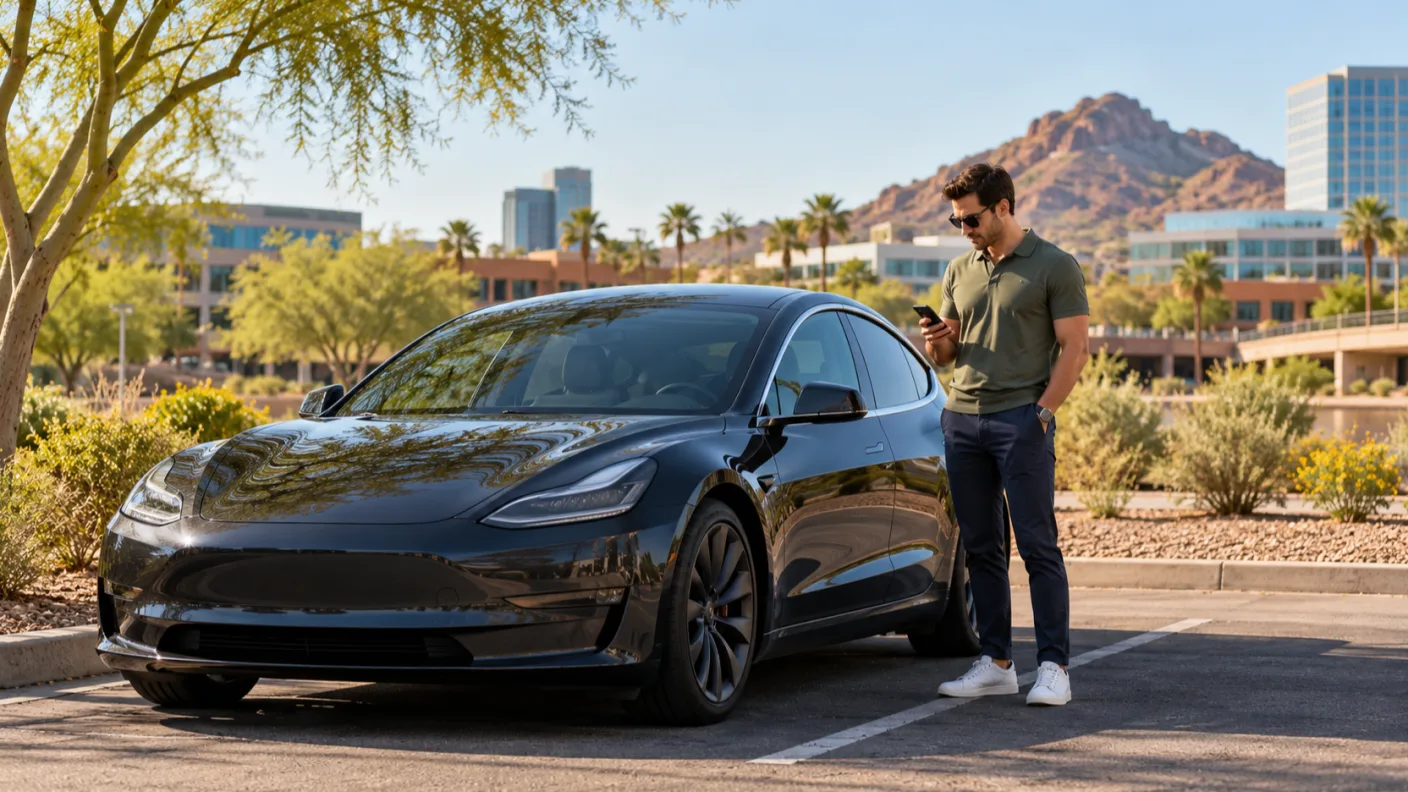
Where Tempe Teslas actually stall
Tempe puts short city trips beside several major freeway connections. I-10, Loop 202 Red Mountain, US-60, and SR-143 all cross or border the city. A low battery near an ASU garage is different from a powerless car on an I-10 ramp.
The first decision is whether the Tesla is safely parked. A car in a campus lot, apartment garage, or workplace lot may have room for an operator to work. A Tesla blocking traffic or sitting on a narrow freeway shoulder may need traffic control or towing instead.
Arizona law says drivers generally can’t stop on the traveled portion of a highway when it’s practical to move off it. If the car still moves, get as far from traffic as the situation safely allows. Keep your location description precise. “Tempe” alone doesn’t tell an operator which ramp, entrance, or parking level you’re on.
Useful location details include:
- The road and direction of travel
- The nearest exit or cross street
- The parking structure and level
- The entrance used to reach the car
- Whether a gate, height limit, or permit controls access
- Whether the Tesla can shift into neutral or transport mode
Tempe’s summer heat also matters. Phoenix averages about 111 days each year at or above 100°F. AAA’s 2026 study found about an 8.5% range loss at 95°F compared with 75°F. That doesn’t diagnose a stalled Tesla, but it can narrow the margin on a hot trip.
For broader local options beyond Tesla-specific help, see our guide to EV roadside assistance in Tempe.
ASU lots, Mill Avenue, and the 202 and I-10 ramps
A Tesla near Arizona State University may be inside a garage, surface lot, apartment complex, or restricted loading area. Access can become the main problem. An operator needs to know whether the vehicle can be reached without entering a controlled campus area.
Send the garage name exactly as shown at the entrance. Include the floor, row marker, and nearby stairwell. If clearance is posted, share it before a vehicle is sent. Don’t assume a tow truck or charging vehicle can enter every structure.
Mill Avenue creates a different problem. A car may be near curb traffic, pedestrians, businesses, or a private lot. Give the operator the exact block and parking arrangement. If property staff control the space, ask how a service vehicle should enter.
Workplace lots can also fall within Tempe’s shared APS and SRP utility territory. That fact doesn’t confirm that a workplace charger is public, working, or available. Check the charging network app, posted access terms, connector type, and live stall status before treating any nearby charger as the answer.
Freeway locations require even tighter instructions. “Loop 202 in Tempe” could mean several interchanges. State the direction and nearest exit. For I-10 toward Sky Harbor, say whether you’re before or after the SR-143 connection. Avoid walking along a ramp to search for charging.
ADOT’s Incident Response Unit helps stranded motorists on Phoenix-area freeways during its published weekday operating period. Its listed services include helping stranded motorists, changing tires, and clearing incidents. ADOT doesn’t publish an EV-specific charging service. Arizona DPS roadside materials also don’t mention EV charging.
That means freeway help may focus on safety and removal. An on-site charge is more practical when the Tesla is in a reachable, protected location.
What Tesla roadside sends versus an on-site charge
Tesla directs drivers to request assistance through the Tesla app. Select Roadside, choose the issue, and confirm the vehicle and location details. Tesla’s official roadside assistance page is the authority for its current process.
What arrives depends on the issue and Tesla’s available dispatch option. Don’t assume the request will produce an on-site charge. Tesla’s published policy says depleted-battery assistance is available, but it isn’t financially covered regardless of warranty status. Tesla typically arranges transport to the nearest Supercharger or service center.
A precise local price, included towing distance, and Tempe arrival estimate couldn’t be confirmed from the approved Tesla material. Review the terms shown in the app before accepting service. Ask what’s being sent, where the car will go, and who will bill you.
A local Tesla roadside rescue match serves a different purpose. Charge Pro PHX can connect you with an independent local operator when you want to check whether on-site charging is practical. The operator, not Charge Pro PHX, quotes and bills the work.
A typical rescue charge can add 10 to 20 miles of range during 15 to 30 minutes of Level 2 charging. That describes charging time, not operator arrival. The added range is intended to help reach a suitable charging location. It isn’t a battery repair or a promise that every stalled Tesla can accept power.
Compare both paths before authorizing a tow. Ask Tesla what it can dispatch. Then ask a local operator whether the location, vehicle condition, and remaining access make mobile EV charging workable.
12-volt lockout versus an empty pack
“Dead Tesla” can describe two different situations. The high-voltage pack may be depleted, or the low-voltage system may not power the locks and controls. Those problems call for different equipment and procedures.
Start by reporting what you can observe:
- Does the Tesla app connect to the car?
- Do the touchscreen or interior lights work?
- Can the doors open normally?
- Does the charge port respond?
- Did the car show a low-range warning?
- Is there a low-voltage warning in the app or vehicle?
- Can the vehicle enter a state suitable for transport?
Don’t treat exposed wires behind a tow-eye cover as charging leads. On the current Model Y, Tesla says those wires only release the hood latches. They can’t charge the low-voltage battery. Tesla also says they must be disconnected after the hood unlatches and can’t remain connected for more than 30 seconds.
Once the hood is open, the current Model Y manual describes separate jump posts. Procedures vary by Tesla model and model year. The current Model Y also uses a lithium-ion low-voltage battery, but other configurations can differ. Check the vehicle information and the correct Tesla manual before anyone connects external power.
The current Model S has a different arrangement. Tesla places its positive jump post under the maintenance panel. The location differs slightly for vehicles made before and after approximately January 2023.
A low-voltage power problem doesn’t mean the main pack needs roadside charging. Likewise, an empty main pack may still leave the screen and locks working. Describe the symptoms without guessing the diagnosis. That helps Tesla or a local operator bring the right equipment.
Never use a Model Y to jump-start another vehicle. Tesla’s manual says it can’t be used for that purpose and warns that damage can result.
What to send when you want a local match
A good service request starts with facts the operator can act on. Send the exact Tesla model and model year first. Then describe what happened immediately before the stall.
For a Tempe match, include:
- Your exact address, cross streets, or freeway position
- Travel direction and nearest exit
- Garage name, level, and clearance
- Tesla model and model year
- Displayed range before the car stopped
- Current screen, lock, and app behavior
- Any warning message shown word for word
- Whether the charge port opens
- Whether the car can roll or enter transport mode
- Photos of the vehicle position and nearby access
Say whether you already opened a Tesla roadside request. If Tesla offered a tow, share the proposed destination and any terms displayed in the app. That lets you compare a confirmed factory option with a local operator’s quote.
Charge Pro PHX is a referral service. It doesn’t charge, tow, diagnose, or repair the Tesla. It doesn’t set the operator’s price or promise an arrival time. You contract with and pay the matched operator directly.
Keep the request focused on Tempe. Nearby city pages can help when the breakdown occurred beyond the city line. Use our Chandler Tesla roadside guide for a stall south of Tempe. The Mesa Tesla roadside guide covers situations east of Tempe. Those pages reflect different roads and access conditions.
Before accepting any service, confirm what the operator plans to provide. Ask whether the quote covers mobile charging, low-voltage assistance, or towing. Also confirm the destination if towing becomes necessary. A clear scope helps prevent a charge request from becoming an unexpected transport decision.
When to call us
Call when your Tesla is safely reachable in Tempe and you want a local mobile charging option checked before accepting a tow. Share the model, location, warnings, and access details so the matched operator can assess the request.
Call us at (602) 932-0920 and we’ll connect you with a local EV rescue operator.