A Mesa Tesla that dies in a Superstition Springs lot, on the US-60 shoulder, or along Loop 202 Red Mountain is a Mesa problem. Tesla roadside assistance starts in the Tesla app, and Tesla’s published path for an empty pack is usually a tow to a Supercharger or service center. Charge Pro PHX is the backup match when you want an on-site charge from an independent local operator instead of sitting through that tow.
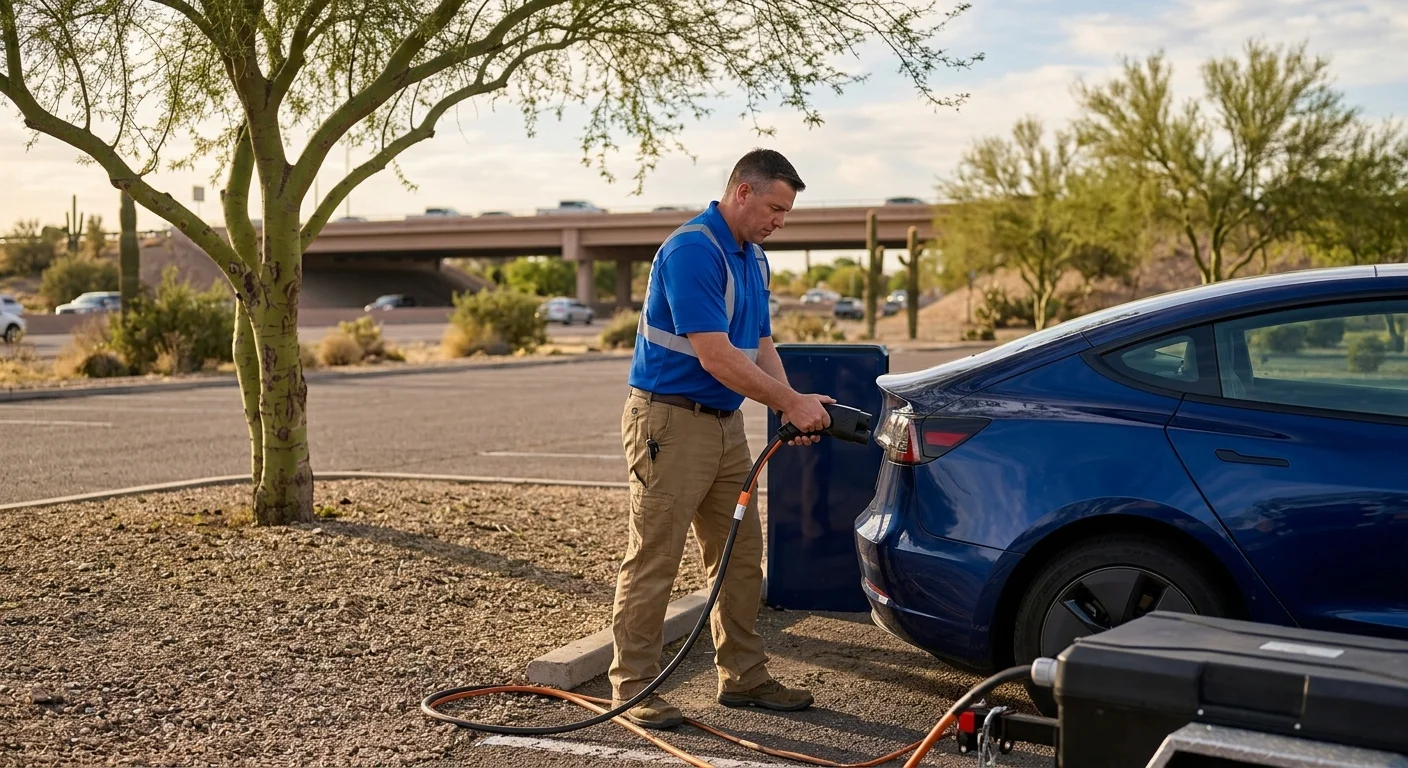
Where Mesa Teslas actually stall
Mesa is the East Valley’s largest city, with 511,764 residents in the ACS 2020-2024 5-year count. That size matters because the stall is rarely “somewhere in Phoenix.” It is a specific arterial, a specific freeway shoulder, or a specific lot with afternoon heat sitting on the pavement.
The pattern that shows up here is short remaining range plus desert load. Phoenix averages about 111 days a year at or above 100F, with July highs near 107F and August near 105F (NOAA 1991-2020 normals via NWS Phoenix). Recurrent, using 345,622 trips by 300 Phoenix-area EVs, reports that EVs can lose 20 to 30 percent of range above about 95F, with loss near 31 percent at 100F. AAA’s 2026 study found about a 10 percent efficiency drop and an 8.5 percent range loss at 95F versus 75F. Cabin cooling is a real draw on top of that. NREL reports climate-control loads can cut EV range in a meaningful way. A Model Y that looked fine leaving downtown Mesa can be in the low teens by Power Road.
Stalls cluster where Teslas sit still in heat, then have to move. Shopping and office lots along Southern, Baseline, and McKellips. The Fiesta District. Downtown Mesa, in the small pocket Mesa Municipal Electric actually serves (about 5.5 square miles around downtown, over 18,000 customers). Phoenix-Mesa Gateway’s Hourly, Daily, and Ray Road Economy lots, where a car can sit through a flight and then refuse to wake. Spring-training parking at Sloan Park on a 100F afternoon. Neighborhood streets in east Mesa when the nav counted on a buffer the heat already spent.
Salt River Project serves much of Mesa. That is useful at home. It does not help you on a shoulder. Arizona DPS Roadside Motorist Assistance will change a tire, add gasoline or diesel, jump a 12-volt in a gas car, and call a tow. Its published materials say nothing about EV charging or an out-of-charge Tesla. ADOT’s Incident Response Unit works Phoenix-area freeways from 5am to 8pm on weekdays. It clears crashes and debris and helps stranded motorists. It also has no EV-specific mention. For Tesla roadside assistance Mesa searches, those crews are neighbors on the shoulder. They are not a charge.
If the car is on the traveled lanes of US-60 or Loop 202, Arizona law wants it off that pavement when it is practical. ARS 28-871 says you may not stop or park on the traveled part of a highway outside a business or residence district if you can get off it. A vehicle disabled so badly it cannot be moved is exempt. When you are stopped you must leave room for other traffic to pass and be visible 200 feet in each direction. Drivers coming up on your flashers have their own duty under ARS 28-775, the Move Over law: move over a lane if they safely can, otherwise slow down. Fines run $275, then $500, then $1,000 for repeats within five years.
US-60, Loop 202, and Superstition-side lots
Name the road when you ask for help. Mesa’s Tesla stalls sit on three corridors that do not behave like Chandler’s Price Road pattern, which we already covered in Tesla roadside help in Chandler.
US-60 is the Superstition Freeway. In Mesa it is the east-west spine: Dobson, Mesa Drive, Val Vista, Greenfield, Higley, Power, Sossaman, then Ellsworth and Signal Butte as the city thins toward Apache Junction. A Tesla that dies on the US-60 shoulder is in through-traffic, not a quiet frontage. Get it as far onto the shoulder as the car will still roll. Hazard lights on. People walking the Superstition Freeway at dusk are hard to see against heat shimmer. If the pack still has a mile or two, a lot at the next exit is safer than the white line.
Loop 202 Red Mountain is the north and east Mesa freeway. University, McKellips, McDowell, and the 202/60 junction are where East Valley trips stack up. Red Mountain is not the Santan. The Santan is the south loop through Chandler and Gilbert. A pin that only says “Loop 202” can send the wrong contractor to the wrong loop. Say Red Mountain. Say the exit. Say which direction you were pointed.
Superstition-side lots are the east Mesa retail and office pads that face the range. Superstition Springs and the Power Road corridor bake in the afternoon. The car is “parked,” which feels safer than a freeway, until the low-voltage battery is too far gone to wake the screens or the main pack is empty and the lot has no working post. Phoenix-Mesa Gateway sits on this same east side. Confirmed parking there is the Hourly lot, the Daily lot, and the Ray Road Economy lots, with a free Economy shuttle. Public charging at Gateway was not confirmed in our ledger, so do not count on a post in that lot. Treat Gateway like any other Mesa stall: you need either Tesla’s tow path or a mobile charge.
East of Mesa the Superstition Freeway starts to climb. Apache Junction sits around 1,700 feet, Superior around 2,890, Top-of-the-World around 4,530 (TopoZone, approximate). A Tesla that left a Mesa Supercharger with “enough” for Globe can be in trouble once the grade starts. If you are still in Mesa city limits, stay in Mesa. Do not nurse an empty pack toward Gold Canyon hoping the next plaza has an open stall.
Arizona has no toll roads, so a stall here is never a toll-plaza problem. It is heat, grade, and a lot with no working charger. For a broader Mesa map of EV roadside options beyond Tesla, see EV roadside assistance in Mesa.
What Tesla roadside sends versus an on-site charge
Tesla roadside assistance is requested in the Tesla app. You select Roadside, choose the issue, and confirm the details (Tesla support, Roadside Assistance). That is the official path. Phone trees change. The app is what Tesla publishes.
For a depleted high-voltage pack, Tesla’s roadside policy says assistance is available and is not a financially covered service, regardless of warranty status. Tesla typically arranges transport to the nearest Supercharger or service center. That is a tow. It is not an on-site charge. Wait times, included miles, and any fee Tesla or its contractor might bill could not be confirmed from Tesla’s public roadside pages. Check the Tesla app and that Tesla roadside page for the figure that applies to your VIN and your incident. Do not guess from a forum screenshot.
That gap is the whole Mesa decision. A tow to the nearest Supercharger can be the right call when the car is in a live lane and you need it moved. It is a long afternoon when the car is already in a Superstition Springs stall, a Gateway lot, or a side street off University, and you only need enough range to get to a working post. An independent operator doing Tesla roadside rescue brings mobile EV charging to the pin. A typical rescue charge, from our brand record, is 10 to 20 miles of range in 15 to 30 minutes of Level 2 charging. That number is charging time on scene. It is not an arrival promise. Charge Pro PHX does not quote a price and does not promise an ETA. The operator you are matched with quotes and bills you directly.
Tesla does not publish that it will charge the car in the lot. When the app assigns a flatbed, that is the service you are getting. We wrote the policy side of that fork here: when Tesla roadside will not charge on site. In Mesa, use that page when the app already shows a tow and you still want a charge in place.
Factory roadside and a local match can both be in play. Open the Tesla ticket so Tesla has the incident. If the assignment is tow-only and the car is in a safe lot, you can also request a local mobile charge. Tell the local operator that Tesla already has a truck on the board, so two crews do not show for one car.
The U.S. Department of Energy’s electric vehicle pages are the clean primer on why a pack at 5 percent in 105F air is a different car than the same pack in 75F air. Mesa in July is the second car.
12-volt lockout versus an empty pack
Two Mesa Teslas can look identical from the sidewalk and need opposite help. One has a dead low-voltage battery. The screens are dark. The doors may not open the normal way. The charge port may not answer. The high-voltage pack can still have tens of miles in it. The other has a live screen, a honest 0 percent, and a car that will not roll under its own power. Mixing those two up wastes the first visit.
On the current Model Y, Tesla describes a lithium-ion low-voltage battery with its own jump-post procedure. Battery type and procedure vary by model and model year. Confirm the type in the vehicle information and use the current manual for the exact car. On that Model Y, Tesla describes jump posts reached after the hood is open. The wires behind the tow-eye cover only release the hood latches. They cannot charge the low-voltage battery. They must be disconnected once the hood unlatches, and Tesla says those cables must not stay connected more than 30 seconds. A random jumper pack on the tow-eye pins is the wrong move. Tesla also states that Model Y cannot be used to jump-start another vehicle, and that doing so can result in damage.
Heat is hard on the small battery even when the pack is fine. Battery Council International failure-mode work, via Battery University, found starter batteries last about 47 months in hot climates versus 59 in cool ones. AAA calls heat the number-one cause of battery failure. Mesa’s summer overnight lows in the mid-80s never really let that small battery rest, especially with Sentry or Cabin Overheat running in a lot.
A 12-volt lockout wants a low-voltage recovery, then a test of whether the car will stay awake. An empty pack wants energy into the high-voltage system, or a tow to a Supercharger. Tesla’s published depleted-battery path is the tow. Tesla’s coverage language for a 12-volt event could not be confirmed as a single public rule that covers every model year. Read the in-app Roadside flow and the Tesla roadside page for your car. If the app is already sending a flatbed and the car is only dark, say so in the ticket and to any local operator you match. They need to know it may be a wake-up, not a 0 percent pack.
Do not stand in the US-60 travel lane to pop a tow eye. If the car is on Red Mountain and will not move, stay behind the barrier, keep the scene visible, and let the assigned help come to a safe pin. ARS 28-872 lets police order a disabled or obstructing vehicle removed, with the owner paying reasonable tow and storage costs before release. A Tesla sitting in a live lane gets that clock whether the problem is 12-volt or pack.
What to send when you want a local match
Charge Pro PHX is a referral service. We connect Mesa Tesla drivers with independent local operators. We do not own the truck, we do not set the price, and we do not run the charge. The faster the pin is accurate, the less time the operator spends hunting the East Valley.
Send the model and year, Model 3, Y, S, X, or Cybertruck, because hood and jump-post steps differ. Send whether the screens are alive. A dark car and a 0 percent car are different jobs. Send the exact Mesa location in street language: “US-60 eastbound shoulder west of Power,” “Loop 202 Red Mountain southbound at University,” “Gateway Daily lot, row C,” “Superstition Springs, south lot.” A pin that only says Mesa will bounce between the 60 and the 202.
Send what Tesla already did. App ticket open or not. Tow assigned or not. Supercharger the app named, if it named one. If Tesla is already rolling a flatbed, the local operator needs that so they do not duplicate the tow. Send whether the car is in a live lane, a shoulder, or a lot. Live-lane jobs are a safety problem first. ARS 28-871 still applies.
Send the port. Current Teslas in Mesa are NACS. An adapter in the trunk only matters if the operator is using a J1772 lead. Send the indicated pack percent if the screen still works, and a one-line heat note: sitting in 105F for three hours in a Gateway lot is different from rolling to a stop on Red Mountain.
We still will not quote a fee or an arrival window. The matched operator does that. What we can tell you from the brand record is the on-scene charge itself: 10 to 20 miles of range in 15 to 30 minutes of Level 2 charging, when a charge is the job. If the car needs a flatbed onto US-60, that is a tow, and Tesla’s typical depleted-battery move is already that tow to the nearest Supercharger or service center.
Keep the Tesla app open while you request the local match. Factory roadside remains the official Tesla path. The local charge is the Mesa backup when that path is tow-only and the car is already in a place a mobile charger can reach.
When to call us
Call when a Mesa Tesla is stuck in a lot or on a safe shoulder, Tesla roadside has assigned a tow, and you want an on-site charge from an independent operator instead. Call when the screens are dark and you need a local match who knows a Tesla low-voltage lockout from an empty pack. Call us at (602) 932-0920 and we’ll connect you with a local EV rescue operator.