A Ford Mustang Mach-E that won’t start in Phoenix is usually a dead 12-volt. Phoenix heat cooks that small battery while you park. The main pack can still be full. A jump or a swap on site often wakes the car.
Heat is what kills this 12-volt first
Valley summers don’t give a parked Mach-E a break. Phoenix averages about 111 days a year at or above 100F. About 21 of those days reach 110F or more. NOAA’s 1991-2020 normals, via NWS Phoenix, back that count. July highs average near 107F. August still sits near 105F. Overnight lows hang in the mid-80s, so the battery never really cools.
Hot-climate starter batteries last about 47 months in Battery Council International work, via Battery University. A five-year battery elsewhere can fail in two or three years here. AAA calls heat the number-one cause of battery failure.
The Mach-E still needs that small 12-volt. It runs the computers, locks, screens, and the contactor. The contactor is the switch that ties in the high-voltage pack. Kill the 12-volt and the car won’t wake. A full drive battery doesn’t matter. The DC-DC converter only recharges the 12-volt while the car is on or charging. Sit in a Chandler office garage all day and that little battery just cooks.
Airport parking is the other classic trap. Phoenix Sky Harbor’s Terminal 3 and Terminal 4 garages bake a Mach-E for a week, and so does East Economy. Level 2 charging is confirmed in those Terminal 3 and Terminal 4 garages. It’s also at the 24th St. station. None of that helps if the 12-volt already dropped too low to close the contactors. You ride the PHX Sky Train back, and the fob does nothing.
Sloan Park in Mesa, Chase Field, and Mortgage Matchup Center bake a parked Mach-E the same way.
Dead 12-volt versus a drained pack
Blame the big battery last. These two failures don’t feel alike.
A dead 12-volt turns the Mach-E into a brick. There’s no cluster and no interior lights. The charge door may ignore the button. The fob can seem lost even with a fresh coin cell. You might hear a click, then silence. That lockout pattern is in what happens when an EV 12-volt dies in desert heat.
A low drive battery usually still wakes the car. You can read a low-charge warning. It may block Drive or cut power. That’s a range problem. Heat makes range worse, but it doesn’t black out the cabin by itself. AAA’s 2026 study found about a 10% efficiency drop at 95F versus 75F, and about 8.5% less range. Recurrent used 345,622 trips from 300 Phoenix-area EVs. It reported 20 to 30% range loss above about 95F. That isn’t the same fault as a silent 12-volt.
If the car is awake and weak, you need energy. If it won’t wake, start with the 12-volt.
East Valley homes in Gilbert, Chandler, and Queen Creek are mostly new, so home charging is common. The no-start still happens after work, in a hot lot. West Valley streets in Glendale, Arizona, Goodyear, and Buckeye see the same parked-heat death.
What the Mach-E screen is actually saying
Ford’s alerts are blunt. They’re not a full diagnosis.
“System Off to Save Battery,” or a shutdown countdown, often tracks a weak 12-volt. The car is rationing what little power is left.
“Key Fob Not Detected” can be the fob coin cell. It can also be a 12-volt too low to run the receivers. Replace the fob battery if you can. Then treat the car’s 12-volt as the next suspect.
A blank screen with no power is the classic 12-volt fail. The car can’t even draw a warning.
“Stop Safely Now” is a harder message. It can point at the high-voltage side or another critical fault. Don’t keep rolling on it. Get out of the traveled lane if you can, then get help.
“Service Vehicle Soon” and generic lamps need a shop later. They don’t always block a start.
Match the words to what the car will still do. Black and silent still means 12-volt until you prove otherwise.
The 12-volt is in the frunk, not the rear
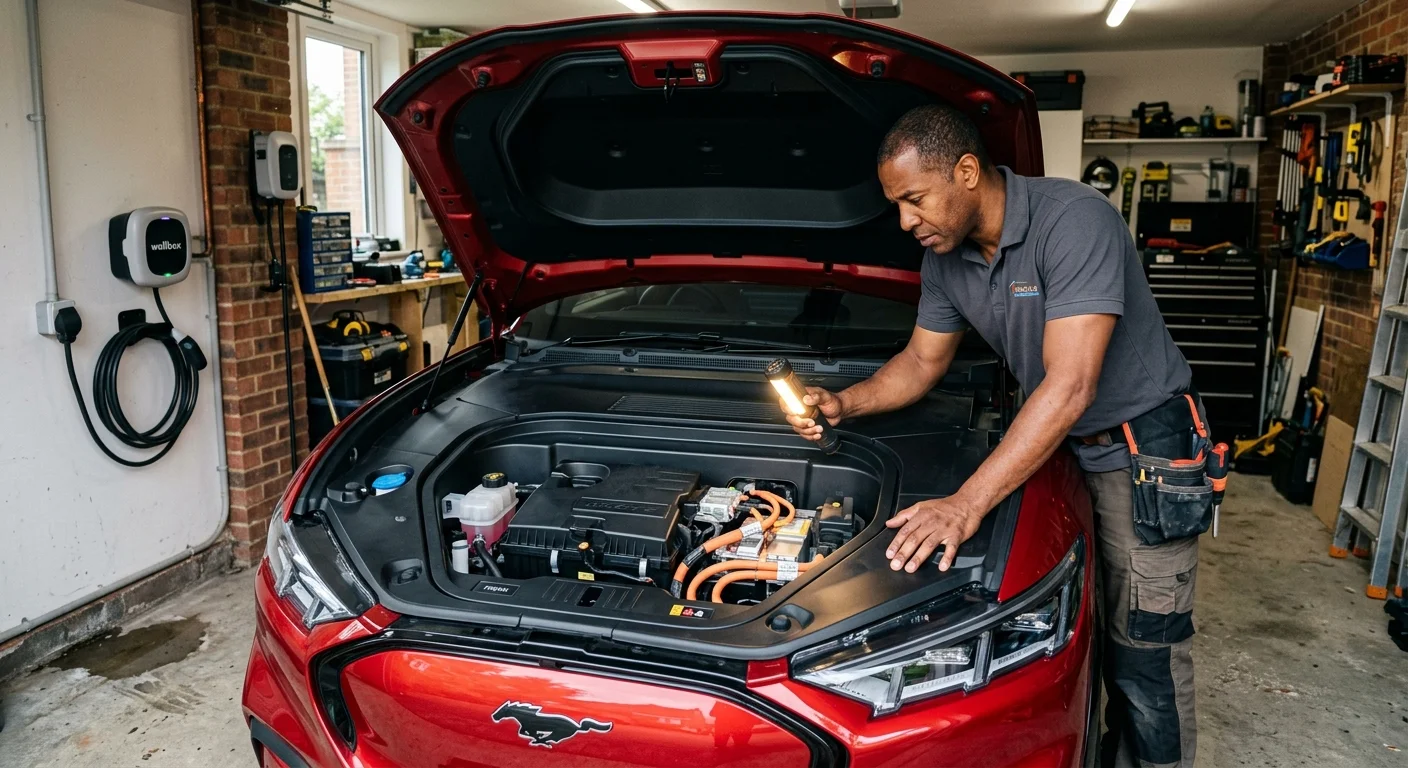
Ford put the Mach-E’s 12-volt under the hood, on the passenger side of the front trunk. It isn’t in the cargo area.
Open the frunk with the fob or the interior release. Find the plastic cover on the passenger side. Lift it and you’ll see a conventional 12-volt battery.
The jump posts are usually easier than the battery clamps. Ford places a positive post under a red cap in the frunk. A nearby bare metal bolt or bracket is the ground. Use the points your manual shows. Don’t clip onto random painted metal.
A multimeter beats a guess. Set it to DC volts. Red on positive, black on negative. A healthy battery rests near a full 12-volt charge. A sagging reading means it’s discharged, failing, or both. This page doesn’t invent a shop cutoff. Check the figure Ford lists for your year.
A jump can wake a discharged battery. If it dies again after a short park, plan on a replacement. The operators we connect you with jump or replace that 12-volt on site. Clamp-by-clamp heat notes live in how to jump start an electric car in desert heat. Ford’s truck has the same 12-volt heat fail: F-150 Lightning won’t start after desert heat.
A curb jump versus Ford’s tow
You’re not jumping the high-voltage pack. You’re only feeding the 12-volt system.
Both vehicles stay off until the cables are connected. Follow Ford’s order for your year. In broad terms, positive goes on the Mach-E jump post first, then the donor positive. Negative goes on the donor next, then the Mach-E ground last. After it wakes, pull the cables in reverse. Keep the Mach-E powered once it comes up. Drive it or plug it in so the DC-DC converter can refill the 12-volt. If it won’t hold, replace it.
Ford’s factory roadside path is a tow. Published carmaker notes say Ford tows to the nearest charger, home, or dealer within 50 miles. That helps an empty pack. It’s a slow fix for a 12-volt that only needs a jump.
Arizona does run free motorist help. Arizona DPS Roadside Motorist Assistance changes tires, brings gasoline or diesel, and jump-starts conventional batteries. Its published materials name gasoline and diesel. They say nothing about charging an EV. ADOT’s Incident Response Unit covers Phoenix-area freeways from 5am to 8pm on weekdays. It also doesn’t advertise an EV charge.
That gap is the job of an independent mobile EV operator. Charge Pro PHX is a referral line. We match stranded drivers with local operators. We don’t own trucks, employ technicians, or hold a trade license. The operator quotes you before starting and bills you directly. The pros we connect you with are licensed and insured.
If the 12-volt failed, they can jump it or swap it where you sit. If the pack is empty, they bring a 240V Level 2 source. Your Mach-E isn’t a Tesla. Tell the operator the year and the port you have. Ask for a non-Tesla EV rescue. The pros we send bring CCS or J1772 adapters for non-Tesla EVs. Typical charging time is 15 to 30 minutes. That usually adds about 10 to 20 miles of range. That’s charging time. It isn’t an arrival time.
If you’re sitting on a Valley shoulder
Get the car out of the traveled lanes when you can. ARS 28-871 bars stopping on the traveled part of a highway outside a business or residence district. Pull off when it’s practical. A vehicle disabled so badly it can’t move is exempt. Leave room for others to pass. Stay visible, and hit the hazards.
ARS 28-775 is the Move Over law. Other drivers must change lanes if they can, or slow down, when they see warning lights. Don’t stand in a live lane.
The Stack at I-10, I-17, and US-60 is a bad place to sit silent. So is the Mini Stack at I-10, SR-51, and Loop 202. Loop 101 is Agua Fria on the west, Pima on the northeast, and Price on the southeast. US-60 is Grand Avenue toward the northwest and the Superstition Freeway toward the east. Those are different segments. Name the one you’re on.
Arizona has no toll roads and no toll express lanes.
A stuck charge cable is a different failure from a no-start. If the port won’t release after a hot session, use Mach-E charge port stuck in the heat.
Tribal land isn’t a Phoenix suburb. Salt River Pima-Maricopa sits between Scottsdale, Tempe, Mesa, and Fountain Hills. Say that when you ask for a match.
Empty pack, hot lot, or cooked 12-volt
APS and SRP split much of the Valley, sometimes block by block. Confirm your own address. Overnight EV rate plans help a car that still wakes at home. They don’t revive a 12-volt that already died at work.
If the car wakes and the gauge is near zero, you need energy, not a jump. Can a roadside jump wake an EV spells out that split. Phoenix Raceway is in Avondale, not Phoenix. Wherever you parked, the first check is still whether the car will wake.
When to call for a match
Stay out of traffic if the frunk is awkward or the cables are at home. Do the same if the alert looks like a high-voltage fault. Call Charge Pro PHX at (602) 932-0920. We connect you with a local operator. They can jump the 12-volt or replace it on site. They can add a Level 2 charge if the pack is what died. The quote comes before they start.
More local charging context is on the Phoenix-area EV charging hub.