A Honda Prologue that won’t start after sitting in Valley heat is usually a dead 12-volt. AAA names heat as the top battery killer, and Phoenix logs about 111 days a year at or above 100F. That small battery still has to wake the Ultium pack. When it fails, the fob, screens, and contactors all go quiet. An independent operator can jump or replace it on site.
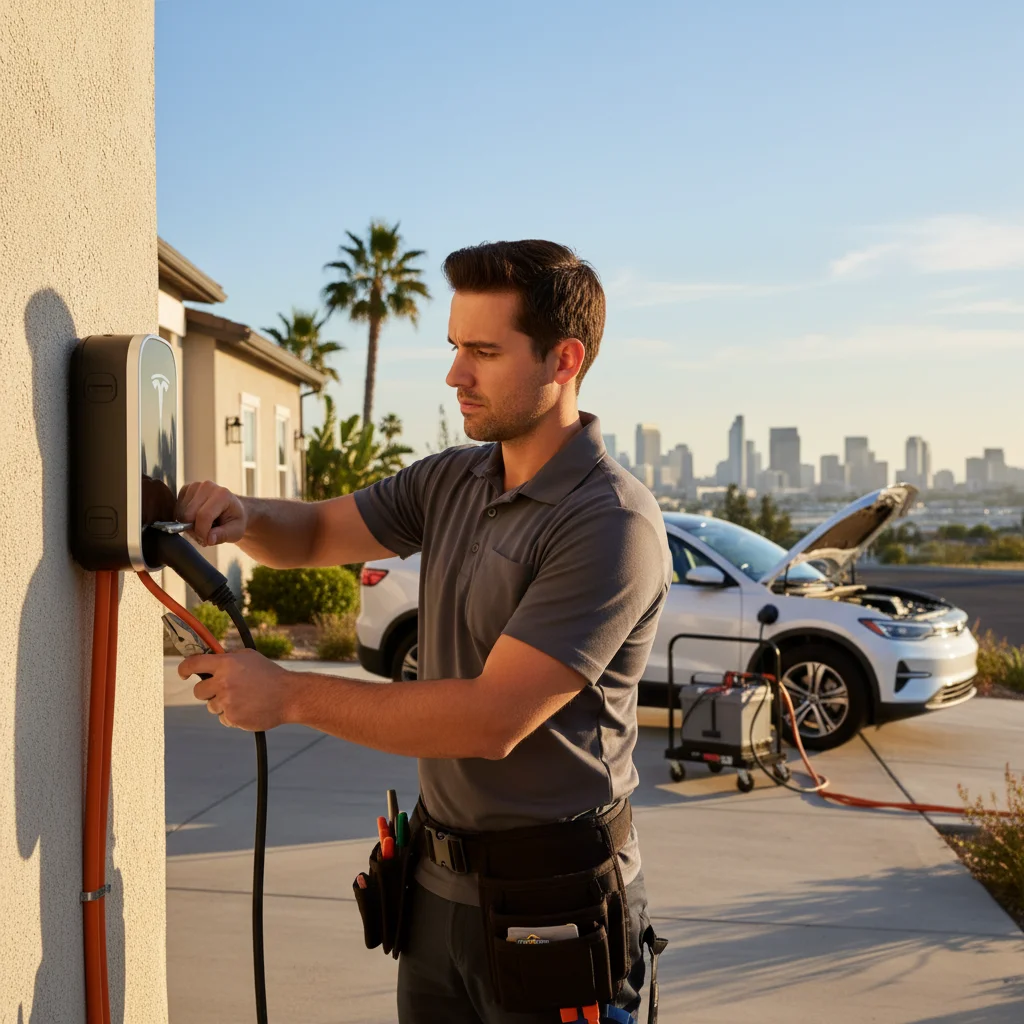
Heat is what kills the Prologue’s 12-volt
Phoenix averages about 21 days a year at or above 110F. July highs sit near 107F. August still runs near 105F. Overnight summer lows hang in the mid-80s, so the battery never really cools. Battery Council International studied heat as a failure mode. Battery University relays that work. Starter batteries last about 47 months in hot climates. Cool climates get about 59 months. A five-year battery elsewhere can fail in two or three in the desert. Your Prologue’s 12-volt lives in that same oven. The Ultium pack can still show a healthy charge.
The big pack can be full and the car still won’t wake
The Prologue’s traction battery stores the miles. The 12-volt runs the computers that close the high-voltage contactors. If that small battery is dead, those contactors never close. The car can’t start. It can’t charge. It often can’t unlock. A DC-DC converter only refills the 12-volt while the car is on. It also refills while you’re plugged in. Parked in a Mesa driveway through a 107F afternoon, that converter is asleep. Modules still draw a little power. Then the fob does nothing.
The Prologue shares GM’s Ultium layout with the Chevy Blazer EV. The Equinox EV and the Acura ZDX sit on it too. The ZDX is the mechanical twin. You’ve already got the twin’s writeup in why an Acura ZDX won’t start after a hot day. The same 12-volt logic applies here.
How to read a silent Prologue from the curb
Watch what still works before you assume the traction pack failed. Dim or dead screens point at the 12-volt first. Interior lights that barely glow tell the same story. A fob that used to work from the porch is fading. If it now needs to touch the door, that’s the 12-volt. After a two-week sit, start with the 12-volt. Treat a silent Prologue that way until something else proves out. If the charge-port door ignores you, the latches likely lost power. Locked handles tell the same story. Press the brake and listen. No relay click is another 12-volt tell. A faint dash that won’t go to Ready is usually borderline. A fully dark cabin is usually flat.
None of that proves the Ultium pack failed. It proves the wake-up circuit didn’t wake. For the lockout version of this failure, see what happens when an EV’s 12-volt dies in desert heat.
Parked Valley days that drain the small battery
The long version is a week at Phoenix Sky Harbor. Terminal 3 and Terminal 4 garages bake through those 100F days. So do the East Economy garages and the East Economy surface lot. Level 2 charging is confirmed in the Terminal 3 garage, the Terminal 4 garage, and at the 24th St. station. A car that sat without a session can still come back dark. So can a car that finished charging and then sat. The 12-volt may not close the contactors. The PHX Sky Train gets you to the terminals. It doesn’t keep the auxiliary battery alive.
East Valley driveways in Gilbert, Chandler, and Mesa do the shorter version. A family parks Friday, flies out, and returns Sunday to a car that won’t unlock. West Valley streets in Glendale, Arizona, Surprise, and Goodyear see the same no-start. It shows up after a long, hot Saturday. Tempe lots near the ASU campus add overnight sits with cabin electronics still drawing. A night at Chase Field or Mortgage Matchup Center can end the same way. You come back to a dark Honda in a hot garage.
If you plug in at home and the car is still dead at dawn, check two things. Check whether the charge session actually ran. Check whether the 12-volt has enough left to wake the car. APS markets EV Overnight Charging from 11pm to 5am weekdays on the R-EV plan. SRP still has an Electric Vehicle Price Plan for customers already on it. New SRP enrollments closed after a February 2025 board decision. Confirm your bill, not a map guess. A missed overnight session doesn’t always empty the Ultium pack. It can still leave the 12-volt too low to close the contactors.
Empty pack, heat range loss, and a charge that never starts
A bright dash and a Ready light mean the 12-volt woke. Range at or near zero is an empty traction pack. Recurrent’s Phoenix-area set, 345,622 trips across 300 local EVs, found range loss near 31% at 100F. AAA’s 2026 study found about a 10% efficiency drop at 95F versus 75F. Range loss in that study was about 8.5%. NREL notes cabin cooling as a major draw. That’s how an I-10 commute runs short in the heat. Loop 101 and the US-60 Superstition Freeway see the same heat tax. Northbound I-17 toward Anthem and Black Canyon City adds grade on top of heat. ADOT posts a 6% maximum grade on that northern climb. Don’t mix that empty-pack stall with a dark 12-volt at the curb.
If the screens are alive and charging refuses to start, think Ultium dropout. Try a different public stall if you can do it safely. Let the car sit in shade. Heat soaks charge hardware on 107F days. The same pattern shows up on a Chevy Equinox EV that won’t charge. A connector that will not unlatch after a session is a different job. Don’t yank it. Work through how to free a stuck EV charge cable.
Jump the labeled 12-volt posts, never the orange cables
The Prologue keeps its 12-volt under the hood. Labeled jump terminals sit there for this stall. You’re waking the small battery. You’re not jumping the Ultium pack. If the cabin is fully dead, the interior hood release may not fire. Check the owner’s manual for your model year before you force anything. Once the hood is up, use the labeled positive and negative points. A portable jump pack or a gas donor car is the source. Stay off the orange high-voltage cables. Don’t pull energy from another EV’s drive battery. When the dash comes back, leave the car awake a few minutes. That lets the DC-DC start supporting the 12-volt. Then decide if that battery needs replacement, not just another jump. Heat-aged 12-volts often fail again after a single boost. For the full desert walkthrough, use how to jump start an electric car in desert heat.
What state trucks will do, and what they won’t
Arizona DPS Roadside Motorist Assistance will jump a conventional 12-volt. It can add gasoline or diesel, change a tire, and call a tow. Published materials name gasoline and diesel. They say nothing about charging an EV. ADOT’s Incident Response Unit works Phoenix-area freeways from 5am to 8pm weekdays. It clears debris, changes tires, and helps stranded motorists. It also doesn’t advertise bringing an EV a charge. They are not a Level 2 truck for a Prologue.
ARS 28-871 says you stay off the traveled lanes when you can. A vehicle disabled so badly it can’t move is exempt. Leave room for traffic. Stay visible 200 feet in each direction. Arizona’s Move Over law is ARS 28-775. Other drivers must change lanes or slow for a stopped vehicle with warning lights. That’s for the operator working your Honda, and for you standing next to it.
What an operator does for a Honda Prologue on site
Charge Pro PHX is a referral line for the Phoenix area. It matches you with an independent local operator. It doesn’t own trucks, employ technicians, or set prices. The pros we connect you with are licensed and insured. The operator quotes you before starting and bills you directly.
For a dark Prologue, they test and jump the 12-volt on the pavement. If that battery is finished, they can replace it on site. For an empty Ultium pack, out-of-charge recovery is the charge-at-the-car option. A non-Tesla EV rescue brings a 240V Level 2 source. CCS or J1772 adapters cover the Prologue’s port. Typical on-site charging adds 10 to 20 miles in 15 to 30 minutes of charging time. That’s plug time, not a promise of when someone arrives.
Factory programs for many brands still prefer a tow to a charger. The Prologue job is still a CCS or J1772 call.
Call (602) 932-0920 and tell the matcher what the dash is doing. The operator quotes the work before it starts.
Frequently asked questions
Why won’t my Honda Prologue start if the main battery is charged?
The Ultium pack doesn’t close its own contactors. The 12-volt runs the modules that wake the high-voltage system. Heat is the top killer of that small battery, per AAA. Valley summers run 100F for about 111 days. A jump or an on-site replacement restores the wake-up path. The traction pack can still be nearly full the whole time.
Can you jump a Honda Prologue the way you jump a gas car?
You jump the 12-volt terminals under the hood, not the orange high-voltage cables. A portable pack or a gas donor car is the right source. Another EV’s drive battery is the wrong one. If the hood release is dead, use the manual’s emergency steps for your year. Heat-aged batteries often need replacement, not another jump tomorrow.
Is a Honda Prologue the same car as an Acura ZDX?
The ZDX is the Prologue’s mechanical twin on GM’s Ultium platform. The Blazer EV and Equinox EV share that architecture too. Same 12-volt dependency, same no-start pattern after a hot sit. A fix that wakes one of those cars is the fix that usually wakes the Prologue.