The cable that won’t leave your EV after a Phoenix charge is often heat. Plastic around the latch swells on a 100F afternoon. The solenoid that should let go never gets a clean pull. End the session on the screen, then use the manual release in your owner’s manual. If that fails, an independent operator can free an EV charger stuck in the car without a tow.
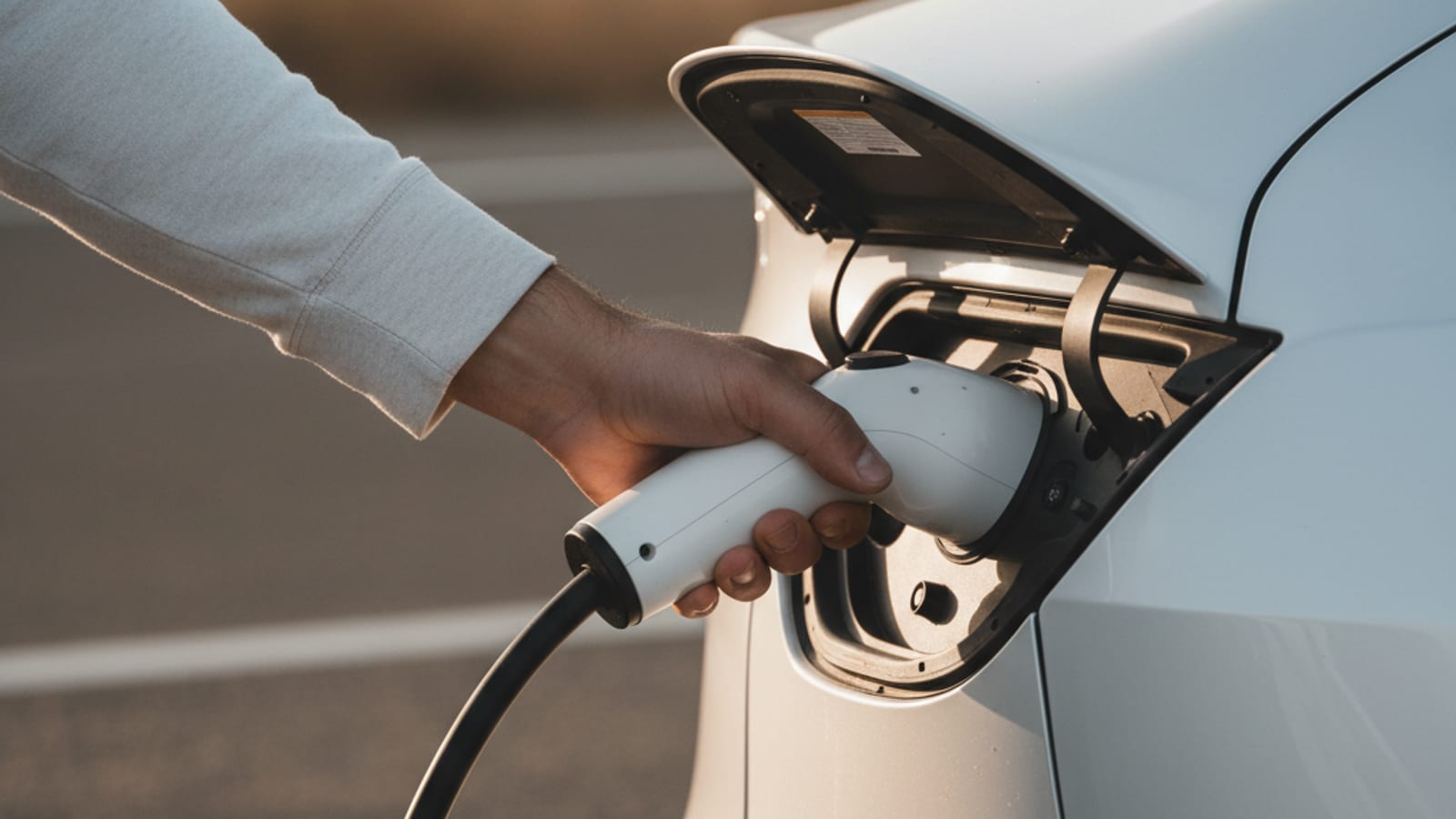
Charge Pro PHX is a referral line for the Phoenix area. We match stranded EV drivers with independent mobile rescue operators. We don’t own trucks or employ technicians. We don’t set prices, and we don’t publish hours. The operator quotes you before starting, and you pay that operator directly.
Heat is what binds a Valley charge port
Phoenix averages about 111 days a year at or above 100F. July highs sit near 107F, and August sits near 105F. Overnight summer lows hang in the mid-80s, so the port never really cools. That soak expands the port housing and the connector’s locking lip. A solenoid that works in January can stall in July.
Newer East Valley homes charge overnight more often. Gilbert housing is only about 4.1% built before 1980, so the stuck handle there is often the wall unit at dawn. Sun City housing is about 88.9% built before 1980. Cars there sit in heat all afternoon, then someone plugs in after dinner.
Garages and event lots cook the same latch
Level 2 charging is confirmed at Phoenix Sky Harbor. Look in the Terminal 3 garage on Level 1 west, Level 3, and Level 7. Terminal 4 has it on Level 4 east, zone B. Chase Field and Mortgage Matchup Center, renamed in October 2025, cook cars through ballgames and Suns nights. State Farm Stadium in Glendale, Arizona, does the same after Cardinals games.
The lock needs 12-volt power, not muscle
EVs lock the connector while current is flowing. That keeps a live handle from getting yanked. It also keeps someone from stealing your home session. A small solenoid inside the port pulls the latch clear when the car says you’re done. That solenoid runs on the 12-volt system. The traction pack can still show miles. If the small battery is weak, the release command goes nowhere.
Battery Council International work, via Battery University, tracked starter-battery life in heat. Those batteries last about 47 months in hot climates, versus about 59 in cool ones. AAA names heat as the number-one cause of battery failure. Tesla features like Sentry Mode and Cabin Overheat Protection draw power while parked. When Tesla 12-volt batteries fail in desert heat covers that failure.
A glitched session is the other common trap. The stall stopped delivering power, but the car never marked the session ended. Tap Stop Charging on the screen, wait for confirmation, then try the handle. For many Teslas, hold both steering-wheel scroll wheels for about 10 seconds. For other brands, use the power-button restart in your year’s manual. Wake the car by opening and closing the driver’s door if it looks asleep. If the cabin is dark and the fob is quiet, treat it as a 12-volt job first. Independent operators in the network can jump or replace a dead 12-volt on site.
Sometimes the cable itself is the problem. The button on an older Tesla Mobile Connector, or on a tired public handle, no longer moves the internal latch. Try a different cable if you can still roll. Don’t pry with a screwdriver or twist the handle like a wrench.
Manual release, by where the maker hid it
Every major EV has a mechanical backup because makers know solenoids fail. Confirm the panel in your owner’s manual before you pull trim.
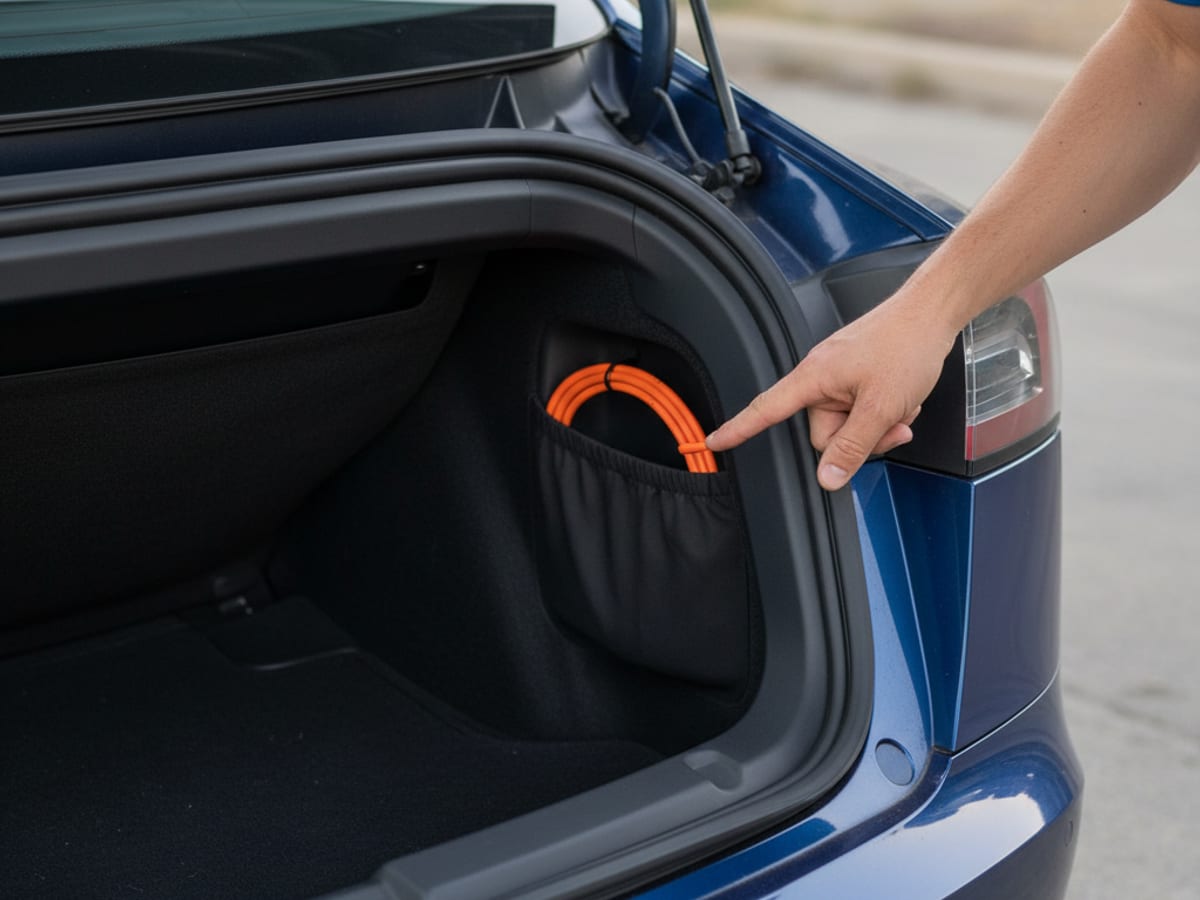
Tesla access is in the trunk or hatch
On Model 3 and Model Y, open the trunk. On the passenger side, peel back the carpeted inner trim and remove the small access panel. Behind it you’ll find a plastic tab on a cable. Pull that cable downward and hold it. Slide the charge handle out while you keep tension. On Model S and Model X, open the rear hatch. Older cars hide the cable on the driver’s side near the taillight, behind carpeted trim. On 2021 and newer refresh S and X, look in the passenger-side trunk trim.
Ford hid a tab on the port itself
Open the charge-port door on an F-150 Lightning or Mustang Mach-E. Near the edge of the housing is a small triangular pull tab with an unlock icon. Pull the tab away from the port while you pull the cable. Ford Mustang Mach-E charge port stuck in the heat is the Mach-E walkthrough.
Cargo, sidewall, and under-seat releases
Hyundai Ioniq 5, Kia EV6, and Kia EV9 put a button in the rear cargo area, under a plastic cover on the driver’s side sidewall. Press and hold that button while you pull the cable. Hyundai Ioniq 5 charge port stuck after a hot Valley charge covers the Ioniq 5 case. The Chevrolet Bolt’s release cord sits under the rear cargo floor, near the 12-volt area. Polestar 2 hides a cord in the trunk near the driver’s-side tailgate hinge. Volkswagen ID.4 uses a labeled pull loop in the trunk, behind passenger-side C-pillar trim. Rivian R1T and R1S keep the release inside the cabin, under the rear seat on the passenger side. Rivian charge port stuck in the heat is the R1T and R1S version.
If the cable still won’t move
Confirm the car is awake, then hold the manual release again. Rock the connector slightly as you pull. A small side-to-side wiggle can slip the latch off the locking lip. If the release moved freely and the handle still won’t budge, stop. Brute force turns a stuck latch into a broken port. Leave the cable in place and match an operator instead of tearing trim.
A freeway shoulder has rules a driveway doesn’t
ARS 28-871 says get off the traveled highway when you can. That applies outside a business or residence district. A vehicle disabled so badly it can’t be moved is exempt. Leave room for traffic to pass, and stay visible 200 feet each way with hazards on. ARS 28-775 is Arizona’s Move Over law. Other drivers should change lanes or slow down around your lights.
Loop 101 is Agua Fria on the west, Pima on the northeast, and Price on the southeast. US-60 is Grand Avenue going northwest and the Superstition Freeway going east. Arizona has no toll roads. Haboobs drop visibility to near zero in monsoon season, so don’t stand in a live lane to fight a plug.
Arizona DPS Roadside Motorist Assistance will change a tire. It’ll bring gasoline or diesel, and it’ll jump-start a dead battery. Its published materials name gasoline and diesel. They say nothing about charging an EV. ADOT’s Incident Response Unit covers Phoenix-area freeways from 5am to 8pm weekdays. Neither program advertises unplugging an EV.
A tow moves the car. It doesn’t unlatch the port
A hook is right after a crash. It’s right if you can’t reach the manual release and the 12-volt won’t wake. It’s a weak first call for a swollen latch in a working stall. Tesla roadside won’t charge you on site. It tows to the nearest Supercharger or service center. Ford tows to the nearest charger, home, or dealer within 50 miles.
The operators we connect you with bring a 240-volt Level 2 source. Teslas take a native NACS plug. Other EVs take a CCS or J1772 adapter. That boost typically adds 10 to 20 miles of range in 15 to 30 minutes of charging. That’s charging time, never an arrival time. They can also jump or replace a dead 12-volt on site, which is often what lets the solenoid fire. Tesla roadside rescue is the matching path for Tesla ports. Non-Tesla EV rescue is the path for CCS and J1772 cars. The pros we connect you with are licensed and insured.
After the handle comes free
Run a complete charge session once you can plug in again. If it finishes and releases cleanly, you were probably looking at heat bind or a glitched session. If the lock fails again, take it to the dealer. If you needed a 12-volt jump to free the cable, plan a replacement. That small battery is on its way out in this climate.
Charge Pro PHX matches you with an independent local operator. Call (602) 932-0920. Describe the car, the stall, and whether the cabin is dark. The operator quotes the job before they start.