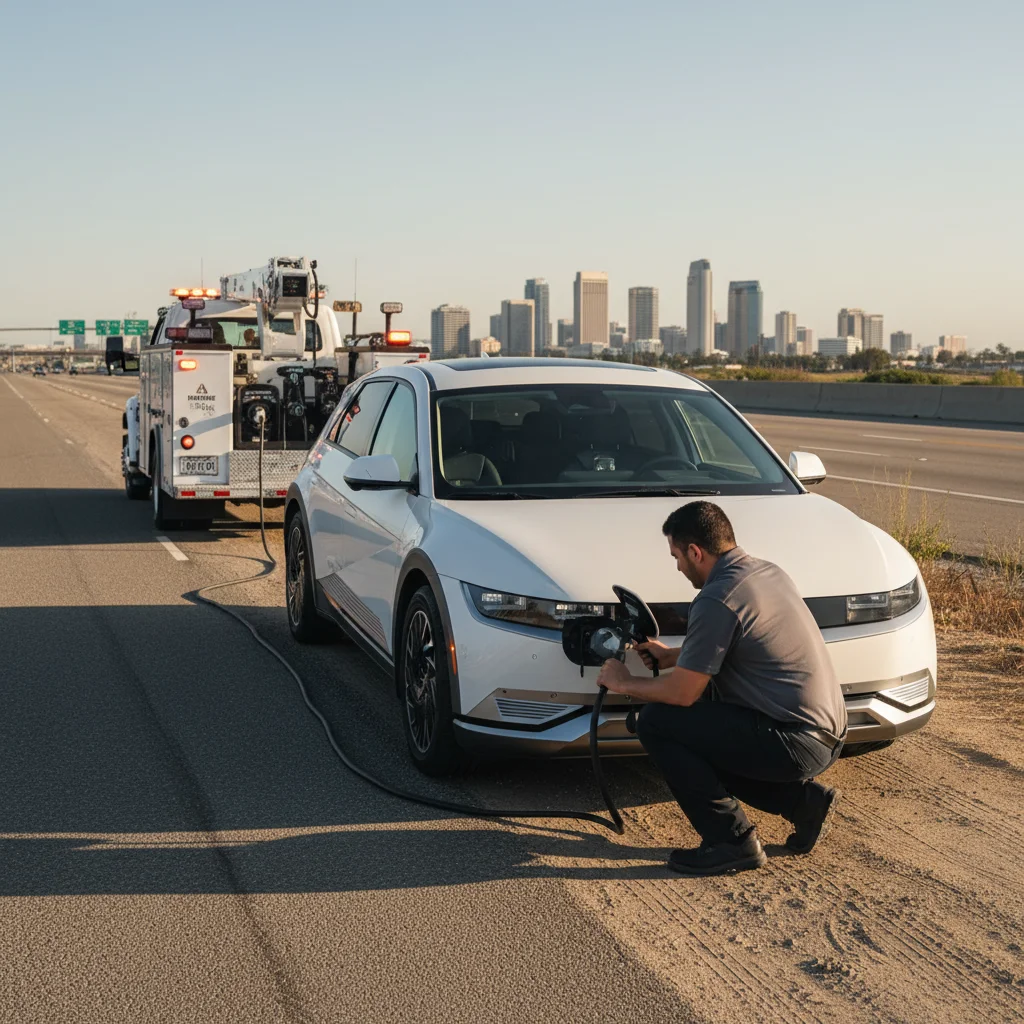
Your EV just died on SR-347 heading into Maricopa. You need EV roadside assistance at the bumper, in Pinal County. Charge Pro PHX matches stranded drivers with independent mobile operators. It’s a referral line, not a shop with trucks. Those operators bring a 240-volt Level 2 source. They can also jump a dead 12-volt on site. They quote you before any work starts. They bill you directly.
Maricopa the city is not Maricopa County
Dispatch mix-ups start with the name. Maricopa County is the Phoenix metro. Maricopa the city sits in Pinal County. It’s a fast-growing place on about 42.5 square miles. The Census ACS 2020-2024 5-year count is 67,163 people. ZIP codes are 85138, 85139, and 85172. About 28.8 percent of residents are Hispanic or Latino.
Only 1.9 percent of housing here was built before 1980. That’s new-suburb stock, so home charging is common in this belt. Electrical District No. 3 serves the city and much of northern Pinal. ED3 publishes an EV time-of-use rate named EV TOU 2-10. It also offers EV smart-charger on-bill financing. Confirm current terms with ED3 before you enroll. Those programs live at the house. They don’t roll a truck onto SR-347. See the Maricopa charging page for the town overview.
Ak-Chin land sits south of town. It’s a sovereign tribal nation. It has its own government and police. It isn’t a Phoenix suburb. If you stall on that side, say so when you call. Don’t assume a Valley pin will land in the right place.
Nearby names on the Pinal belt include San Tan Valley and Casa Grande. Apache Junction and Gold Canyon sit farther east. Chandler sits at the north end of the 347 run. Name the city you’re actually in.
Heat turns a thin buffer into a stall
SR-347 is how most people reach this city. It’s a two-lane road north toward I-10 and Chandler. SR-238 and the Maricopa-Casa Grande Highway also feed in. The Pinal Belt is long-haul dispatch. Ask the operator about timing when they quote. Don’t treat this like a short Tempe hop.
Phoenix heat is the other load. NOAA 1991-2020 normals, via NWS Phoenix, set the pace. The metro sees about 111 days a year at or above 100F. About 21 days hit 110F or more. July highs average near 107F. August highs average near 105F. Overnight summer lows sit in the mid-80s.
Recurrent reported range loss of 20 to 30 percent above about 95F. Loss was near 31 percent at 100F. That dataset included 345,622 trips by 300 Phoenix-area EVs. AAA’s 2026 study found about a 10 percent efficiency drop at 95F versus 75F. Range loss in that study was about 8.5 percent. NREL notes cabin cooling is among the biggest draws. Don’t treat the nav’s remaining miles as a promise. A hot hour on the 347 can spend them faster.
A car that left Rancho El Dorado a little low can run out of margin. The same is true coming home from Chandler with the AC on. You don’t need a dramatic failure. You need heat, climate control, and a two-lane stretch.
ADOT’s National Electric Vehicle Infrastructure plan includes parts of SR-347 among designated corridors. Construction is underway in 2026. Check a live app for stalls that are actually open. PlugShare is one place to look. Confirm what the app shows before you commit the last bar. If you’re already empty on that highway, read Ran out of charge on SR-347 toward Maricopa: what to do.
Subdivisions, parked cars, and the 12-volt
Stranding here isn’t only the highway. Named neighborhoods include Rancho El Dorado, Province, and Cobblestone Farms. Glennwilde, Senita, and The Lakes at Rancho El Dorado are in the same pattern. A car that sits in a driveway all day can refuse to wake. The traction pack may still be full. The small 12-volt is what runs handles, screens, and the contactor. If that battery is dead, the car is a brick.
Battery Council International failure-mode work, via Battery University, found a clear climate split. Starter batteries last about 47 months in hot climates. Cool climates saw about 59 months. AAA calls heat the number-one cause of battery failure. It recommends AGM batteries for hot areas. A DC-DC converter recharges the 12-volt while the car is on or charging. Tesla Sentry Mode and Cabin Overheat Protection draw power while parked.
If the dash is dark, start with the 12-volt. The operators in this network can jump or replace that battery on site. They handle Tesla and every major EV brand. They bring a native NACS plug. CCS or J1772 adapters cover non-Tesla cars.
What Arizona motorist help will actually do
Arizona does run free motorist help. Two programs cover the Phoenix metro. Neither one advertises an EV charge.
Arizona DPS Roadside Motorist Assistance is statewide. It was originally funded by the Maricopa Association of Governments. It changes tires and brings gasoline or diesel. It jump-starts dead batteries, adds water, and calls tows. In 2018 it assisted 75,235 motorists statewide. Its published pages name gasoline and diesel. They don’t mention charging an empty EV pack. Hours and specific corridors aren’t published. Check azdps.gov for what it currently covers.
ADOT’s Incident Response Unit works Phoenix-area freeways. Hours are 5am to 8pm weekdays. It clears crashes and debris, changes tires, and helps stranded motorists. It also doesn’t advertise bringing an EV a charge.
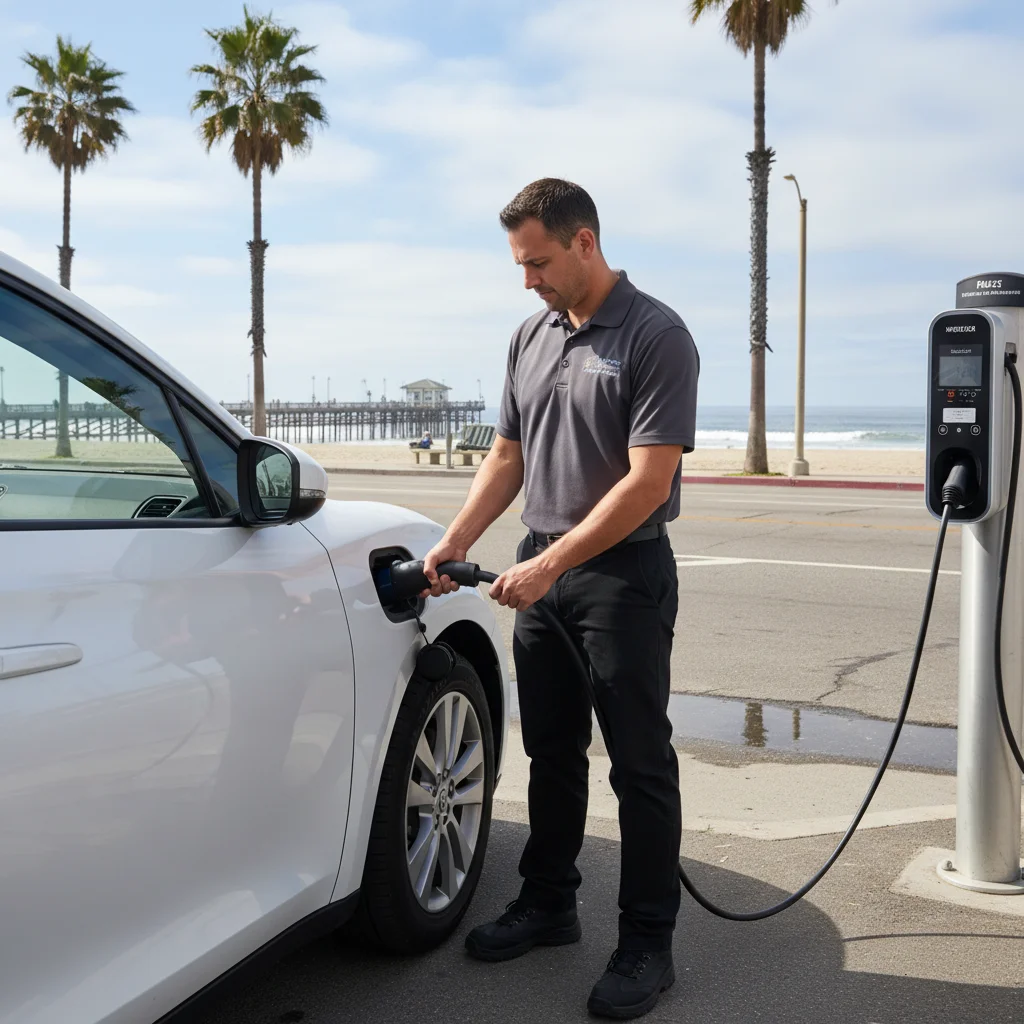
If your tire is flat, those programs may be the right call. If the pack is empty, you need a different kind of help. An independent mobile operator can bring Level 2 power to the car. Factory Tesla roadside, as Tesla describes it, tows to a Supercharger or a service center. It doesn’t charge you on the shoulder.
If you’re stopped, ARS 28-871 still applies. Don’t stop on the traveled lanes if you can get off them. That rule applies outside a business or residence district. A vehicle disabled so badly it can’t be moved is exempt. Leave room for other traffic to pass. Be visible 200 feet in each direction. ARS 28-775 is the Move Over law. Other drivers must move over a lane if they safely can. If they can’t, they slow down. That’s why an operator working a shoulder needs space.
Arizona has no toll roads and no toll express lanes. ADOT confirms that. Texts about unpaid Arizona tolls are scams. They aren’t why you’re stuck.
Charge the car where it sits, or tow it
A tow still belongs in some calls. If the car is wrecked, tow it. If it won’t accept a charge, tow it. Police can order a disabled vehicle removed under ARS 28-872. Owners pay reasonable tow and storage costs before release. Arizona sets no statewide tow-rate cap. Cities and counties may set local maximums. Confirm the quote before anyone hooks up.
Mobile EV charging brings 240-volt Level 2 power to you. Typical charging time is 15 to 30 minutes. That’s charging time, never an arrival time. It typically adds 10 to 20 miles of range. That’s usually enough to reach a public stall you pick. Confirm the stall is open first. You stay with the vehicle. The operator quotes you first.
Charge Pro PHX doesn’t own trucks. It doesn’t employ technicians. It doesn’t set prices. It holds no license. It performs no work. The match is the product.
If you’re south toward I-10, read Stranded in Casa Grande: mobile EV help on the I-10 south run. Tesla owners comparing factory help to a local charge can see Tesla rescue in Phoenix: AAA or a mobile charge.
What to say when you call
Say you’re in the city of Maricopa, Pinal County. Name SR-347, SR-238, or the Maricopa-Casa Grande Highway. If you’re in a driveway, name the subdivision. Glennwilde isn’t the same pin as a shoulder north of town. This is long-haul dispatch. Ask about timing. Ask which plug they’ll use. Ask whether they can jump a 12-volt if the car won’t wake.
Then wait for the quote. If it isn’t right, you can decline. Nothing starts until you agree.
Call when the car won’t move in Maricopa or on the SR-347 approach. Call when the pack is empty. Call when the 12-volt cooked in the driveway. Get off the traveled way if you can. Put on hazards and give other drivers room. Don’t sit in a live lane.
If you’re still rolling and the range looks thin, change the plan now. Read EV running low in Phoenix heat: what to do before you’re stranded. Then pick a safe lot.
Charge Pro PHX matches stranded EV drivers with independent local operators. That coverage includes Maricopa and the rest of the Phoenix area. The number to call is (602) 932-0920. An operator quotes you before work starts. Nobody here promises an arrival clock.