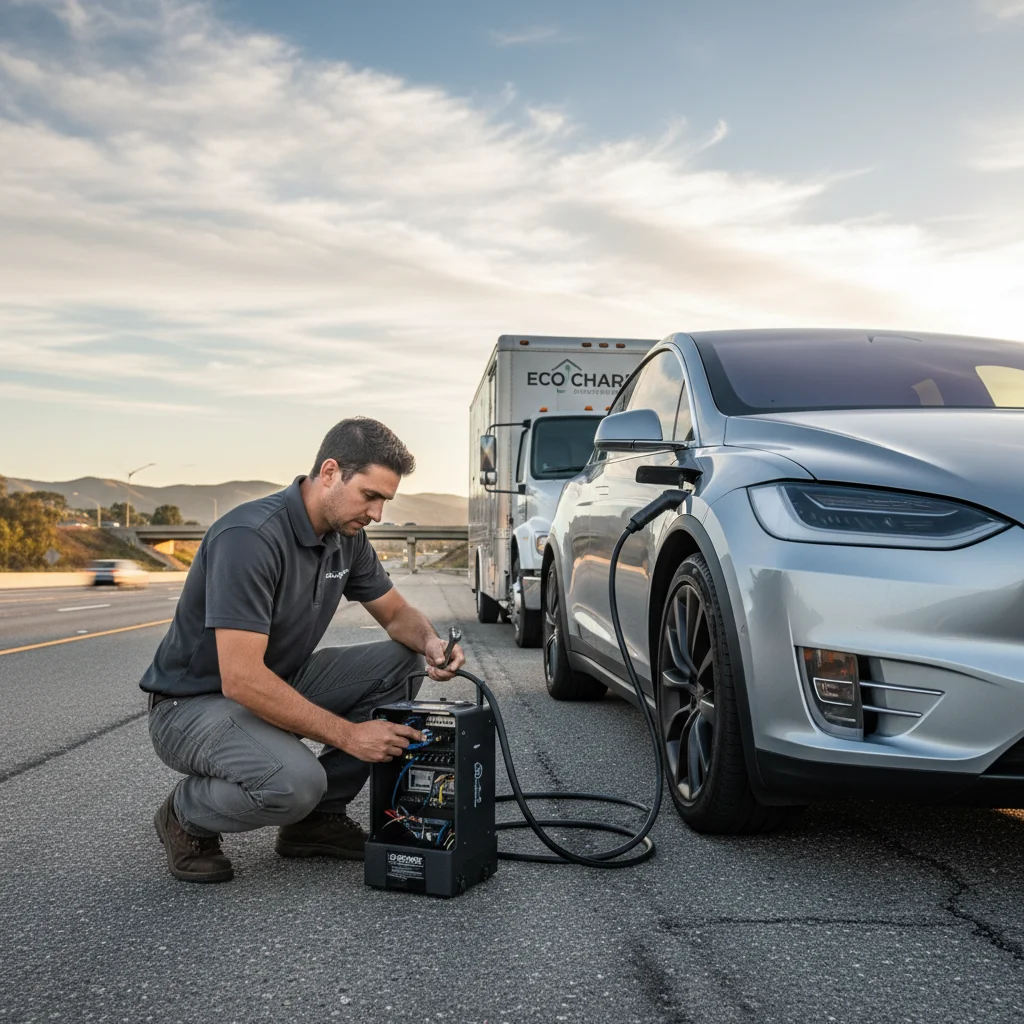
The remaining miles drop hard on I-10 through Casa Grande. This Pinal County city sits at the midpoint of the Phoenix to Tucson run. It sits on a long, exposed desert corridor. Recurrent’s Phoenix-area set puts range loss at 20 to 30 percent above about 95F. A haboob can pin you on the shoulder with the climate running. An empty pack or a car that won’t wake is a roadside job. EV roadside assistance in Casa Grande is an operator at the car. Charge Pro PHX matches you with that independent pro. It doesn’t do the work.
Casa Grande sits on the Pinal belt, not in the Valley core
Casa Grande is in Pinal County. Don’t mix it up with Maricopa County. The Census Gazetteer puts the city at about 113.8 square miles. A stall near Downtown Casa Grande is a different pin. So is a stall out toward Arizona City. About 60,905 people live here, per ACS 2020-2024. About 21 percent of housing was built before 1980. Many residents charge at home. The stranded calls are the interstate and the heat.
Electrical District No. 2, ED2, serves Casa Grande, Coolidge, and Florence. No EV-specific rate plan turned up on the district’s site. If you plug in at home, confirm your rate with ED2. APS and SRP programs don’t automatically apply on this side of the belt.
I-10 near Casa Grande sits at about 1,380 feet. This isn’t the I-17 grade toward Black Canyon City. Range fades here from heat, air conditioning, and open interstate miles.
Heat on the Phoenix to Tucson run
NOAA normals for this desert show about 111 days a year at or above 100F. About 21 days hit 110F or more. July highs average near 107F. Summer nights often stay in the mid-80s. A parked battery doesn’t get a cool reset.
AAA’s 2026 study found about an 8.5 percent range loss at 95F versus 75F. Recurrent used 345,622 trips from 300 Phoenix-area EVs. It reports 20 to 30 percent loss above about 95F. Loss was near 31 percent at 100F. NREL flags cabin cooling as one of the large loads. On I-10 south, you keep the cabin cold.
Drivers leave the East Valley with a number that looked safe. The estimate keeps sliding past San Tan Valley and the Maricopa stretch. By Casa Grande, the buffer is gone. Northbound traffic from Tucson hits the same midpoint. That’s why this city sees long-haul empty-pack calls from both directions. For the wider I-10 problem, read out of charge on I-10 in the heat.
ADOT’s NEVI plan lists I-10 as a designated charging corridor. Build-out is underway in 2026. Treat live stall status in your charging app as the check you run that day.
Dust walls and monsoon pull-asides
Monsoon season is June 15 to September 30. Haboobs can drop visibility to near zero. Pulling off and waiting is the sane choice. Sitting there with cooling on still spends charge.
After a storm, don’t drive into water. ARS 28-910 is the flooded-barricade rule. Drive around a barricade into water and you can be billed for the response. If the road is covered, wait it out.
Lots, visits, and neighborhoods off the freeway
Interstate shoulders get the headlines. Parked cars fail too. The Promenade at Casa Grande is a long summer errand. Banner Casa Grande Medical Center can run past your plan. Casa Grande Ruins National Monument is a highway side trip. Mission Royale, Ghost Ranch, Villago, and Downtown Casa Grande see another pattern. Driveway cars sit too long, then they won’t wake.
Arizona City sits nearby. So do Maricopa and San Tan Valley. I-8 west toward Gila Bend is the other long desert highway. Elevation toward Gila Bend drops to about 700 feet. It’s still hot. If that’s your road, see stranded on I-8 toward Gila Bend.
Get off the traveled lane if you can
ARS 28-871 covers highway stops outside a business or residence district. Don’t stop on the traveled part if you can get off it. A vehicle disabled so badly it can’t move is exempt. Leave room for others to pass. Stay visible 200 feet in each direction.
Move Over is ARS 28-775. If you’re passing, move over a lane when you can. Do it only if it’s safe. If you can’t, slow down. Operators working a shoulder depend on that space.
Arizona has no toll roads and no toll express lanes, per ADOT. A text about an unpaid Arizona toll is a scam.
What DPS and ADOT won’t bring you
Arizona DPS Roadside Motorist Assistance is statewide. Crews change tires, bring gasoline or diesel, jump-start batteries, add water, and call tows. Their published materials name gasoline and diesel. They don’t mention charging an out-of-charge EV.
ADOT’s Incident Response Unit works Phoenix-area freeways. Hours are 5 a.m. to 8 p.m. weekdays. It clears crashes and debris, changes tires, and helps stranded motorists. It also doesn’t advertise EV charging. A Casa Grande I-10 shoulder may sit outside that Phoenix-area beat. ADOT’s pages don’t confirm the unit’s reach here. Don’t plan on a state truck filling a traction pack.
If you’re empty, you need out-of-charge recovery. That’s a mobile 240-volt source at the car.
Empty pack versus a cooked 12-volt
From the shoulder, both failures look alike. Screens stay dark.
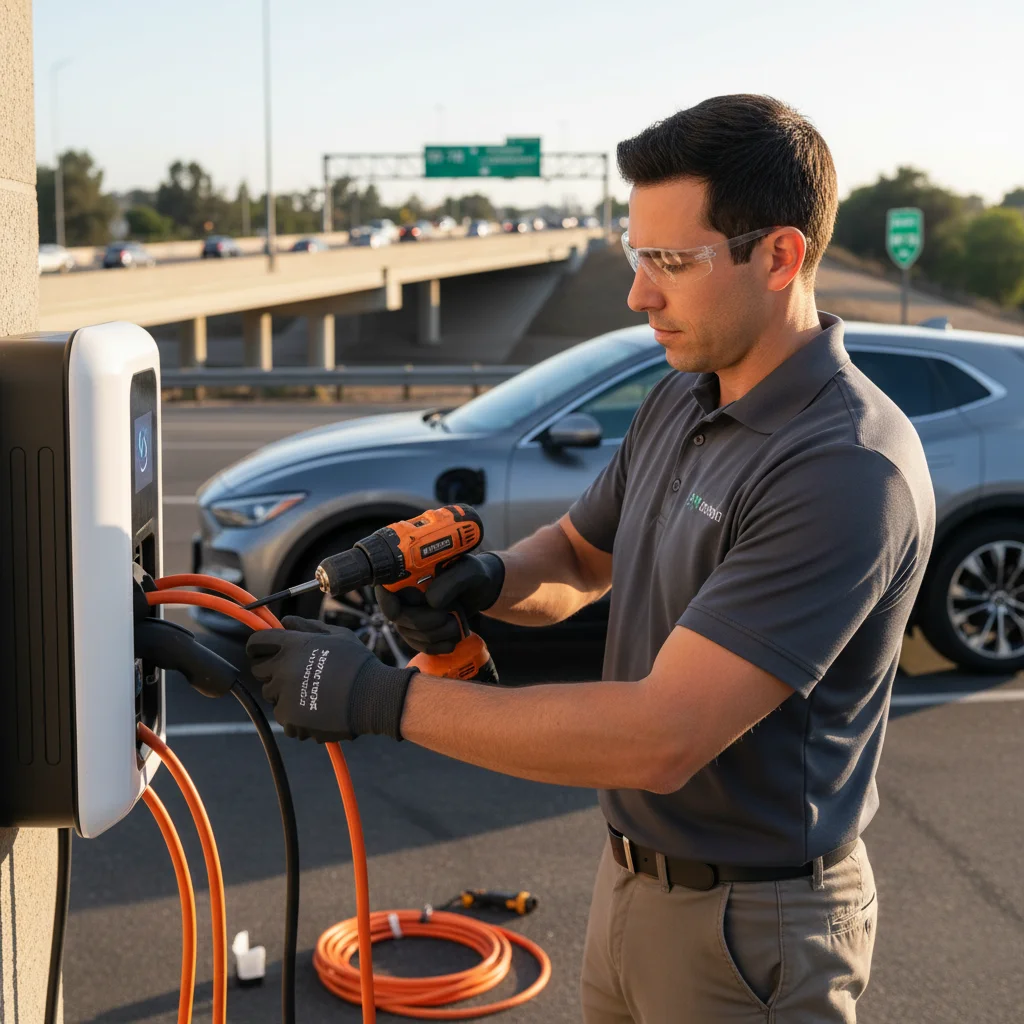
An empty traction pack needs energy at the port. Operators in this network bring a 240-volt Level 2 source. Tesla and other NACS cars use a native NACS plug. CCS or J1772 adapters cover non-Tesla EVs. A typical stop adds about 10 to 20 miles of range. Charging takes 15 to 30 minutes. That window is plug time. It isn’t an arrival time. The operator quotes you before starting. The operator bills you directly.
A dead 12-volt is another job. Heat wrecks that small battery. Battery Council International work, via Battery University, tracked starter-battery life. Hot climates saw about 47 months. Cool climates saw about 59. AAA calls heat the number-one cause of battery failure. In an EV, the 12-volt runs handles and screens. It also runs the contactor that connects the main pack. A full traction battery won’t move you if that small battery is dead. A DC-DC converter recharges it only while the car is on or charging. Tesla features such as Sentry Mode and Cabin Overheat Protection draw power while parked.
If the car won’t unlock, say so on the call. You may need a jump or a 12-volt replacement on site.
Tesla roadside, for an empty pack, tows to a Supercharger or service center. Tesla doesn’t charge on site. Ford’s published help is a tow to a charger, home, or dealer. If you want the car charged where it sits, call a local mobile operator.
When a charge is enough, and when it isn’t
The pack is only empty. A mobile Level 2 stop can get you rolling. You finish charging at a place you choose. You don’t need a flatbed for that.
Choose a tow when something else is broken. A charge port that won’t release. A drivetrain fault. A 12-volt that dies again after a jump. Arizona sets no statewide cap on private-property tow rates. Cities and counties may set local maximums. Confirm the tower’s price before the hook goes on. Under ARS 28-872, police may order a disabled vehicle removed. Owners pay reasonable tow and storage costs before release.
For that choice in plain terms, read when you need a charge, not a tow.
How a Casa Grande call actually works
Charge Pro PHX is a referral line for the Phoenix area. It matches stranded EV drivers with independent local mobile rescue operators. It holds no trade license. It owns no trucks. It employs no technicians. It sets no prices and publishes no arrival window. The pro who shows up quotes you, then bills you.
Give a pin a stranger can use. On I-10, say northbound or southbound. Add the nearest mile marker or exit. Say whether you’re on the shoulder or already in a lot. Downtown, the Promenade, and Banner Casa Grande are easy to name. A Ghost Ranch or Mission Royale driveway needs a street. Don’t give only the subdivision.
If dust is still moving, say that too. Wind and visibility change how an operator stages behind you.
Before a Phoenix to Tucson run, check a charging app. If that plan fails, mobile EV charging is the backup.
When the pack is at zero, call (602) 932-0920. Same if the 12-volt cooked in a Casa Grande driveway. You’ll be matched with an operator. They can quote an on-site charge or a 12-volt jump. That quote comes before any work begins.