Westbound I-8 toward Gila Bend is a drop, not a climb. You’re headed for about 700 feet on open desert pavement. The town sits at I-8 and SR-85. The Barry M. Goldwater Air Force Range is nearby. If the pack hits empty here, the car stays put. You need energy brought to the shoulder. Charge Pro PHX is a referral line. It matches stranded EV drivers with independent local operators. Those operators quote you before they start, then bill you directly.
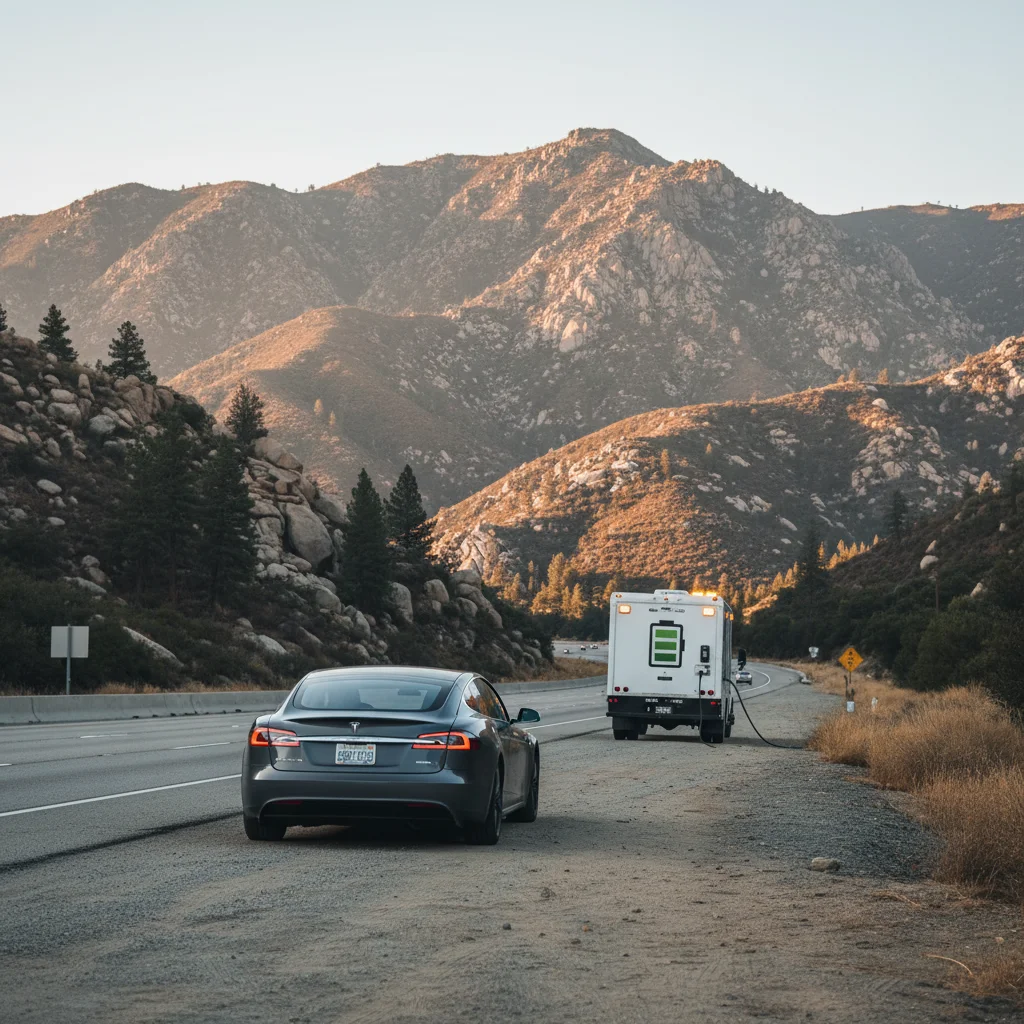
A small town on the emptiest highway this line covers
Gila Bend has 1,363 residents. The land area is about 64.4 square miles. Those figures come from the Census Bureau. Through-drivers know the Space Age Lodge. Locals treat SR-85 as the road north to I-10 at Buckeye. I-10 south at Casa Grande sits near 1,380 feet. I-8 west from that junction drops toward Gila Bend at about 700. You’re descending, not grinding up a posted mountain grade. Regenerative braking can return some energy on the drop. It doesn’t cancel desert heat.
This is a long-haul dispatch. Charge Pro PHX still serves the town. The operator who takes the job should be straight about the drive. Ask about timing when you call. Nobody on this line publishes an arrival clock, and we won’t invent one.
Wickenburg and Circle City are the other long-haul desert corners on this line.
Heat does the damage a climb would do elsewhere
Phoenix averages about 111 days a year at or above 100F. About 21 days hit 110F or more. Those are NOAA normals through NWS Phoenix. July highs average near 107F. Gila Bend runs some of the most extreme heat in the state. The highways out here are exposed.
Summer range loss of 20 to 30 percent hits hard here. It’s at its worst on this corner. Recurrent looked at 345,622 trips from 300 Phoenix-area EVs. That work found a 20 to 30 percent range loss above about 95F. Loss sat near 31 percent at 100F. AAA’s 2026 study is milder in a lab setting. It found about a 10 percent efficiency drop at 95F versus 75F. Range loss in that study sat near 8.5 percent. Your dash estimate was built on recent miles. It isn’t a promise for this air.
What the dash won’t tell you
Cabin cooling pulls from the high-voltage pack. Battery thermal gear does too. NREL flags climate-control loads as a real range cut. On I-8 west, you’re not climbing ADOT’s 6 percent I-17 grade. You’re spending the pack on heat, and that’s the local difference.
If this trip started on a hot Valley day, leave extra buffer. Watch watt-hours per mile. Don’t stare at miles-to-empty.
The 12-volt can fake an empty pack
A dark screen isn’t always a dead traction battery. The small 12-volt runs door handles and screens. It also runs the contactor that connects the main pack. If that battery is cooked, the car won’t wake. That can happen with a full high-voltage pack.
Heat is the number-one cause of 12-volt failure, per AAA. Battery University cites Battery Council International on this. Starter batteries last about 47 months in hot climates. Cool climates sat near 59 months. Five-year batteries elsewhere can fail in two or three years here. Tesla features like Sentry Mode draw power while parked. Cabin Overheat Protection does too. If you stopped at the Lodge and the car is silent, tell the operator. The pros we connect you with are licensed and insured. They can jump or replace a 12-volt on site. They handle Tesla and every major EV brand.
Get off the travel lanes, then stay visible
Arizona law is specific once you’re stopped. ARS 28-871 covers stopping on a highway outside a business or residence district. You may not sit on the traveled part if you can get off it. A vehicle disabled so badly it can’t be moved is exempt. When you’re stopped, leave room for other traffic to pass. You also need to be visible 200 feet in each direction. Keep your hazards on, and get the wheels off the travel lanes if you can.
ARS 28-775 is the Move Over law. Drivers who see warning lights should change lanes if they can do it safely. Otherwise they slow down. That’s for your operator as much as for you.
Arizona DPS Roadside Motorist Assistance is statewide. Crews change tires and bring gasoline or diesel. They jump-start 12-volt batteries, add water, and call tows. Published materials name gasoline and diesel. They say nothing about charging an EV that’s out of pack. ADOT’s Incident Response Unit works Phoenix-area freeways from 5am to 8pm on weekdays. It clears crashes and debris. It changes tires and helps stranded motorists. It also doesn’t advertise an EV charge. Confirm whether your mile marker is even on that freeway program. This I-8 run sits southwest of the core Valley loops. It sits well off Loop 101 and the I-10 stacks.
Those programs do real work. They aren’t a mobile Level 2 source.

What the operator brings to the shoulder
Charge Pro PHX doesn’t own trucks or send employees. Independent operators do the work. The matching call is how you reach them.
A mobile EV charging job is a 240-volt Level 2 source. The operator rolls it to the car. Tesla vehicles take a native NACS plug. CCS and J1772 adapters cover non-Tesla EVs. Operators typically add 10 to 20 miles of range. That takes 15 to 30 minutes of charging. That window is charging time. It isn’t a promise of when someone shows up. That 10 to 20 miles gets the car moving again. It isn’t a full overnight charge.
Read how a mobile EV charging truck actually helps you for the hardware picture. For a pack at zero, you want out-of-charge recovery. Don’t start with a tow guess. A tow still has a place if the car can’t take a charge. The operator tells you that after they see the car.
Tesla’s own roadside play is a tow. They take you to a Supercharger or a service center. Tesla doesn’t charge you on the spot. Ford’s published help is a tow to the nearest charger, home, or dealer. That tow is within 50 miles. If you want miles added where you sit, that’s the mobile operator. It isn’t the factory script.
SR-85 north is the Buckeye connector
If you still have a few miles, SR-85 heads back toward I-10 at Buckeye. Don’t treat that as a live charger map. The DOE station feed wasn’t available to confirm plugs for this page. No verifiable station list for this shoulder turned up in that check. Your charging app is the authority for what’s open. ADOT’s NEVI plan names I-8 as a designated interstate corridor. Construction on that program is underway in 2026. Planned sites are 150 kW minimum. Confirm what’s actually working before you count on a stop. Charging apps to check before you’re stuck is the pre-trip version of that habit.
APS serves Gila Bend. If you live in town, APS has home EV tools. The R-EV plan and APS Smart Charge are the named programs. Take Charge AZ is the utility’s public and workplace charging program. Dollar amounts on those programs weren’t logged for this page. Confirm current terms with APS before you count on a rebate.
Plan the westbound run before you leave the Valley
Range planning is the whole game on this corner. A driver who runs low out here faces a real wait. That wait is about the operator’s drive. It isn’t about whether help exists.
Charge in the Valley before you commit to I-8 west. Pre-cool the cabin while you’re still plugged in. Grid power beats pack power once you’re on open pavement. Use Eco or Chill if your car has it. Speed is a heat multiplier. The air is already working the pack.
Don’t trust a range number from a Loop 101 commute. Those miles were shorter and often in traffic. I-8 toward Gila Bend is steady highway in hard sun. Recurrent’s Phoenix-area dataset backs that 20 to 30 percent summer loss. Build that in before you pass Buckeye heading south on SR-85. Build it in before you leave I-10 at Casa Grande for I-8 west.
If the car won’t wake in Gila Bend, start with the 12-volt. Then check the pack, and ask for a charge on site. A flatbed is the last resort. Use it when the car can’t accept energy. Use it when you can’t stay on the shoulder safely.
Monsoon season runs June 15 to September 30. Haboobs can drop visibility to near zero. If dust or water is moving across the lanes, stay off the travel way. Don’t drive into flood water. Don’t go around a barricade to do it, per ARS 28-910.
If you’re already sitting on I-8
Stay with the car if it’s safe, hazards on, and stay visible. Don’t stand in the travel lanes.
Call Charge Pro PHX at (602) 932-0920. You’ll be matched with a local operator for this long-haul shoulder. That person quotes the job before starting, then bills you directly. Ask how long the drive is from where they are. Gila Bend is the emptiest stretch this network covers. Timing is the honest question. The work itself is a Level 2 top-up or a 12-volt jump. Sometimes it’s a clear no if the car needs a different kind of help.