The Beeline climb toward Payson burns range faster than a Valley-floor commute. SR-87 gains thousands of feet from the Phoenix basin. ADOT posts a 7% grade into Slate Creek Canyon. If the car just hit zero on that grade, start with where you stopped. Then copy what the dash still shows.
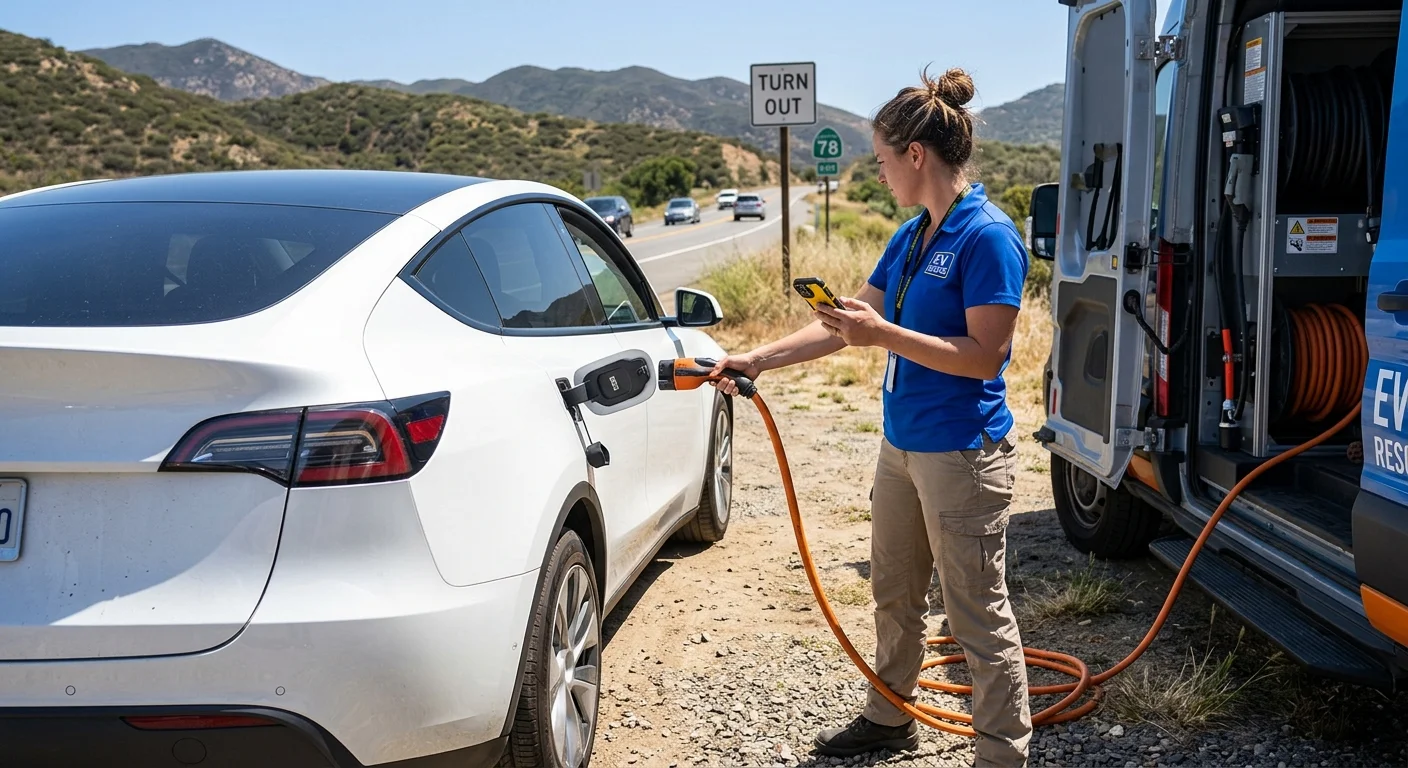
Why range fades faster on SR-87 than the nav shows
Phoenix sits near 1,135 feet at Sky Harbor. Payson sits near 4,920 feet. That climb isn’t a flat Loop 101 hop. ADOT posts a 7% grade into Slate Creek Canyon. The motors draw more watt-hours per mile on that slope. The trip planner often models a gentler road than the one you’re on.
Heat stacks on the grade. Phoenix averages about 111 days at or above 100F, per NWS Phoenix normals. July highs average near 107F. AAA’s 2026 study found about a 10% efficiency drop at 95F versus 75F. Range loss in that test sat near 8.5%. Recurrent looked at 345,622 trips by 300 Phoenix-area EVs. It reported 20 to 30% range loss above about 95F. Loss sat near 31% at 100F. Cabin cooling is a real draw, per NREL.
The I-17 north climb shows the same nav surprise. Forum drivers there report roughly 40% more energy going up than coming down. A 7% Beeline grade can do the same after a comfortable reading in Scottsdale.
Fountain Hills sits on this corridor before the mountain steepens. If you rolled out from Scottsdale, you’ve likely spent extra.
Get off the traveled lane if the car can still move
Arizona law cares about the lane before it cares about your pack. ARS 28-871 covers stopping outside a business or residence district. Don’t stop on the traveled part of the highway if you can get off it. A vehicle disabled so badly it can’t move is exempt. When you’re stopped, leave room for others to pass. Stay visible 200 feet in each direction.
This page can’t tell you whether a specific turnout is reachable. An empty pack might not complete another pull-off. If the scene is dangerous, call 911 and follow the people who arrive.
ARS 28-775 is the Move Over law. Approaching drivers must change lanes when they can, or slow down. Keep your hazards on so they can see you. Don’t walk in a live lane to grab a better pin.
If an officer, firefighter, or ADOT crew is already there, say so. Tell anyone you call what they asked you to do. Police can order a disabled vehicle removed under ARS 28-872. Owners pay the tow and storage. Confirm those costs with the towing company. Charge Pro PHX doesn’t set them.
What Arizona motorist trucks will and won’t do
Arizona runs free motorist help. Two programs cover a lot of this metro. Neither one advertises bringing an EV a charge.
Arizona DPS Roadside Motorist Assistance can change a tire. It can bring gasoline or diesel. It can jump a dead 12-volt, add water, and call a tow. Its published materials name gasoline and diesel. They say nothing about charging a traction battery.
ADOT’s Incident Response Unit works Phoenix-area freeways from 5am to 8pm on weekdays. It clears crashes and debris, changes tires, and helps stranded motorists. It also doesn’t advertise EV charging.
If a patrol truck stops, take the tire change or the traffic control. Then still plan a charge or a tow for the pack. That gap is what an independent mobile operator fills.
Empty pack or a cooked 12-volt
A car that won’t roll hasn’t diagnosed itself. Heat kills 12-volt batteries faster in the desert. Battery Council International, via Battery University, timed starter batteries in hot climates. They last about 47 months there, versus 59 in cool ones. AAA calls heat the number-one cause of battery failure. In an EV, a dead 12-volt can freeze the doors and the screens. It also holds the contactor that connects the main pack. You can have miles left in the traction battery and still go nowhere.
Copy the dash instead of guessing.
- Displayed percent or estimated miles
- Any out-of-energy wording
- Any low-voltage warning
- Whether the main screen is still on
- Whether doors and the charge port still respond
- Any charging or system-fault text
Use the car’s app if it still connects. A screenshot keeps wording that later vanishes.
Tesla features like Sentry Mode and Cabin Overheat Protection draw power while parked. That drain hits harder on a hot shoulder than in a garage. Don’t open panels. Don’t try a jumper from a gas truck on a guess. Let the matched operator confirm the vehicle and the fix.
A 12-volt problem might need a jump or an on-site replacement. If the traction battery is empty, you need energy into the charge port. Our EV roadside assistance page is the broader match.
Pin the Beeline, not somewhere toward Payson
Near Payson or on the Beeline covers too many miles. Operators need one stopping place.
Read the next sign as it’s printed. Share:
- Northbound toward Payson or southbound toward the Valley
- SR-87, not a guessed county road
- The last numbered junction or named cross street you can see
- A map pin, plus a screenshot that shows the route
- Which side of the highway you’re on
- Whether you’re in a turnout, on the shoulder, or on private property
- Fountain Hills, Fort McDowell Yavapai land, or Salt River land if a sign says so
Tribal land isn’t a Phoenix suburb. Fort McDowell Yavapai sits northeast of Scottsdale. Salt River Pima-Maricopa sits between Scottsdale, Tempe, Mesa, and Fountain Hills. Those nations have their own police. If a sign names them, say that. Don’t invent a jurisdiction you can’t see.
If the pin and a roadside sign disagree, send both. Mention a median, a closed gate, or a driveway that doesn’t connect. A pin can sit on the wrong side of a divided highway.
Fountain Hills drivers hit this grade on the way out of town. Our Fountain Hills EV roadside note covers stalls closer in. Mobile charging on the Fountain Hills climb is the grade from that side. This page is the longer SR-87 run toward Payson.
What a mobile charge can add from the shoulder
Charge Pro PHX is a referral line. We match you with independent local operators. We don’t own trucks, set prices, or promise when someone arrives. The operator quotes you before work starts and bills you directly. The pros we connect you with are licensed and insured.
Those operators typically bring a 240-volt Level 2 source to the car. Teslas get a native NACS plug. Other EVs use a CCS or J1772 adapter. A typical top-off adds about 10 to 20 miles of range. Charging time is usually 15 to 30 minutes. That’s charging time, not a clock on when someone shows up.
Ask the operator to confirm:
- Whether the symptoms fit a charge, a 12-volt jump, or a tow
- Connector fit for your make and model year
- Room to park beside the charge port
- What output they can actually deliver on site
- Where you plan to drive after the session
Don’t treat 10 to 20 miles as a promise you’ll reach a specific lot. This page doesn’t name a next charger. Station lists go stale. Check a live app before you pick a destination. Our charging apps checklist is the prep step to run while you wait.
Tesla factory roadside won’t charge you on the spot. It tows to the nearest Supercharger or service center, and that tow is billed. If you want energy in the port where you sit, say so. Out-of-charge recovery is the match for an empty pack. Mobile EV charging is the Level 2 truck itself.
Transport still wins when the car won’t accept a charge. It also wins when a fault is unresolved, or the stop isn’t workable. Confirm loading method, destination, and price with the transporter.
Confirm what’s actually open on your map before you roll.
The I-17 north climb has the same grade surprise. Compare that climb in out of charge on I-17.
Call when SR-87 has already stopped you
Call when you’re stopped on the Beeline with an empty EV. You’ll need a local operator to weigh a charge, a jump, or a tow. We don’t do the physical work. We connect you.
Call (602) 932-0920 and we’ll pass your pin, dash wording, and access notes to an independent operator. Confirm price and the plan with that operator before they start.