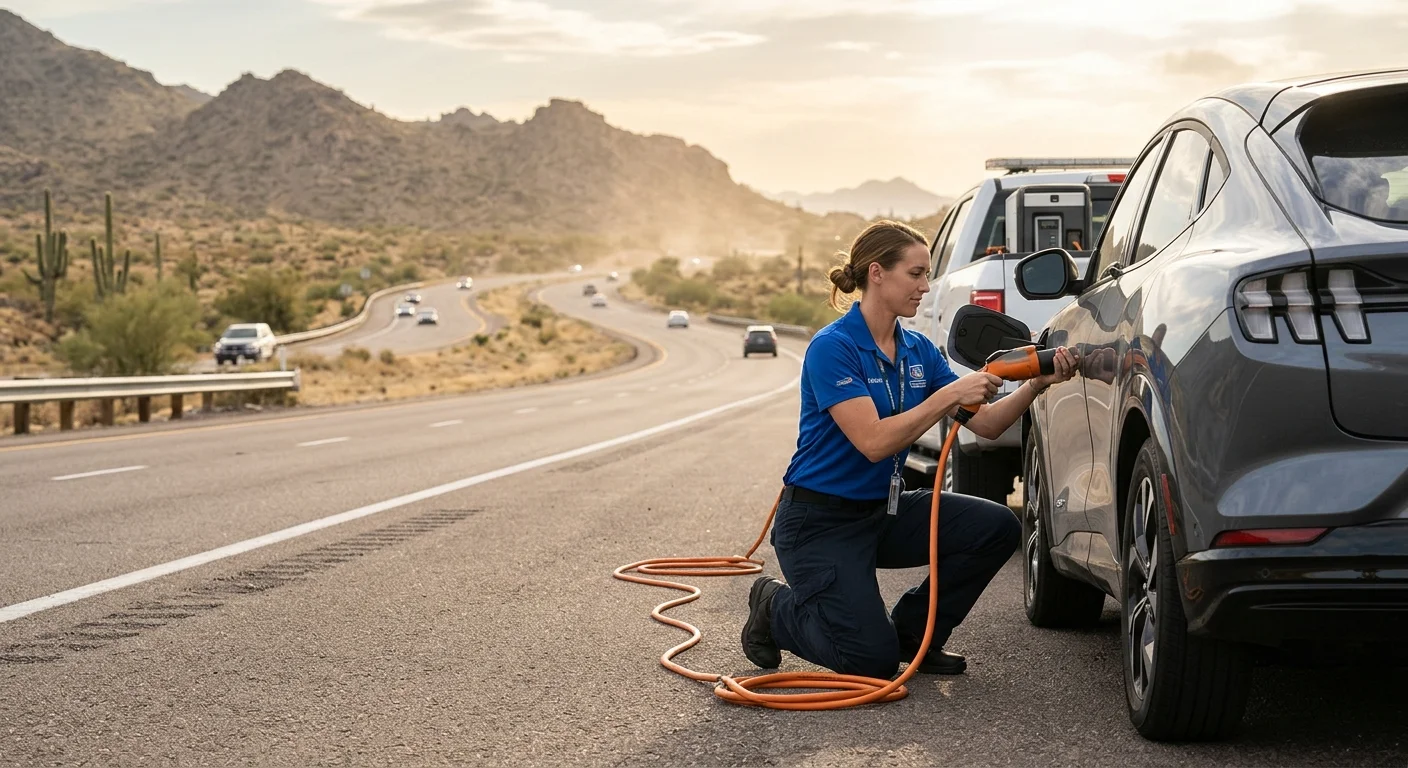
The pack hits zero on Loop 202 through Ahwatukee and the car coasts onto the shoulder. This is the South Mountain Freeway, between the park and the Gila River, not the East Valley 202 through Mesa. Charge Pro PHX connects you with an independent operator for out-of-charge recovery. That operator quotes you, bills you, and does the charge.
Why the South Mountain stretch runs thin on chargers
Loop 202 South Mountain skirts South Mountain Park, then runs along the northern edge of the Gila River Indian Community. That alignment was built as a public-private partnership. It is still free. Arizona has no toll roads, and scam texts about unpaid Arizona tolls are scams. What you do not get on this belt is the retail charging density of Tempe, Chandler, or the Santan stretch.
Federal charging money follows designated corridors. Arizona’s National Electric Vehicle Infrastructure plan names I-10, I-17, I-8, I-19, I-40, and parts of US-60 and SR-347. Loop 202 is not on that list. The South Mountain Freeway is a metro beltway, not an interstate build-out. Fast-charge sites cluster where those corridors already have traffic and land. Ahwatukee sits off to the side of that map.
The mountain itself eats a huge piece of Phoenix. South Mountain Park is one of the city’s landmarks, and the freeway has to go around it. On the south side you get Ahwatukee’s neighborhoods, Pecos, and a thin commercial strip. You do not get the big-box pads that line the East Valley 202. Live charger counts change by the hour. No page can honestly list them as a fixed inventory. Before you leave home, check PlugShare or your car’s charging app. If you are already on the shoulder, treat any pin as unverified until the app shows it available right now.
Heat makes a thin grid worse. Phoenix averages about 111 days a year at or above 100F, and about 21 at or above 110F. July highs average near 107F, August near 105F. Recurrent looked at 345,622 trips from 300 Phoenix-area EVs and reported 20 to 30 percent range loss above about 95F, near 31 percent at 100F. AAA’s 2026 study found about a 10 percent efficiency drop and an 8.5 percent range loss at 95F versus 75F. Cabin cooling is a real draw. NREL has long treated climate control as one of the biggest loads on an EV. On this stretch you feel that on the south-facing side of the mountain, in afternoon sun, with few places to stop and plug in.
If you planned this drive like the East Valley 202, that plan does not transfer. The Santan and Red Mountain legs run through Mesa, Gilbert, and Chandler. This page is only the South Mountain Freeway. For the East Valley belt, use the sibling note on being stranded on Loop 202 in the East Valley. For heat on the interstate, use out of charge on I-10 in the heat.
Ahwatukee, the I-10 split, and the Gila River edge
Ahwatukee sits south of South Mountain Park and north of the Gila River. The South Mountain Freeway is the spine. Pecos is the east-west arterial through the village. Baseline sits farther north. 51st Avenue and 17th Avenue are the exits people actually name when they call from the shoulder. Get those names right. “Somewhere on the 202” is not a location.
The west end dumps into the I-10 stack in southwest Phoenix. That is Estrella, 51st Avenue, and the run toward Tolleson, not Sky Harbor. The east end meets I-10 again on the southeast side of Phoenix. From there you can point toward the airport, Tempe, or the East Valley. Those two I-10 splits are not the same job. A car that dies west of 51st Avenue is in a different grid than a car that dies near the east stack.
South of the freeway, the land quickly becomes the Gila River Indian Community, a sovereign nation. Sacaton is the seat. Several listed places in the southeast and Pinal belt sit on tribal land under tribal jurisdiction. The freeway itself is an ADOT facility. If you leave the pavement onto Community land, you are not in a Phoenix city process anymore. Do not assume a city tow board, a city charger map, or a city police protocol still applies. Confirm where the car actually sits before anyone rolls.
Ahwatukee housing is newer than the Phoenix core, but the drive is still a desert commute. People run this belt to I-10 for work, to Pecos for errands, and around the mountain because the park blocks a straight shot downtown. There is no frontage-road shopping maze like you get on the Price Freeway. When the pack is low, the next public plug is often not “the next exit.” It may be a surface-street hunt after you get off at 17th Avenue or 51st Avenue, and only if the car still moves.
Stay off the traveled lanes if you can. ARS 28-871 says you may not stop or park on the traveled part of a highway outside a business or residence district if it is practical to get off it. A vehicle disabled so badly it cannot be moved is exempt. When you are stopped, you must leave room for other traffic to pass and be visible 200 feet in each direction. Arizona’s Move Over law, ARS 28-775, tells approaching drivers to move over a lane if they safely can, or slow down. Fines run $275, then $500, then $1,000 for repeats within five years. Hazard lights on. People on this freeway do not always move over. Keep everyone inside the car unless you have a safe place off the pavement.
Empty pack versus a dead 12-volt on the 202
Two failures look like “the car died” from the shoulder. They are not the same rescue.
An empty traction pack is a range-to-zero event. The display was counting down. Climate control, speed, and the climb around the mountain used the last miles. The car may still unlock, still show a screen, and still let you open the charge port. What it will not do is drive to a public charger. That is an out-of-charge job. An independent operator can bring mobile EV charging to the car if the port will accept a charge. A typical rescue charge is 10 to 20 miles of range in 15 to 30 minutes of Level 2 charging. That is charging time, not travel time to you.
A dead 12-volt, or the low-voltage battery on newer Teslas, is a brick. Screens go dark. Locks may freeze. The charge port may not release. The high-voltage pack can still have range left. Jumping or waking the low-voltage system is a different task than filling the pack. On a current Model Y, Tesla describes jump posts reached after the hood is open. The wires behind the tow-eye cover only release the hood latches. They cannot charge the low-voltage battery, and they must be disconnected once the hood unlatches. Procedures differ by model and year. Confirm the type in the vehicle information and use the current manual. A Model Y also cannot be used to jump-start another vehicle.
Tesla’s roadside policy says assistance for a depleted battery is available but is not a financially covered service, regardless of warranty status. Tesla typically arranges transport to the nearest Supercharger or service center. That is a tow plan, not a charge-on-the-shoulder plan. Factory roadside is requested in the Tesla app under Roadside. Ford’s program, for Ford EVs, tows an out-of-charge vehicle to the nearest public charger, home, or a preferred Ford dealer within 50 miles of the breakdown. Coverage runs five years or 60,000 miles from purchase. Neither of those programs is Charge Pro PHX. If you want a truck that charges on site, say that up front so the operator you get is set up for it.
Do not guess which failure you have. If the car still talks to you and the range reads zero, treat it as an empty pack. If nothing powers up, treat it as low-voltage until someone who knows the model checks. Arizona DPS Roadside Motorist Assistance changes tires, provides gasoline or diesel, jump-starts dead batteries, adds water, and calls tows. Published materials name gasoline and diesel and say nothing about EV charging. ADOT’s Incident Response Unit covers Phoenix-area freeways from 5am to 8pm weekdays. It clears crashes and debris, changes tires, and helps stranded motorists. There is no EV-specific mention. Those crews can make the shoulder safer. They are not a rescue charge.
Public charging along this stretch versus a truck to the car
If the car still has a few miles, the first move is the charging app, not a random exit. Pins go stale. A stall that was open at breakfast can be down by late afternoon, especially in heat. Charging power itself drops in high ambient heat. Field measurement of DC fast chargers in extreme heat found offered power declining by up to 35 to 40 kW once rectifier temperature approached 55C, with charging duration rising sharply under extreme summer conditions. The car’s battery management system also requests lower current when thermal headroom is limited. A “fast” charger on a 110F Ahwatukee afternoon may not be fast.
Confirmed Level 2 charging exists at Phoenix Sky Harbor in the Terminal 3 garage (Level 1 west side, Level 3, Level 7), the Terminal 4 garage (Level 4 east end, zone B), and at the 24th Street station. EVPassport installed charging at PHX in 2022. That helps only if you are already near the east I-10 split and you can still drive. It does not help a dead car on Pecos, 17th Avenue, or 51st Avenue. Do not spend the last three miles hunting the airport if the pack cannot make the ramp.
A public plug is the right call when you can get off the freeway, park legally, and wait. A truck to the car is the right call when you cannot. ARS 28-872 lets police order a disabled or obstructing vehicle removed. Owners pay reasonable tow and storage costs before release. Arizona sets no statewide tow-rate cap. Cities and counties may set maximums locally. If the car is blocking a lane on the South Mountain Freeway, waiting for a charger pin to turn green is how you get towed.
Charge Pro PHX is a referral service. It matches you with independent local EV charging professionals. It performs no work, employs no technicians, owns no trucks, and sets no prices. The operator quotes the job and bills you directly. There is no published arrival window from us, and no fee we can quote. If a factory program will only tow, and you want miles put back into the pack on the shoulder, say you need on-site charging. For a wider Phoenix picture of who to call and what each path actually does, read EV roadside assistance in Phoenix.
AAA has advertised mobile EV charging in select markets, with Level 2 trucks that put enough range on the car to reach home or the nearest station. That pilot is not a promise that a truck is standing by on Loop 202 South Mountain. Confirm with AAA if you are a member. Confirm with a local operator if you are not. The U.S. Department of Transportation tracks corridor charging at a national level. Your shoulder is still a local problem.
What to tell an operator from the shoulder
Give a location a stranger can drive to without guessing. Direction of travel, eastbound or westbound. Nearest named exit: 51st Avenue, 17th Avenue, Pecos, Baseline, or the I-10 stack, west or east. A mile marker if you can see one. “Ahwatukee” alone is not enough. “South Mountain 202, westbound, before 17th Avenue, on the shoulder” is enough.
Then the failure. Range read zero, or the car went dark. Charge port open, or not. Any warning on the screen before it died. Make, model, and year. Connector: NACS, CCS, or J1772. If you have an adapter, say so, and say whether it is AC-only. Rivian’s J1772 AC adapter is for AC chargers, not DC. A CCS DC adapter alone does not make AC work.
Stay in the car if the shoulder is narrow. Keep seat belts on until you are sure the spot is safe. Hazard lights. If you have warning triangles and you can set them without stepping into a lane, do it. ARS 28-961’s fusee and flag rules are written for disabled trucks and buses outside cities at night. They are still a reminder to be visible. Flame signals are prohibited for vehicles hauling flammables. You are in a passenger EV. Be bright, not clever.
Tell the operator if ADOT, DPS, or Phoenix police are already on scene. Tell them if a tow has already been ordered. Two trucks for one car is how people get billed twice. If the car must move because it is obstructing, say that first. A charge job on a closed lane is a different setup than a charge job on a wide shoulder west of 51st Avenue.
If you can still roll a short distance, say how far the app claims you can go. Do not spend those miles on a scenic loop around the mountain. Get to a legal, lit place off the freeway if you can. If you cannot, stay put and wait for the operator who is actually coming to you.
When to call us
Call when the pack is empty on Loop 202 South Mountain and the car cannot reach a verified charger, or when a 12-volt failure has locked you on the Ahwatukee shoulder and you need an independent EV rescue operator, not a gas-can service. Call us at (602) 932-0920 and we’ll connect you with a local EV rescue operator.