When your Phoenix EV hits empty, state motorist help won’t bring a charge. Arizona DPS Roadside Motorist Assistance lists gasoline, diesel, tire changes, water, and battery jumps. Its published materials say nothing about charging an empty traction pack. ADOT’s Incident Response Unit works Phoenix-area freeways from 5am to 8pm on weekdays. Same silence on EV charging. Charge Pro PHX connects you with an independent operator. That operator can charge or jump the car where it sits.
Empty on the gauge is not the same as a dead 12-volt
Phoenix heat changes the numbers before you see zero. The city runs about 111 days a year at or above 100F. About 21 days reach 110F or higher. July highs average near 107F. Overnight lows often stay in the mid-80s. Recurrent found Phoenix-area EVs lose 20 to 30 percent of range above about 95F.
A low gauge usually still gives you limp mode. You may still roll onto a shoulder or into a lot. Some cars keep a small reserve after the display reads zero. That leftover is a last coast, not a plan.
The high-voltage pack can’t move the car. If the 12-volt is also down, doors, screens, and the contactor go dark. You can’t shift to neutral. You can’t count on hazards. The car is a heavy object on the pavement.
Heat often kills the small battery first
Plenty of Phoenix dead-EV calls aren’t an empty pack. Desert heat shortens 12-volt life to two or three years. That small battery runs the handles, screens, and the pack’s contactor. A full traction battery does nothing if the 12-volt is dead.
Sky Harbor is the version owners know too well. A Tesla sits a week in the Terminal 3 or Terminal 4 garage. Sentry Mode and cabin overheat protection keep drawing. You come back from a trip and the car won’t wake. East Economy lots see the same parked-car drain. An operator can jump that 12-volt on site. That’s a wake-up, not a pack fill.
Downtown and midtown apartment towers produce the other pattern. The car sat without a plug after a long I-10 or I-17 commute. The gauge was already in single digits. Heat stole more miles than the nav showed. Then it dies in the lot before work.
Get the car off the traveled lane
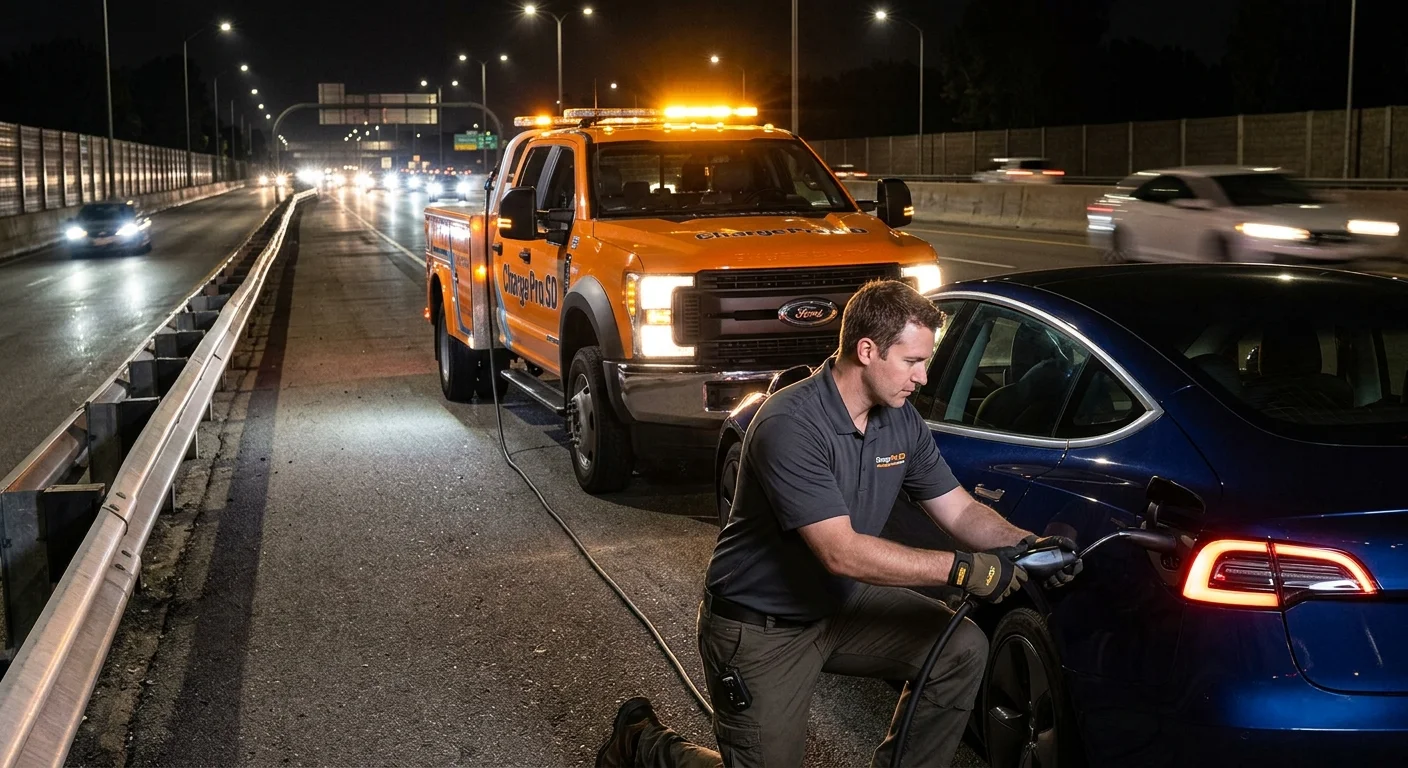
If you still have any roll, coast to the shoulder. Hazard lights if they still work. Stay belted inside on a fast freeway. The cabin is safer than standing on the pavement at night.
Arizona law is specific here. ARS 28-871 bars stopping on the traveled highway outside a business or residence district. That’s if you can get the car off it. A vehicle disabled so badly it can’t move is exempt. You still leave room for traffic and stay visible 200 feet each way.
Don’t try to push the car. Traction batteries make these vehicles very heavy. If you’re blocking I-10, I-17, SR-51, or Loop 202, call 911.
ARS 28-775 is Arizona’s Move Over law. Other drivers should change lanes or slow for warning lights. That rule exists because people work on shoulders. Keep your own flashers on once you have them.
Why DPS and ADOT aren’t the charge call
This is the Phoenix-specific hole in roadside help. DPS Roadside Motorist Assistance helped 75,235 motorists statewide in 2018. It’ll change a tire or bring gasoline or diesel. It’ll jump a dead battery and call a tow. Hours and corridors aren’t published on the DPS pages we checked. None of that published list is a Level 2 charge into an empty EV.
ADOT’s Incident Response Unit is a 14-member team on Phoenix-area freeways. It clears crashes, debris, and stranded motorists. It doesn’t advertise charging an EV.
Most insurer programs have the same limit on an empty pack. Factory Tesla roadside won’t charge on site. Tesla tows to a Supercharger or a service center. That helps if the car can go into tow mode. It doesn’t help if you needed miles where you sit.
An on-site charge or jump is the actual rescue
The operators we match you with bring a 240-volt Level 2 source. That’s mobile EV charging at the bumper, not a stall you have to reach. Tesla owners get a native NACS plug. CCS and J1772 adapters cover non-Tesla EVs. Typical charging time adds 10 to 20 miles in 15 to 30 minutes. That’s charging time, never a promise of when someone arrives.
If the car won’t wake, they jump or replace the 12-volt on site. Tesla’s jump point is behind the front bumper tow-hook cover, not under a hood. They handle Tesla and every major EV brand.
A tow can still be right after a crash or a lock. It’s also right if the pack won’t take a charge. Improper towing can damage the drivetrain. That risk is real if the car won’t go into neutral. Ask for a flatbed if a tow is what you need. For an empty pack on a shoulder, out-of-charge recovery is the on-site charge. An operator charges the car where it sits. If charge, jump, or tow isn’t clear, this charge, jump, or tow guide walks through it.
What happens after you call Charge Pro PHX
Charge Pro PHX is a referral line. It holds no trade license. It owns no trucks. It employs no technicians. You call, then you give the location, make, model, and a callback number. We match you with an independent local operator covering that part of Phoenix.
The operator quotes you before starting. The operator bills you directly. We don’t set prices. We don’t publish hours. We don’t promise an arrival window.
When the operator’s truck is on scene, they check the car’s spot. Then they connect Level 2 power, or they jump the 12-volt. They bring NACS, CCS, or J1772 as needed.
The goal isn’t a full pack. It’s enough miles to reach a charger you choose. The operator talks that through with you. Confirm the nearest working stall in your own app.
Where these calls cluster in Phoenix
Phoenix covers about 518 square miles from Ahwatukee Foothills to Deer Valley.
Sky Harbor’s Terminal 3 garage has Level 2 stalls. They’re on Level 1 west, Level 3, and Level 7. Terminal 4 has them on Level 4 east in zone B. The 24th St. station has charging too. Cars still die in those garages and in East Economy because they sat for days. Heat and accessory drain hit the 12-volt first.
After a Diamondbacks night at Chase Field, packs are often already low. A Suns game at Mortgage Matchup Center does the same. Then you sit in traffic on the Papago Freeway or the Broadway Curve.
Long I-10 and I-17 commutes end at single digits in Maryvale, Laveen, and Desert View. Parked cars in Camelback East, Arcadia, and Encanto won’t wake after a 110-degree afternoon. North Mountain sits closer to the I-17 grade. The I-17 climb toward Anthem, New River, and Black Canyon City uses extra energy. The nav often undersells it.
Monsoon season runs June 15 to September 30. Haboobs on I-10 drop visibility to near zero. ADOT’s guidance is Pull Aside, Stay Alive. Once you’re off the lane, cut extra draw and call before the phone dies. Don’t drive around barricades into floodwater.
APS and SRP split Phoenix block by block. Their home rate plans don’t help you on a shoulder. For neighborhood charging context, see the Phoenix EV charging page.
When to make the call
Call EV roadside assistance when the car won’t move. You need a charge or a 12-volt jump where you sit. Call from a Sky Harbor garage if the screen is black after a trip. Call from a downtown tower lot if the pack is empty before work. Call from the I-17 shoulder if the climb ate the nav’s reserve.
If you’re still rolling on a low gauge, that’s a different problem. Kill extra climate load if you can do it safely. Read EV running low in Phoenix heat. Tesla owners can compare factory help to a local charge. Start with Tesla rescue in Phoenix: AAA or a mobile charge.
Charge Pro PHX serves Phoenix and the rest of the Valley. That includes nearby Mesa, Tempe, Chandler, and Gilbert. The number is (602) 932-0920. An independent operator quotes before any work starts.