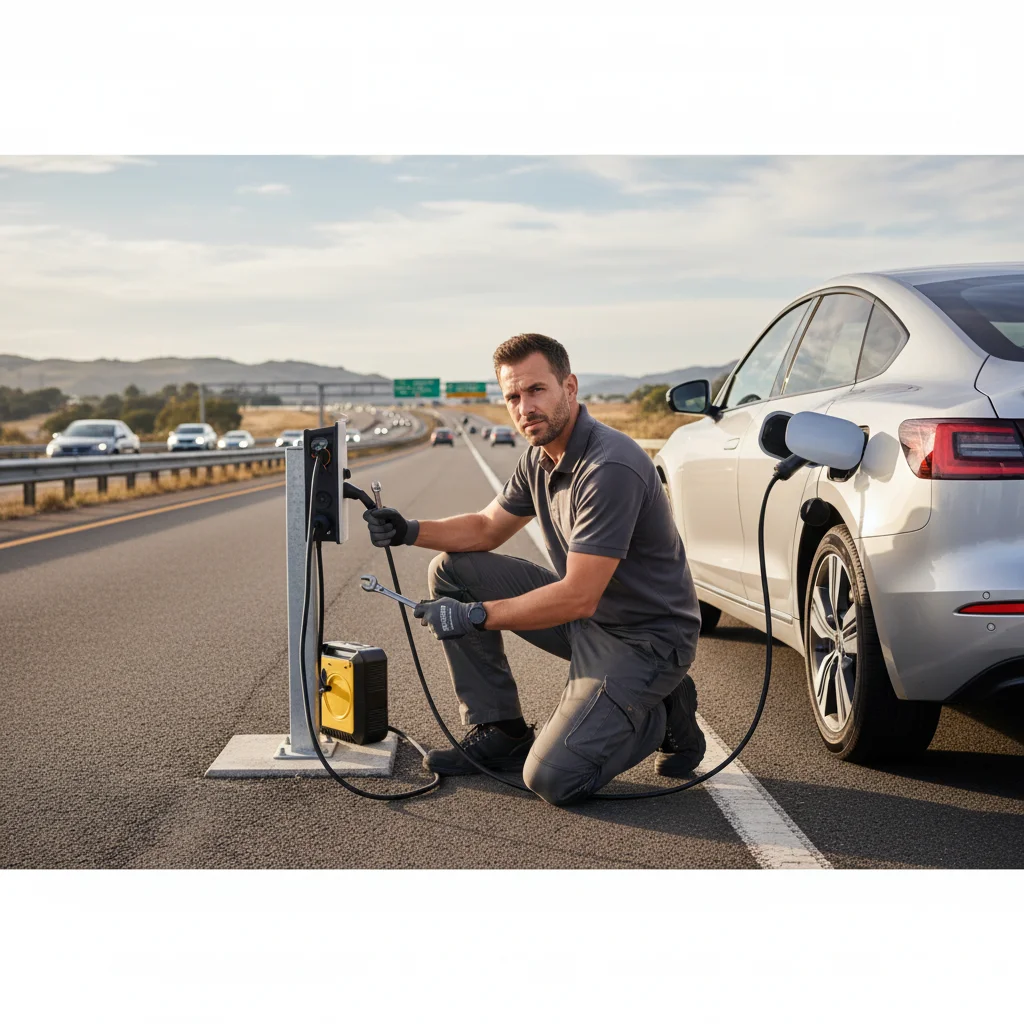
The pack hits zero on Loop 101 Agua Fria in a live west-valley lane. Cardinals traffic is stacking toward State Farm Stadium in Glendale, Arizona. The car won’t pull forward. Arizona law is the first instruction, not a charging app. ARS 28-871 says get off the traveled part of the highway when it’s practical. A vehicle disabled so badly it can’t move is exempt. If you can still coast, use that last motion for the shoulder. Leave room for other traffic to pass. Stay visible for 200 feet in each direction. Then you can deal with the empty pack.
Clear the lane before you fight the gauge
ARS 28-871 is written for highways outside a business or residence district. Loop 101 Agua Fria is that kind of road. You may not stop on the traveled part if you can get off it. Two tires on the white line still count as being in the lane. Get the whole car onto the shoulder. If a barrier is what you’ve got, sit far from passing traffic.
This stop isn’t a hunt for a public plug from the travel lane. This research didn’t confirm station counts by Agua Fria exit. Don’t walk the freeway looking for a stall you haven’t verified. The statute wants you out of the lane. A mobile EV charging operator can come to the car once you’re stable.
Police may order a disabled or obstructing vehicle removed under ARS 28-872. Owners pay reasonable tow and storage costs before release. ADOT mails notice to owners. Arizona sets no statewide tow-rate cap. Cities and counties may set local maximums. Confirm those rules with the city or county that actually governs the stop. Glendale, Peoria, Surprise, and Goodyear aren’t the same clerk.
If the stall becomes a minor crash, move off the traveled roadway when it’s safe. That’s ARS 28-674. You’re not at fault merely for moving the car. ADOT may require and assist removal when no serious injury is apparent.
You’re on the Agua Fria, not the rest of Loop 101
Loop 101 is three named legs. Agua Fria is the west one. Pima runs northeast, and Price runs southeast. Tell a dispatcher Agua Fria or you may send help toward Mesa. The west belt serves Glendale, Peoria, Surprise, Goodyear, Avondale, and Tolleson. El Mirage, Sun City, Youngtown, and Litchfield Park feed into it. US-60 on this side of town is Grand Avenue, not the Superstition Freeway.
Arizona has no toll roads and no toll express lanes. ADOT confirmed that. SB 1340, effective January 1, 2024, bars the state from adding them without a new legislative vote. A text about an unpaid Loop 101 toll is a scam, so delete it.
HOV occupancy rules still apply during weekday rush hours. Alternative-fuel and energy-efficient-plate solo access ended on September 30, 2025. The federal exemption expired. Your EV plate doesn’t buy that lane alone anymore. Don’t drop into HOV on a dying pack thinking the plate will cover you.
State Farm Stadium is in Glendale, Arizona. Desert Diamond Arena is in Glendale too. Camelback Ranch runs Dodgers and White Sox spring training in Glendale. Peoria Sports Complex sits in Peoria, Arizona, for Padres and Mariners camps. Surprise Stadium is in Surprise. Those event days load Loop 101 Agua Fria with slow, air-conditioned miles. Phoenix Raceway is in Avondale, not Phoenix, despite the name. Race traffic uses this west-valley belt.
Sun City’s housing stock is the oldest in the service area. About 88.9% of it was built before 1980, per ACS 2020-2024. Youngtown is next, at 51.8% before 1980. A lot of those trips home still use this loop after a Glendale event. Home charging later is a different problem. APS serves Surprise, Goodyear, El Mirage, Youngtown, Sun City, and Litchfield Park. It shares Glendale, Peoria, and Avondale with SRP. That split can change block by block. Confirm your address with the utility. Ask later about APS R-EV and APS Smart Charge. Take Charge AZ is the public and workplace program. SRP’s EV Smart Charge is the other name to know. Amounts aren’t listed here because they change and this page isn’t a rate sheet. On the shoulder, the utility can’t roll a truck to you.
Heat spends the buffer you thought you had
Phoenix averages about 111 days a year at or above 100F. About 21 days reach 110F or more. Those are NOAA 1991-2020 normals via NWS Phoenix. July highs average near 107F. August averages near 105F. Summer overnight lows still sit in the mid-80s. NREL reports climate-control loads can cut EV range in a real way. Cabin cooling is one of the bigger draws.
AAA’s 2026 study found about a 10% efficiency drop at 95F versus 75F. Range loss in that work was about 8.5%. Recurrent reported 20 to 30% range loss above about 95F. Loss was near 31% at 100F. That dataset included 345,622 trips by 300 Phoenix-area EVs. Don’t treat those figures as a Tesla spec. tesla.com wasn’t a source for range-in-heat numbers.
Arizona had about 141,800 battery EVs and 33,900 plug-in hybrids as of 2025, per DOE AFDC. Statewide plug-ins totaled about 175,700. That statewide count is why empty-pack stops aren’t rare anymore. Arizona doesn’t publish a Maricopa County EV count, so this page won’t invent one.
Monsoon season runs June 15 to September 30. Haboobs can drop visibility to near zero. Flash floods follow. ARS 28-910, the Stupid Motorist Law, is simple in practice. Don’t drive around a barricade into water. You can be billed for the emergency response. Stay on pavement you can see.
A 12-volt failure can mimic an empty pack. The small battery runs door handles, screens, and the contactor that connects the traction pack. A DC-DC converter only recharges it while the car is on or charging. Battery Council International work, via Battery University, found shorter life in heat. Starter batteries last about 47 months in hot climates versus 59 in cool ones. AAA calls heat the number-one cause of battery failure. It recommends AGM batteries for hot areas. Tesla features like Sentry Mode and Cabin Overheat Protection draw power while parked. If the car is silent with a reported high state of charge, tell the operator. That’s a jump or 12-volt replacement job, not an out-of-charge recovery.
State motorist help won’t publish an EV charge
Arizona runs two free roadside programs in this metro. Read what they actually advertise.
Arizona DPS Roadside Motorist Assistance is statewide. It was originally funded by the Maricopa Association of Governments. Crews change tires, provide gasoline or diesel, jump-start dead batteries, add water, and call tows. In 2018 the program assisted 75,235 motorists statewide. Published materials name gasoline and diesel. They don’t mention charging an empty EV. Hours and corridor lists aren’t published. Ask DPS what they can do at your pin. Don’t assume a charge.
ADOT’s Incident Response Unit covers Phoenix-area freeways from 5am to 8pm on weekdays. It’s a 14-member unit, sponsored by State Farm since 2020. It has logged 10,400-plus responses since October 2019. The unit clears crashes and debris, changes tires, and helps stranded motorists. There’s no EV-specific mention in the public description.
A jump from either program might help a dead 12-volt. An empty traction pack is a different call. Charge Pro PHX is a referral line. We match stranded EV drivers with independent local mobile rescue operators. We don’t hold a trade license for the work. We don’t own the trucks. The pros we connect you with are licensed and insured. The operator quotes you before starting and bills you directly.
How to sit once you’re out of the lane
Put hazards on as soon as your speed drops below the flow. ARS 28-775, the Move Over law, is why those lights matter. Other drivers must move over a lane if they can do it safely. If they can’t, they slow down. Your flashers are the signal they have to honor.
Stay off the traveled lane with your body too. On a right-shoulder stop, the driver’s door opens toward traffic. Use the passenger door when that’s the safer path. Keep the car between you and the lanes. Don’t walk the shoulder toward an exit. Pedestrians on urban freeways are hard to see.
You don’t need a made-up mile marker. Direction plus the last west-valley city is a real location. Northbound toward Surprise isn’t southbound toward Goodyear. Say Glendale, Arizona, or Peoria, Arizona, so a national call center doesn’t route you to another state. Tolleson and Avondale are short, named stretches. Use those city names.
If you still have a sliver of range, leave the freeway. Meet on an arterial in Glendale or Peoria. That’s usually the calmer pin. Only do that if the car will actually make the ramp. Dying in a merge is worse than a legal shoulder stop.
What actually moves a rescue quote
A flatbed clears Loop 101. It doesn’t put miles in the pack. Many EVs need a flatbed so the drivetrain isn’t dragged. The drop is often a yard. Arizona has no statewide cap on private tow rates. Cities and counties may set maximums. The operator or tower quotes before the hook. Confirm that quote before they hook the car. For the mechanical side of a dead-EV tow, read what towing a dead EV in the Phoenix area actually involves.
Tesla roadside, for an empty pack, tows to a Supercharger or service center. It doesn’t charge on site. Ford tows to the nearest charger, home, or dealer within 50 miles. Independent operators can bring 240V Level 2 to the bumper instead. Native NACS for Tesla. CCS or J1772 adapters for everyone else. They typically add 10 to 20 miles of range. That takes 15 to 30 minutes of charging. That’s time on the plug. It isn’t an arrival clock.
Charge Pro PHX doesn’t set the price. Distance along the Agua Fria moves it. So does time of day, stadium let-out, monsoon visibility, and how many miles you need. A bump to the next arterial isn’t the same job as range toward Goodyear. The operator quotes before work starts. If the number isn’t right, you can decline.
If you drive CCS or J1772, say that in the first minute. The non-Tesla EV rescue path exists so the operator brings the right adapter. More on this belt sits in mobile EV charging along Loop 101 Agua Fria.
We serve the Phoenix area, including this west loop. Bookmark out-of-charge recovery before you need it. When you call, have direction, city, make, model, and whether the screens still wake.
Frequently asked questions
What does ARS 28-871 require on Loop 101 Agua Fria?
Get off the traveled part of the highway if you can. A car that can’t move is exempt. Leave room for traffic to pass. Stay visible for 200 feet in each direction. Hazards help other drivers meet the Move Over law. Then call for help from the shoulder, not from a live lane.
Will DPS or ADOT put charge in my EV?
Their published programs change tires, bring gasoline or diesel, jump batteries, and call tows. They don’t advertise EV charging. A jump might wake a dead 12-volt. An empty traction pack needs a mobile Level 2 operator. Or it needs a charger you’ve already verified you can reach. Charge Pro PHX matches you with independent operators who bring that 240V source.
I still have a few miles. Do I stay on the loop?
If the ramp is close and the car still rolls, get off Loop 101 Agua Fria. Meet on a surface street. If you’re not sure the ramp is inside the remaining range, take the shoulder under ARS 28-871. Don’t gamble the last bar in HOV or a merge. Tell the matcher your percent, direction, and the last city you passed.
If the pack is already dead on Loop 101 Agua Fria, stay out of the lane and call (602) 932-0920. We’ll connect you with a local operator who quotes the job before any cable goes in. The operator bills you directly.