EV roadside assistance in Glendale, Arizona is the call when a pack hits empty. That stall shows up after Westgate, and on Loop 101. Charge Pro PHX matches stranded drivers with independent local operators. Those pros bring Level 2 charging or a 12-volt jump to the car.
Why Glendale AZ event traffic empties packs
State Farm Stadium sits in Glendale’s Westgate Entertainment District. Cardinals games fill those lots for hours. It’s also a Super Bowl host site. Desert Diamond Arena sits next to it. That hall used to be Gila River Arena. The Coyotes left in 2024, and concerts still pack the same blocks.
You walk back to a car that’s been sitting in Valley heat. Tesla Sentry Mode keeps cameras alive while you’re inside. Cabin Overheat Protection pulls power while you’re gone too. Either one can flatten the 12-volt even when the traction pack still shows range. The car then won’t wake, and the doors may not pop.
Camelback Ranch sits in Glendale, Arizona as well. Dodgers and White Sox spring training fills those lots. Cars sit through the game, then the dash won’t ready. That’s a 12-volt call as often as an empty pack.
About 35.4% of Glendale housing was built before 1980, per the ACS 2020-2024 5-year. Historic Downtown Glendale, Orangewood, and older rental streets often have no home Level 2. Westgate parking is the charge you didn’t get that day. That’s the local shape behind mobile EV charging around Glendale events.
Arrowhead Ranch and Sahuaro Ranch sit farther from the stadium grid. The way home is Bell Road or the Agua Fria. If you rolled out of Westgate already low, that last stretch is where the estimate breaks. Glendale Community College, Historic Downtown Glendale, and Westgate all sit in the same city. This isn’t a far-suburb run.
Loop 101 Agua Fria and Grand Avenue stalls
Name the freeway correctly when you call. Loop 101 through Glendale is the Agua Fria Freeway. It isn’t the Price Freeway and it isn’t the Pima. US-60 here is Grand Avenue, the northwest leg, not the Superstition Freeway in the East Valley. I-17 runs the city’s east edge. Glendale Road and Bell Road feed all of those.
The city covers about 67.1 square miles. The Census count is 252,833 people. This is dense West Valley commuting, not a two-exit town. Heat and low-speed traffic both tax the estimate you made at home. Grand Avenue adds lights and slower speeds. A nav number from a cool morning doesn’t always hold.
Summer range loss of 20 to 30 percent applies in Glendale. Recurrent reported EVs can lose 20 to 30% of range above about 95F. Loss ran near 31% at 100F, from 345,622 trips by 300 Phoenix-area EVs. AAA’s 2026 study found about a 10% efficiency drop at 95F versus 75F, plus about 8.5% range loss. Those are different studies. Both say heat taxes the pack.
NOAA 1991-2020 normals, via NWS Phoenix, put the Valley at about 111 days a year at or above 100F. About 21 days reach 110F or more. July highs average near 107F, and August highs average near 105F. Overnight summer lows sit in the mid-80s. The cabin still wants cooling in a Westgate exit queue. NREL notes cabin cooling and heating among the biggest draws on range.
Monsoon season runs June 15 to September 30. Haboobs can drop visibility to near zero. If dust hits while you’re already on the shoulder, stay in the car with hazards on. ARS 28-910 can bill you for emergency response if you drive around a barricade into flood water. Don’t do that on Glendale Road or Bell Road when a cell dumps.
If the car’s still moving, get fully out of the travel lanes while you still can. Flip hazards on as you ease right. If it’s already dead, you’re in EV roadside assistance territory. The Glendale city hub covers this West Valley grid. Peoria, Surprise, Goodyear, and Avondale sit against Glendale’s edges. Plenty of stalled drivers were finishing a trip that started in one of those cities.
The 12-volt fails in the same heat
From the curb, an empty pack and a dead 12-volt look alike. Nothing readies, and the screen stays black. Handles may stay flush. The 12-volt runs the contactors that close the high-voltage system. A full traction battery can’t help if that small battery is dead. A DC-DC converter only recharges the 12-volt while the car’s on or charging.
Battery Council International work, via Battery University, found starter batteries last about 47 months in hot climates. That’s versus about 59 months in cool ones. AAA names heat as the number-one cause of battery failure. A 12-volt that lasts five years in a mild city can fail in two or three here.
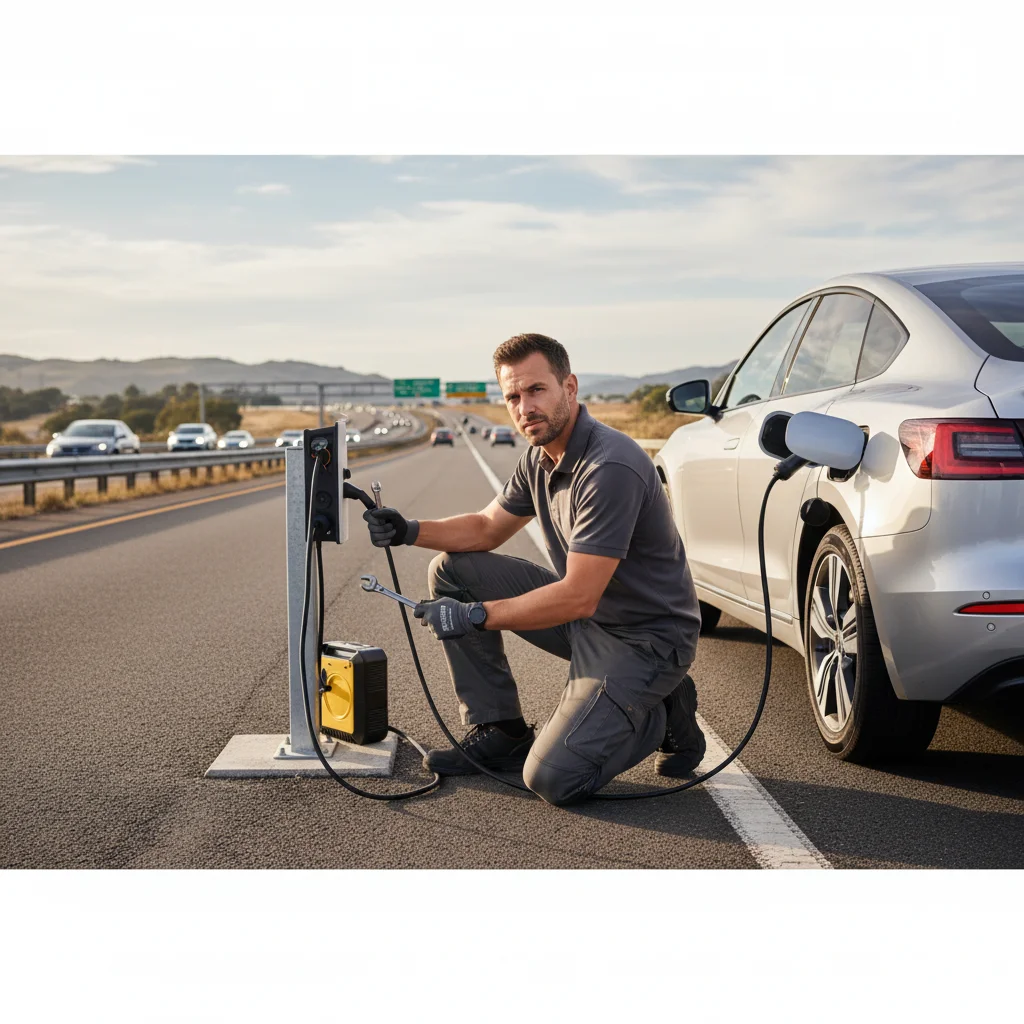
Operators in the network jump or replace a dead 12-volt on site. They also bring a 240V Level 2 charge when the traction pack is what’s empty. Don’t mix the two jobs in your own head. Tell the operator the last warning you saw. Mention a long park at Westgate, a zero-mile flag, or a car that died rolling on Loop 101.
Out-of-charge recovery is the empty-pack path. A 12-volt job is a jump or a replacement at the car. Tesla and every major EV brand are in scope for the operators Charge Pro PHX matches.
What Arizona law and state crews will and won’t do
Arizona has no toll roads and no toll express lanes. ADOT confirmed that. SB 1340, effective January 1, 2024, bars the state from adding them without a new legislative vote. Loop 101 is free. Texts about unpaid Arizona tolls are scams.
ARS 28-871 covers stopping on a highway outside a business or residence district. You can’t stay on the traveled part if you can get off it. A vehicle disabled so badly it can’t be moved is exempt. When you’re stopped, leave room for other traffic to pass. You need to be visible 200 feet in each direction.
ARS 28-775 is the Move Over law. A driver who sees your warning lights has to move over a lane if that’s safe. If it isn’t, that driver has to slow down. It doesn’t mean everyone will.
ARS 28-872 lets police order a disabled or obstructing vehicle removed. Owners pay reasonable tow and storage costs before release. If you’re in a live lane, call 911 first. Then call for a mobile rescue match.
Arizona DPS Roadside Motorist Assistance changes tires. It brings gasoline or diesel. It jump-starts dead batteries, adds water, and calls tows. In 2018 it assisted 75,235 motorists statewide. Published materials name gasoline and diesel. They say nothing about charging an EV that’s out of range.
ADOT’s Incident Response Unit covers Phoenix-area freeways from 5am to 8pm weekdays. It’s a 14-member unit, sponsored by State Farm since 2020. It’s logged 10,400-plus responses since October 2019. It clears crashes and debris, changes tires, and helps stranded motorists. It also doesn’t advertise an EV charge.
Independent mobile EV charging is the on-site charge those programs don’t offer. Charge Pro PHX doesn’t own a fleet and doesn’t employ technicians. It connects you with a local operator. That operator quotes before starting and bills you directly.
For the Agua Fria shoulder in more detail, use out of charge on Loop 101 Agua Fria.
What a mobile operator can add on site
Network operators bring a 240V Level 2 source to the car. Teslas get a native NACS plug. Other EVs get a CCS or J1772 adapter. That’s non-Tesla EV rescue when your inlet isn’t NACS.
Charging time on site is typically 15 to 30 minutes. That figure is plug time, never an arrival clock. It typically adds 10 to 20 miles of range. This isn’t DC fast charging. It’s enough to roll to the charger or home plug you already meant to use.
Tesla factory roadside doesn’t charge an empty pack on the spot. It tows to the nearest Supercharger or service center. Ford’s published out-of-charge path is a tow to the nearest charger, home, or dealer within 50 miles. A local Level 2 charge on site is the stay-put option those programs don’t include.
The pros we connect you with are licensed and insured. Charge Pro PHX holds no license, owns no trucks, and performs no work. It sets no prices and it doesn’t publish hours.
Give the operator your direction on Loop 101, Grand Avenue, or I-17. Add the nearest exit, a Westgate lot name, or a cross street in Arrowhead Ranch or downtown. Say Glendale, Arizona. There’s another Glendale in California, and you don’t want that mix-up.
APS and SRP both serve parts of Glendale. The split can change by block, so confirm your address with the utility. Home rate plans and charger rebates don’t reach a freeway shoulder. You still need energy at the bumper, or a tow you choose.
Frequently asked questions
Will DPS or ADOT charge an EV on Loop 101 in Glendale?
No published DPS or ADOT program says it’ll charge an out-of-range EV. State motorist help is tires, gasoline or diesel, jumps, and tow calls. For a traction pack at zero, you want a mobile Level 2 operator or a tow you choose.
Is a Westgate no-start the pack or the 12-volt?
It can be either, and the tools differ. Climate control plus slow traffic can empty the traction pack. A long park with Sentry Mode or overheat protection often kills the 12-volt instead. Tell the operator how long the car sat and what the last screen showed.
Can non-Tesla drivers get EV roadside assistance in Glendale AZ?
Operators carry CCS and J1772 adapters for the major non-Tesla brands. Tesla cars use the native NACS plug. The match is by plug type and location, not by a factory dispatch app.
If you’re stalled in Glendale, Arizona, after a Westgate night or on Loop 101, call (602) 932-0920. Charge Pro PHX matches you with an independent operator. That pro quotes before starting and bills you directly.