A CCS or J1772 car in Scottsdale can sit empty while NACS Superchargers stay busy a mile away. The plugs along Loop 101, Pima Road, and Shea are not one network. Charge Pro PHX connects you with a local operator who can bring a charge to the car.
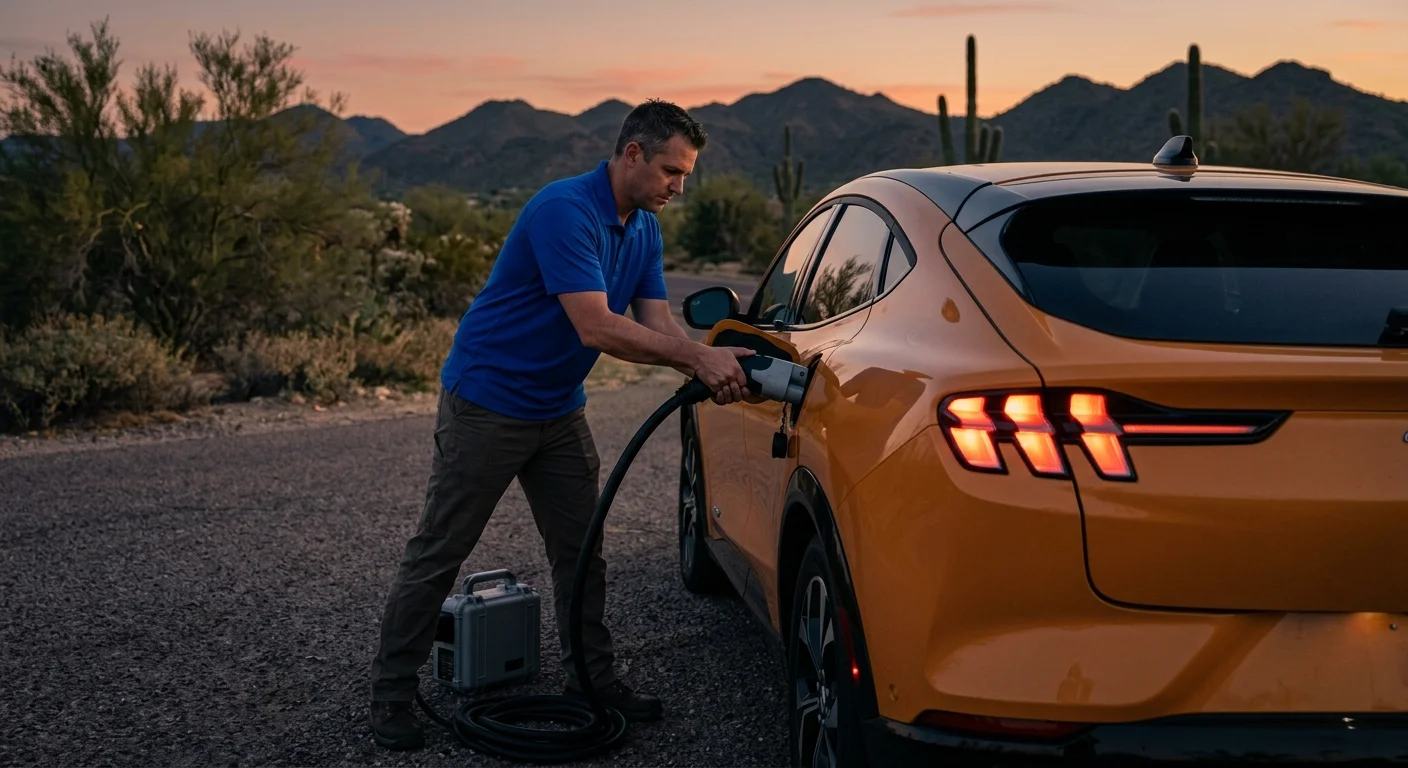
Why a CCS or J1772 car gets stuck in Scottsdale
Scottsdale’s charging map is split by inlet, not by city limits. Tesla Superchargers are built around NACS. Some of those stalls now take other NACS cars. A CCS Combo 1 inlet still needs a CCS stall. J1772 is the Level 2 AC inlet on most non-Tesla EVs sold in the United States. It is not a Supercharger plug. Read both inlets in the owner’s manual. Do not guess from a photo of the port.
Heat opens that gap. Phoenix averages about 111 days a year at or above 100F, and about 21 at or above 110F (NOAA 1991-2020 normals via NWS Phoenix). July highs average near 107F. Recurrent reports EVs can lose 20 to 30% of range above about 95F, with loss near 31% at 100F, from 345,622 trips by 300 Phoenix-area EVs. AAA’s 2026 study found about a 10% efficiency drop and an 8.5% range loss at 95F versus 75F. NREL reports climate-control loads can cut range in a real way. Cabin cooling on Shea in August is a load, not a comfort extra.
A CCS driver leaving Old Town can watch the estimate look fine, then lose miles on a northbound run with the air on. Public CCS and J1772 stalls are a different hunt from Tesla’s network. Drivers looking up EV roadside assistance near me in this city often hit Tesla-weighted results first. Our public CCS versus Tesla Supercharger guide covers that split for the Valley. Scottsdale’s general EV roadside assistance page is Tesla-weighted too. This page is for the car those Superchargers will not take.
State trucks will not fill the pack. Arizona DPS Roadside Motorist Assistance changes tires, provides gasoline or diesel, jump-starts dead batteries, adds water, and calls tows. Published materials say nothing about EV charging. ADOT’s Incident Response Unit clears crashes and debris on Phoenix-area freeways, 5am to 8pm weekdays, with no EV-specific mention. Out of electrons in a CCS car is a charge problem. The U.S. Department of Energy explains connector types at a national level. Your manual still governs the car on Pima.
North Scottsdale desert roads versus the 101
Loop 101 through Scottsdale is the Pima Freeway. It is stop-and-go, fast, and exposed. If you die on the traveled lanes, Arizona law is not fuzzy. ARS 28-871 says you may not stop or park on the traveled part of a highway outside a business or residence district if it is practical to get off it. A vehicle disabled so badly it cannot be moved is exempt. When you are stopped you must leave room for other traffic to pass and be visible 200 feet in each direction. ARS 28-775, the Move Over law, tells approaching drivers to move over a lane if they safely can, otherwise slow down. Fines run $275, then $500, then $1,000 for repeats within five years.
North of Shea, the problem changes. Pima Road runs long and open toward Carefree and Cave Creek. The McDowell Sonoran Preserve sits to the east. Grades and heat stack. You are farther from dense retail and farther from stacked chargers. A low pack on the 101 near a mall is one situation. A low pack on Pima north of Dynamite, or east on Shea toward Fountain Hills, is another. Gilbert’s non-Tesla stalls tend to sit on a tight East Valley grid. North Scottsdale is desert road, longer gaps, and a climb. There is no statewide tow-rate cap in Arizona. Cities and counties may set maximums locally. Do not assume a cheap tow solves a CCS inlet problem. A tow still has to find a working CCS stall.
Arizona has no toll roads. HOV-lane occupancy rules apply during weekday rush hours. As of September 30, 2025, alternative-fuel and energy-efficient-plate vehicles no longer get solo HOV access. That does not charge the car. It only changes how you use the 101 if you still have range.
If you can roll into a shoulder, a business lot, or a side street, do that before the pack hits zero. Desert shoulders get hot. Cabin cooling while you wait eats what little range you have left. For the wider Valley pattern, see non-Tesla EV rescue in the Phoenix area. Scottsdale’s north desert and the 101 are not the same job.
What a local operator can do on site
Charge Pro PHX does not roll a truck. We match you with an independent local operator. That operator quotes you, bills you, and does the work. The brand sets no price and promises no arrival window.
On site, a mobile EV charging operator is trying to put enough range back into the pack to get you to a public CCS stall or home Level 2. A typical rescue charge is 10 to 20 miles of range in 15 to 30 minutes of Level 2 charging. That figure is charging time, not travel time to you. It is enough for many Scottsdale hops: Pima back to a retail lot, Shea to a garage, or the 101 to a charger you already passed. It is not a full pack. Do not plan a Carefree loop on a rescue charge.
The operator needs the right inlet. CCS Combo 1 is the common DC fast-charge inlet on older non-Tesla EVs in this market. J1772 is the common AC inlet. Some newer non-Tesla cars shipped with NACS. That is why the manual matters. Non-Tesla EV rescue is the match path for CCS and J1772 cars. Mobile EV charging is the on-site charge itself, including mobile EV charging Scottsdale drivers ask for when a public stall will not take the plug.
A dead 12-volt battery is a different failure from an empty high-voltage pack. One locks the car. The other leaves you with a car that still talks but will not move far. Tell the operator which symptoms you have: no dash, no unlock, or a pack at 0% with the screens still on. Do not let a gas-roadside truck treat an EV like a stalled sedan. Jumping the 12-volt, if the operator offers it, is their call and their method.
Nobody here warrants the car. The operator’s work is between you and them.
Factory help versus a matched Phoenix-area pro
Automaker roadside is a contract you already have or do not. Ford, GM, Hyundai, Kia, BMW, and the rest each write their own rules. Coverage changes by model year and plan. Confirm with the number in your glovebox whether they send a mobile charge or a tow to a public stall. Do not wait on a promise you have not heard from them.
Tesla owners in Scottsdale have a denser Supercharger map and a Tesla-weighted local page. If that is your car, start with EV roadside assistance in Scottsdale. If your inlet is CCS or J1772, that Tesla path will not charge you. Roadside assistance for EV in this city is not one product. The inlet decides the match.
A matched Phoenix-area pro is local and independent. You are not hiring Charge Pro PHX to touch the car. You are asking us to connect you. The operator tells you the price. We do not. The operator tells you when they can be there. We do not publish hours or ETAs.
Factory tows still have to obey the same highway rules. If you are on the 101, the first job is getting off the traveled lanes when it is practical. A tow to a CCS stall only helps if that stall is working, compatible, and not blocked. Heat soaks public cabinets. A stall that looked fine in the app can refuse a session. That is a common reason drivers ask for a mobile charge instead of another loop around the same lot.
The U.S. Department of Transportation tracks public charging as infrastructure. It does not dispatch a truck to Pima Road. When factory help is a tow you do not want, or a wait you cannot use, a local match is the other path.
What to have ready when you request a match
Have the car’s make, model, and year. Have the inlet type from the manual, not from memory. Say CCS, J1772, or NACS in plain words. If you have an adapter, say so. Adapters fail in heat. Do not assume the operator can use yours.
Give a location a driver can find. North Scottsdale is not enough in a city of 243,821 people (U.S. Census Bureau ACS 2020-2024 5-year). Pima and Shea, a 101 exit, a grocery lot, a trailhead, or a mile marker is. If you are on the shoulder, say which direction you were headed. If you made it into a parking stall, name the business.
If the screens still work, read the pack percent and any error text. If the car is dark, say that. Mention whether people are waiting in the cabin. Heat is the emergency around them, not a color detail.
If it is practical to get off the traveled roadway, do that first (ARS 28-871). Put on hazards. Arizona’s Move Over law is for the cars coming at you. You still need to be visible.
APS and SRP both serve Scottsdale. That split matters for home rates later. It does not charge you on Pima. After a rescue, a home Level 2 session is the usual way to refill. SRP’s Electric Vehicle Price Plan is closed to new enrollment as of a February 2025 board decision. Existing customers may stay until the November 2029 billing cycle. APS still lists an R-EV overnight plan. Confirm current rates with the utility, not with us.
We do not need a VIN to start a match. The operator might. Have the registration handy if they ask.
When to call us
Call when a CCS or J1772 car is stranded in Scottsdale and a Supercharger will not take the inlet, or when you have range left to reach a shoulder but not a working public stall. That is a mobile EV rescue, not a gas-can stop. Call us at (602) 932-0920 and we’ll connect you with a local EV rescue operator.