Your Tesla is dead in Scottsdale. The useful question is who can actually help on that road. Factory roadside, an auto club, and a mobile EV operator each do different work. Scottsdale has one of the higher EV-ownership concentrations in the state. It stretches from Old Town to DC Ranch, Grayhawk, Troon, and McDowell Mountain Ranch. Summer heat and the climbs toward the McDowells cut range. Visitors drain cars at Fashion Square, WestWorld, and Salt River Fields. Residents stall on Scottsdale Road, Shea Boulevard, and the Loop 101 Pima Freeway. For on-site help, start with Tesla roadside rescue.
Factory roadside, an auto club, or a mobile operator
Tesla owners here usually start with one of three numbers.
Tesla’s own roadside lives in the app, and you can call them. Coverage depends on the car and Tesla’s current policy. Confirm what they’ll do before you wait. One point is consistent in Tesla’s published approach. They don’t charge you on site. They arrange a tow to a Supercharger or a service center.
An auto club like AAA covers many vehicles, including EVs. The contractor who shows up may be a general tow truck. Some can jump a 12-volt. Many can’t add range to a Tesla. Ask what they’ll bring before they roll.
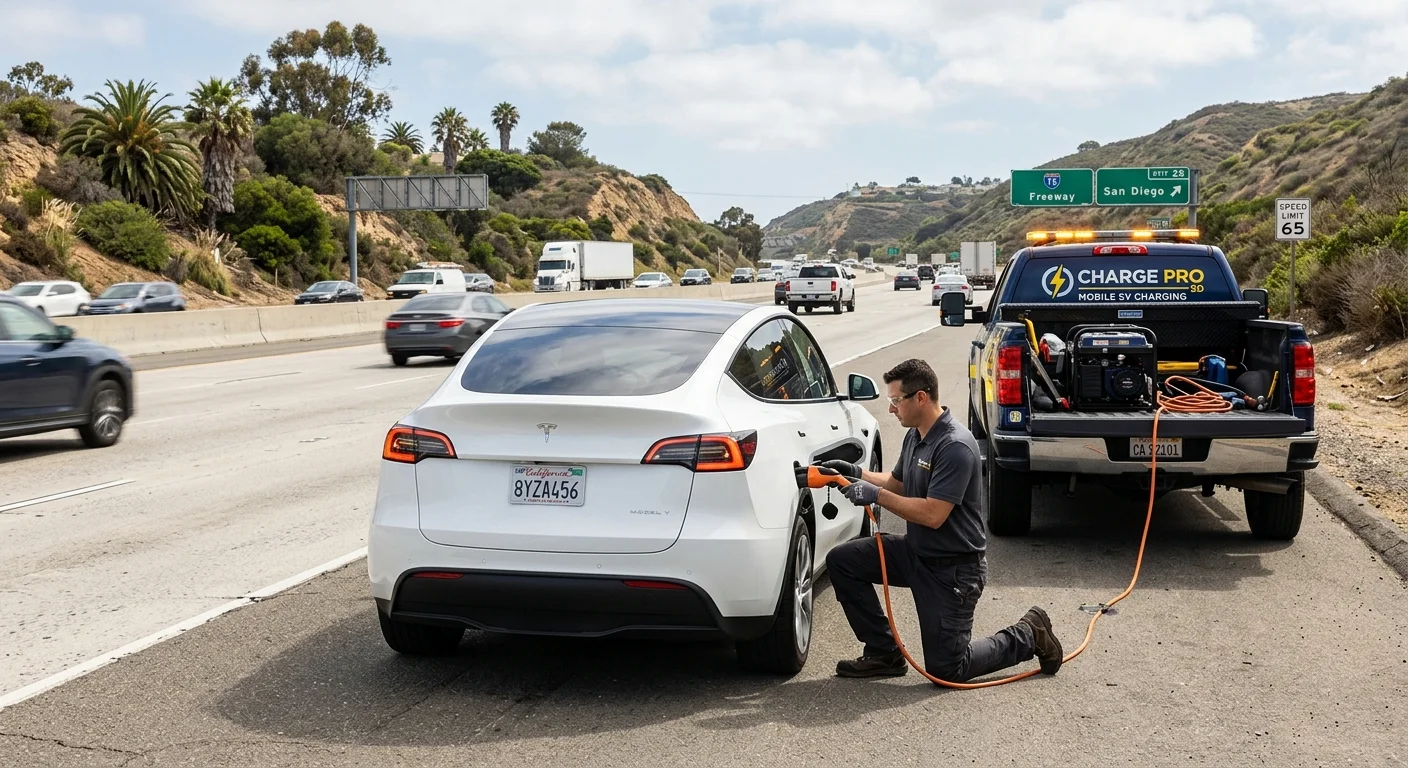
A mobile EV operator comes to the car with a 240-volt Level 2 source. Teslas take a native NACS plug. Other EVs use a CCS or J1772 adapter. Typical charging time adds 10 to 20 miles in 15 to 30 minutes. That’s charging time, never an arrival time. The same operator can jump or replace a dead 12-volt on site. Charge Pro PHX is a referral line. It matches you with an independent local operator. That operator quotes you before starting and bills you directly.
See Tesla rescue in Phoenix: AAA or a mobile charge for that comparison.
What Tesla roadside covers, and what it tows
Tesla roadside is built around getting the car to Tesla infrastructure. A pack at zero often ends in a tow. So does a car that won’t wake. So does a tire you can’t plug. The tow goes to the nearest Supercharger or a service center. That can be a long move from north Scottsdale. It can also be a long move from a resort lot in Paradise Valley. Paradise Valley is its own incorporated town. It isn’t the Phoenix urban village with the same name.
A tow is right when the car is damaged. It’s also right when the car can’t take a charge. It’s the wrong default when the pack is empty. It’s also wrong when the 12-volt has cooked. The high-voltage pack can still be full.
If the screen is dark, start with the small battery. If the handles won’t pop, do the same. The Tesla 12V battery jump path is for that failure.
What an auto club usually sends
Auto clubs are large. Their contractor mix is uneven. A truck may change a tire. A truck may jump a conventional 12-volt. A truck may not carry a Level 2 source for a Tesla. A Tesla that won’t roll on its own often needs a flatbed. A hook tow can stress an EV drivetrain.
Ask three things when you call an auto club. Confirm they can charge the traction battery on site. Confirm they can jump the 12-volt the Tesla way. Confirm they have a flatbed if a tow is required. If those answers are no, keep a local operator as backup. When AAA can’t charge you, a mobile EV operator can.
What a mobile operator brings to the car
The operator brings the charge to you. That matters on the Loop 101 Pima Freeway. It matters on Scottsdale Road through Old Town. It matters on Pima and Dynamite as those roads climb north. It also matters in a valet lot. It also matters in a garage at HonorHealth’s Osborn, Shea, or Thompson Peak campuses.
A Level 2 rescue isn’t a Supercharger. It’s enough miles to reach a stall you already had in mind. Operators handle Tesla and every major EV brand. For an empty pack, mobile EV charging is the service to request.
Charge Pro PHX doesn’t own trucks. It holds no licence. It employs no technicians. It sets no prices. The independent operator on the call quotes first.
Scottsdale is a long city, not one neighborhood
Census figures put Scottsdale at 243,821 people across 184.0 square miles. A stall in Old Town and a stall in Troon are different jobs. The south end carries full Valley heat. The far north sits a little higher. Desert grades there pull range down further.
Recurrent used 345,622 trips from 300 Phoenix-area EVs. It reports 20 to 30 percent range loss above about 95F. Loss sits near 31 percent at 100F. AAA’s 2026 study found about a 10 percent efficiency drop at 95F versus 75F. Range loss in that study was about 8.5 percent. NREL notes cabin cooling as a real draw. Tesla’s own range figures weren’t available to confirm here. Use the car’s display, then add a heat buffer.
Loop 101 Pima is a regular stall corridor. So is the SR-51 Piestewa Freeway tie-in. Scottsdale Road, Shea Boulevard, and Pima and Dynamite roads run into the north. Arizona has no toll roads.
Old Town, Fashion Square, and parked Teslas that won’t wake
Old Town Scottsdale and Scottsdale Fashion Square draw shoppers who leave a Tesla sitting. WestWorld hosts large events. Salt River Fields at Talking Stick sits on Salt River Pima-Maricopa land next to Scottsdale. Cactus League traffic for the Diamondbacks and Rockies fills those lots. Sentry Mode running in heat can kill the 12-volt. Cabin Overheat Protection draws power while parked too. The traction pack may still show plenty of miles. The 12-volt runs the contactors, screens, and door handles. If that small battery is dead, the car won’t wake.
North Scottsdale, DC Ranch, and the McDowell climbs
North Scottsdale, DC Ranch, Grayhawk, McDowell Mountain Ranch, and Troon sit on longer roads. Elevation and rolling desert grades cut range on the way home. A thin buffer out of Old Town can fail on the climb. Check your charging app for an open stall. Then decide whether you can reach it. If you can’t, a mobile operator brings Level 2 to the shoulder.
Rio Verde sits farther out on Rio Verde Drive. That’s a single main road off Forest Road from north Scottsdale. It’s a small unincorporated desert community near the Tonto National Forest boundary. Dispatch out there is a longer run. Ask the operator about timing when you call.
Paradise Valley, Fountain Hills, Cave Creek, and Carefree
The northeast Valley shares these roads. Paradise Valley is a separate incorporated town. Large-lot estates and resorts sit under Camelback and Mummy Mountain. Lincoln Drive, Tatum Boulevard, and McDonald Drive are the local grid. Calls there are often a resort guest whose car drained in a valet lot.
Fountain Hills sits against the McDowells. It’s at the foot of SR-87, the Beeline Highway toward Payson. Shea Boulevard connects it to Scottsdale. The Beeline climb gains thousands of feet. There’s a posted 7 percent grade into Slate Creek Canyon. Payson sits at about 4,920 feet. Drivers who skip a top-up before that climb show up in this pattern.
Cave Creek and Carefree sit at the north edge of the metro. The roads are Cave Creek Road, SR-74 Carefree Highway, and Pima Road from north Scottsdale. Weekend visitors to Cave Creek’s Old West downtown who parked and drained also call. After a stall, see mobile EV charging after a Scottsdale stall. The city page is EV charging in Scottsdale.
Heat and the 12-volt that strands a full pack
Phoenix averages about 111 days a year at or above 100F. About 21 days hit 110F or more. Those figures are NOAA 1991-2020 normals via NWS Phoenix. July highs average near 107F. August highs average near 105F. Overnight summer lows sit in the mid-80s. Scottsdale’s south end feels that same heat. The far north is slightly cooler, higher desert, and still brutal.
Battery Council International work timed starter batteries at about 47 months in hot climates. Battery University is the source for that figure. Cool-climate starter batteries lasted about 59 months. A battery good for five years elsewhere can fail in two or three here. AAA names heat as the number-one cause of battery failure. It recommends AGM batteries for hot areas. In a Tesla, a dead 12-volt strands the car even with a full traction battery. The DC-DC converter only recharges the 12-volt while the car is on or charging.
Parked cars at estates in Paradise Valley, at Troon, and in resort lots take this hit. The heat cooked the small battery. You return and nothing wakes.
Arizona’s free motorist programs won’t charge a Tesla
Arizona does run free motorist help. Two programs cover the metro.
Arizona DPS Roadside Motorist Assistance, or RMA, changes tires and calls tows. It also provides gasoline or diesel, jump-starts dead batteries, and adds water. In 2018 it assisted 75,235 motorists statewide. Its published materials name gasoline and diesel. They say nothing about EV charging or an empty traction pack.
ADOT’s Incident Response Unit works Phoenix-area freeways from 5am to 8pm weekdays. It’s a 14-member unit, sponsored by State Farm since 2020. It’s logged 10,400-plus responses since October 2019. It clears crashes and debris, changes tires, and helps stranded motorists. No EV-specific mention appears in its materials.
The state can help with a tire or a gasoline can. Neither program advertises bringing a Tesla a charge. That’s the work an independent mobile operator does. If you’re on a freeway shoulder, they can still help with a tire. They aren’t a substitute for Level 2.
If you’re already stopped
ARS 28-871 limits stopping on the traveled part of a highway. That rule applies outside a business or residence district. You must get off it if you can. A vehicle disabled so badly it can’t be moved is exempt. Leave room for traffic to pass. Be visible 200 feet in each direction.
ARS 28-775 is the Move Over law. Drivers approaching a stopped vehicle with warning lights must move over a lane if they can. Otherwise they must slow down. An operator working your car on the shoulder needs that space.
ARS 28-674 covers minor crashes. You must move the vehicle off the traveled roadway when it’s safe. You aren’t at fault merely for moving it.
Hazards on. Get the car as far right as you can. Don’t stand in a travel lane. If monsoon water is on the road, stay out of it. Don’t drive around a barricade into a flooded wash. ARS 28-910 is the rule behind that warning. Monsoon season runs June 15 to September 30. Haboobs drop visibility to near zero.
How the referral call works
You call Charge Pro PHX. The line matches stranded EV drivers with independent local mobile rescue operators. It performs no work. The operator quotes before starting. The operator bills you directly. There’s no membership. This brand doesn’t publish an arrival window, because it doesn’t control the truck.
If the pack is empty, charging time is typically 15 to 30 minutes. That usually adds 10 to 20 miles. If the 12-volt is dead, the operator jumps or replaces it on site. Tesla, and every major EV brand, is in scope.
APS and SRP both serve parts of Scottsdale, often block by block.
When a local operator is the better first call
Call a mobile operator first when the car is intact. That’s the call for miles or a 12-volt wake. Call Tesla roadside first when you want a factory tow. That tow goes to a Supercharger or a service center. Call an auto club when you already have that membership. Confirm they can do the EV work you need. Call DPS or ADOT help for a freeway tire. Use them if that program is working your stretch. Stack the calls if you have to. Don’t assume the first number you try will charge the pack.
After a stall, a short on-site charge often beats a long tow. A jump on a cooked 12-volt often beats a shop visit. The operator on scene decides what the car will take. You approve the quote first.
If you’re stranded in Scottsdale now, call (602) 932-0920. Charge Pro PHX will try to match you with a local operator. That operator quotes before any work starts.