The pack died on Northern. Or it died in a Westgate-area lot after the car sat in the sun. This page is for that Glendale stall, when you need a charger brought to the car instead of a hunt for a public plug. Charge Pro PHX matches you with an independent local operator. We don’t run the truck, and we don’t set the quote.
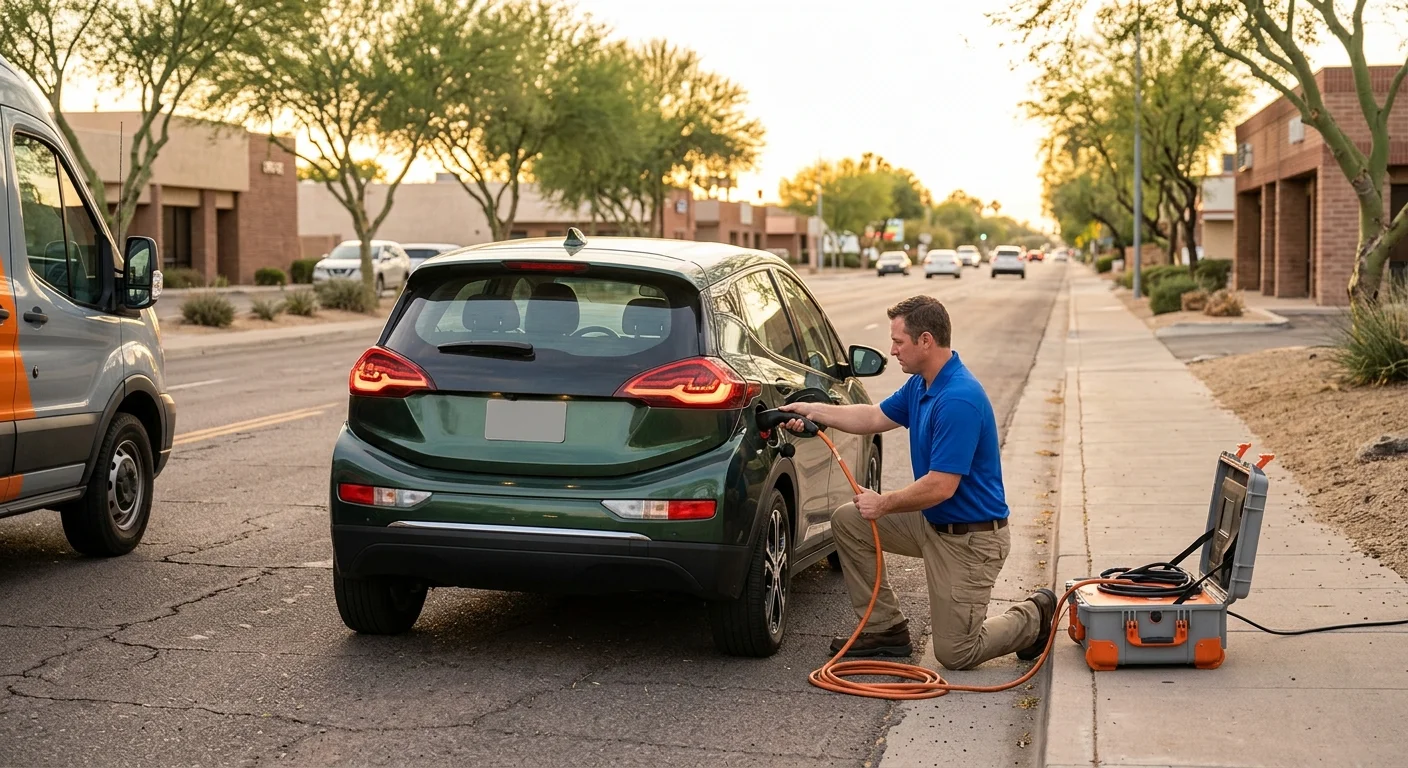
Where Glendale EVs actually stall
Glendale sits in the 250,000 to 280,000 population band. It is a West Valley city with a wide arterial grid and a freeway spine. Stalls follow that grid.
Northern Avenue is a frequent one. The dash promised enough range at noon. By late afternoon the same corridor is a different car. Glendale Avenue between Loop 101 and 51st Avenue is another. So are 59th, 67th, 75th, and 83rd, where a grocery lot and a left-turn lane both hide a dead EV from the next driver. Drivers searching mobile EV charging near me in this city usually mean that picture: the car is here, the plug is not.
Phoenix-area heat is the multiplier. Phoenix averages about 111 days a year at or above 100F, and about 21 at or above 110F. July highs average near 107F. Overnight summer lows sit in the mid-80s. Recurrent reports EVs can lose 20 to 30 percent of range above about 95F, with loss near 31 percent at 100F, from 345,622 trips by 300 Phoenix-area EVs. AAA’s 2026 study found about a 10 percent efficiency drop and an 8.5 percent range loss at 95F versus 75F. NREL reports climate-control loads can cut range meaningfully, with cabin cooling among the biggest draws.
Home charging would have prevented a lot of these stops. Glendale is an APS/SRP shared city, so the overnight plan on your bill depends on which utility serves the meter. A municipal off-peak EV incentive also shows up in search for Glendale. The dollar figure, the hours, and the eligibility rules were not confirmed in our claims ledger. Read the utility on your bill and confirm the current program before you plan around it.
When the car cannot roll to a working plug, that is a mobile EV charging match. If you still have a mile and a live stall is that close, use the stall. If you don’t, stay with the car.
Jumps, 12-volt no-starts, and other Glendale roadside jobs live on our EV roadside assistance in Glendale hub. This page stays on the empty-pack stall.
Loop 101, Grand Avenue, and stadium-area lots
The Agua Fria stretch of Loop 101 is Glendale’s freeway. It runs north-south through the West Valley and meets Glendale Avenue, Northern, Thunderbird, and Bell. An empty pack here is an out-of-charge stop on Loop 101 Agua Fria, with traffic at freeway speed next to your door.
Arizona’s Move Over law, ARS 28-775, says drivers approaching a stopped vehicle with flashing or warning lights must move over a lane if they safely can, otherwise slow down. Fines run $275, then $500, then $1,000 for repeats within five years. Leave the hazards on. Stay out of the travel lane.
ARS 28-871 says you may not stop or park on the traveled part of a highway outside a business or residence district if it is practical to get off it. A vehicle disabled so badly it cannot be moved is exempt. When you are stopped, leave room for other traffic to pass and be visible 200 feet in each direction. If the car will still creep, get it onto a ramp, a gore, or a frontage before the pack is fully dead.
ADOT’s Incident Response Unit covers Phoenix-area freeways from 5 a.m. to 8 p.m. weekdays. It clears crashes and debris, changes tires, and helps stranded motorists. Published materials do not mention EV charging. Arizona DPS Roadside Motorist Assistance is statewide. It changes tires, provides gasoline or diesel, jump-starts dead batteries, adds water, and calls tows. It says nothing about EV charging. Either unit may help you off the lane. The pack still needs a charger after that.
Grand Avenue, US 60, cuts northwest across Glendale as a diagonal. Stalls stack at the Northern and Glendale Avenue signals, in center turn lanes, and in the small lots that face the old highway. Arizona has no toll roads, so you are sitting in mixed traffic with freight, not in a pay lane.
Westgate-adjacent lots are the other Glendale stall. The concert-drain version lives on mobile EV charging around Glendale events. This page is the parked car that sat through a meal, a shift, or errands, then would not go. Pin the row and the nearest named entrance. Walking the lot for a public post wastes the range you no longer have.
HOV-lane occupancy rules apply during weekday rush hours. As of September 30, 2025, alternative-fuel and energy-efficient-plate vehicles no longer get solo HOV access. An empty EV in that lane is a stopped car in a restricted lane. Get it out of the travel path.
Public charger failed versus the pack hit zero
Two stalls look the same from the sidewalk. One still has range. The other is a pack at zero.
You reached a public stall and it did not charge. That is a plug problem. Heat is a common reason. Field measurement of DC fast chargers in extreme heat found offered power declining by up to 35 to 40 kW once rectifier temperature approached 55C. Efficiency dropped about 5 to 8 percent. Charging duration rose from 86 minutes in winter to 169 minutes under extreme summer conditions. The vehicle’s battery management system also requests lower current when thermal headroom is limited. If the car still rolls, try another stall. Then decide.
The pack hit zero. No creep. No second stall. That is out-of-charge recovery. A mobile Level 2 session is often the clean match. A typical rescue charge is 10 to 20 miles of range in 15 to 30 minutes of Level 2 charging. That is charging time on the cable, not travel time to you. It is a get-you-moving top-up, not a full pack.
Drivers talk about an 80/20 habit on DC fast stalls. Many people stop a public session near 80 percent because the last stretch takes longer as the pack fills. That habit does not map onto a Glendale shoulder. The operator is running a short, safe top-up so the car can reach a working plug or home.
AAA offers mobile EV charging in select markets through a pilot. Those trucks carry Level 2 mobile chargers and provide enough range to reach home or the nearest charging station, at no additional charge to members. Whether Glendale is inside that pilot could not be confirmed from our claims ledger. Check the live coverage in your membership app. Do not wait on a market that may not include this city.
Tesla’s roadside policy says assistance for a depleted battery is available but is not a financially covered service, regardless of warranty status. Tesla typically arranges transport to the nearest Supercharger or service center. Ford Roadside Assistance takes an out-of-charge Ford EV to the nearest public charger, the owner’s home, or their preferred Ford dealer within 50 miles of the breakdown. Beyond 50 miles it tows to the nearest charge station or Ford EV-certified dealer. Those programs arrange a tow or a transport. A local operator brings a charger to your bumper in a Glendale lot.
Club roadside, factory roadside, and a local ev mobile charging service are three different matches. Pick the one that fits the stall.
For a federal primer on charging after you are rolling, the U.S. Department of Energy keeps an electric vehicles overview.
How a mobile charge is quoted by local operators
Charge Pro PHX sets no price. The independent operator you match with quotes the job and bills you directly.
The quote is usually site, connector, and energy. A Level 2 unit can range from 2.9 to 19.2 kW power output. Most residential Level 2 chargers operate at up to 30 amps, delivering 7.2 kW. Roadside kits vary. Ask what the operator is bringing. J1772 and J3400 (NACS) are used for AC charging. A CCS vehicle inlet includes the J1772 portion for AC and adds separate DC pins for fast charging, so a CCS DC adapter alone does not establish AC compatibility. Rivian’s J1772 AC Adapter is a Rivian-approved part for AC chargers only. It must not be used with a DC charger.
Site changes the number. A Loop 101 shoulder with no safe pull-off is a harder setup than a marked stall in a Westgate-area lot. A private lot may need the property owner to allow a truck to stage and run a cable. Tell the operator if you are in a gated garage, a fire lane, or a stall the lot will ticket.
Energy is the other half. Operators quote a rescue top-up, not a fill. The 10 to 20 mile window is the typical shape. If home is farther, in Surprise or across town in Phoenix, say that before they start. Heat will slow the session. Charging power is reduced in high ambient heat. That is the pack and the charger protecting themselves.
There is no brand fee, no waiver, and no free-estimate promise on our side. Dollar averages for Valley mobile charging are not in our verified ledger, so we will not invent one. Confirm the operator’s number before the cable goes in. If they will not say it, decline and ask for another match.
Portable chargers for electric cars exist as equipment on an operator’s vehicle. They are not a public map of rolling stations. You match one operator. They come to your pin. They unplug and leave.
What the matched operator needs from you
Have this ready.
Your exact pin. Westgate is not an address. Row, level, and the nearest named entrance are. On Loop 101, give direction of travel and the closest interchange: Glendale Avenue, Northern, Thunderbird, or Bell. On Grand Avenue, give the cross street. The diagonal eats blocks and hides a car.
Make, model, year, and the inlet on the car. NACS, J1772, or CCS. Whether your adapter is in the car. If the 12-volt is also dead, say so up front. A pack at zero and a 12-volt that will not close contactors are different jobs. Some cars will not accept charge until low-voltage is up.
The state of charge the car reports, even if that is zero. Any dash warning. Whether the car will roll a few feet. Whether you already called Tesla, Ford, AAA, or a tow.
Stay with the vehicle when it is safe. An unattended car on the Agua Fria shoulder is a problem for the operator and for traffic. If you had to walk to shade, say where you are.
Access notes. Gate code. Lot hours. A manager who will let a charger stage. Campus and shopping lots have their own posted rules. We do not have a verified public charger count or a confirmed time limit for Glendale campuses in our ledger. Treat the posted sign as the rule.
You pay the operator. We do not take that payment.
If the operator cannot stage safely, they will say so. The match may shift to a flatbed to a working stall. That is still recovery.
Keep hazards on. Give approaching drivers the Move Over picture. Do not stand in a live lane to watch the connector.
When to call us
Call when the Glendale stall is real: pack at zero, a failed public stall behind you, and no safe roll to the next plug. Call us at (602) 932-0920 and we’ll connect you with a local EV rescue operator.