You found a free Phoenix charger, but the stall is full or broken. Before spending your remaining range on another listing, confirm its status, access rules, and connector.
What free EV charging in Phoenix actually means
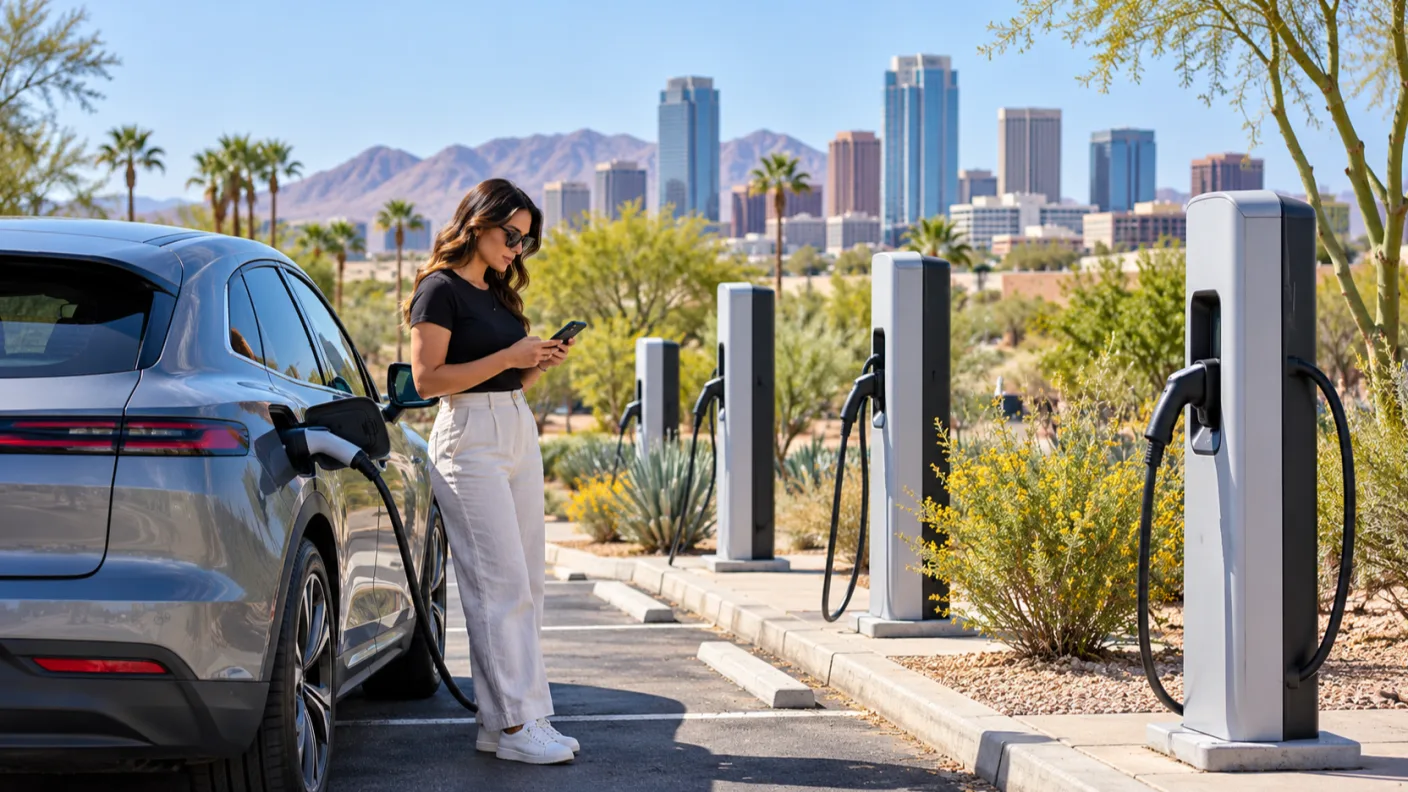
A search for “free EV charging stations Phoenix” doesn’t produce a dependable directory of available stalls. The City of Phoenix confirms that city-owned public ports exist at parks, libraries, the convention center, Sky Harbor, and parking garages. Its information doesn’t establish that every port is free, open, compatible, or working when you arrive.
Use the City of Phoenix public charging information as a starting point, not a live guarantee. Then check the charging network’s app before driving there.
“Free” may describe the charging session while leaving other conditions unresolved. Parking access, property access, session limits, connector requirements, and current availability can vary. None of those details could be confirmed for every Phoenix listing. The property and charging network set the current terms, so check both before relying on a stall.
Phoenix also spreads across a large area. A downtown garage near Chase Field isn’t a practical backup for every driver near Mayo Clinic Hospital in northeast Phoenix. Sky Harbor has confirmed Level 2 charging in the Terminal 3 garage, Terminal 4 garage, and at the 24th St. station. That doesn’t mean those locations provide free energy or an open stall. Confirm parking terms, charging cost, and live status before entering airport property.
If your search is really “where can I charge my EV near me,” start with distance and remaining range. Free charging only helps when you can reach it, access it, and connect successfully.
How to verify a stall before you drive to it
Check the same location in more than one place. Start with PlugShare, ChargePoint, the City of Phoenix map, and the charging app you already use. Your vehicle’s navigation can provide another view, but don’t treat any single listing as final.
Look for these details before leaving:
- Recent driver check-ins or fault reports
- Live port availability, when the network provides it
- The connector your car accepts
- Charging level and expected power type
- Property access and parking restrictions
- Any fee shown by the network or property
- Whether an account, app, or payment method is required
A station pin doesn’t prove that a charger works. An old review doesn’t prove that it remains broken either. Favor current network status and recent driver reports. If the listing conflicts with the property page, contact the property or network that controls the stall.
Connector details matter. J1772 and J3400, also called NACS, are used for AC charging. A CCS inlet uses its J1772 portion for AC and adds separate pins for DC fast charging. An adapter must match the car, connector, and charging type. Don’t assume a DC adapter solves an AC compatibility problem.
If the apps show uncertain information, choose a second reachable station before moving. Save enough range for that backup. Our charging apps guide explains what each source can tell you without turning one app into your only plan.
Drivers comparing connector types can also review public CCS and Tesla charging in Phoenix. Compatibility is more important than a tempting free label.
Grocery, garage, and workplace stalls that run out
Free chargers often attract drivers because the energy cost appears low or absent. That also makes an open port hard to count on. A grocery lot, parking garage, or workplace may show a charger online while every compatible stall is occupied.
The exact free-charging terms at individual Phoenix grocery stores, garages, and workplaces couldn’t be confirmed from the approved sources. Check the property and network before going. Don’t rely on an old photo, search snippet, or review that omits current access rules.
When you arrive, distinguish an occupied charger from a blocked space. A connected vehicle may still be charging. Another vehicle may have finished but remain parked. A non-EV may block the stall. The property controls its parking area, so bring access or enforcement questions to the property staff.
If another compatible port is open, inspect the charger screen and cable before starting. Follow the network prompts. Don’t use damaged equipment. If the unit reports a fault, note the station identifier and report it through the network’s support channel or app.
Downtown Phoenix adds another decision. A charger inside a garage may require enough remaining range to enter, circle, and leave if every port is taken. The same concern applies near event traffic around Chase Field and the downtown arena. Northeast Phoenix trips can involve a long cross-city backup route.
Set a personal cutoff before chasing another free station. Once your remaining range can’t support a verified backup, stop searching by price alone. Compare a reachable working charger with mobile EV charging or an appropriate tow. The cheapest listing isn’t useful when the car can’t reach it.
Empty pack versus a dead 12-volt at a free stall
A car beside a charger isn’t always waiting for energy. The high-voltage traction pack may be depleted, or the low-voltage system may be unable to wake the car and begin a session. Those problems need different help.
An empty traction pack usually follows falling range and low-charge warnings. The displays may have worked until the vehicle stopped. If the car reaches a compatible charger and communicates normally, the charging session may begin after you follow the network prompts.
A low-voltage failure can look different. The car may not unlock normally, wake its screens, release the charge-port door, or communicate with the charger. Plugging in doesn’t guarantee the high-voltage pack will start charging when the vehicle’s control systems have no usable low-voltage power.
Don’t apply a generic jump procedure. Battery type, access points, and instructions vary by model and year. For example, Tesla says the wires behind the current Model Y tow-eye cover only release the hood latches. They don’t charge the low-voltage battery. The actual jump posts are reached after opening the hood. Use the current owner’s manual for your exact vehicle.
A charger that starts and then stops may involve the stall, connector, account, vehicle settings, or heat. Phoenix averages about 111 days each year at or above 100°F. High ambient heat can reduce charging power, and the vehicle may request less current when thermal headroom is limited.
If you’re unsure which battery is causing the problem, don’t keep moving between stations. Describe the dashboard messages, lock behavior, remaining range, and charger response. For a fully depleted traction pack, out-of-charge recovery may be the better next step.
When a matched mobile operator is the next call
A matched mobile operator makes sense when you can’t safely reach a confirmed working charger. It can also help when the free stall is broken or full and your remaining range won’t support another search.
Charge Pro PHX is a referral service. We connect Phoenix-area drivers with independent local EV rescue operators. The operator evaluates the vehicle, quotes the service, performs the work, and bills the driver directly. Charge Pro PHX doesn’t own charging trucks, set prices, promise arrival times, or provide the physical service.
Share precise details when requesting a match:
- Your vehicle’s make, model, and model year
- Your location inside the lot or garage
- The displayed range or charge level
- Any warning messages
- Whether the doors, screens, and charge port respond
- The connector at the failed stall
- Any access or height limits at the property
Those details help separate an empty high-voltage pack from a low-voltage problem. They also help the operator assess connector compatibility and site access before accepting the job.
Mobile Level 2 charging is meant to restore usable range, not refill every battery. A typical rescue charge can add 10 to 20 miles of range during 15 to 30 minutes of Level 2 charging. That figure describes charging time, not operator arrival. Conditions and vehicle acceptance can affect the result.
If a faster public charger remains reachable, compare that option with roadside help. Our guide to rapid charging versus roadside service explains that decision. If the car can’t take power or can’t be moved safely, the operator may recommend a different recovery path.
When to call us
Call when the free stall is full, failed, or unreachable with your remaining range. A matched operator can assess whether mobile charging or another recovery option fits the situation.
Call us at (602) 932-0920 and we’ll connect you with a local EV rescue operator.