The car sat in a Sun City West driveway all afternoon. Now it won’t wake. You charged at home last night, so the pack shouldn’t be empty. That’s the usual stall here. The 12-volt cooked in West Valley heat. The traction battery may still have range. Charge Pro PHX matches you with independent local operators. They jump that small battery on site. Or they add a short Level 2 charge where you parked. That’s EV roadside assistance in Sun City West in practice.
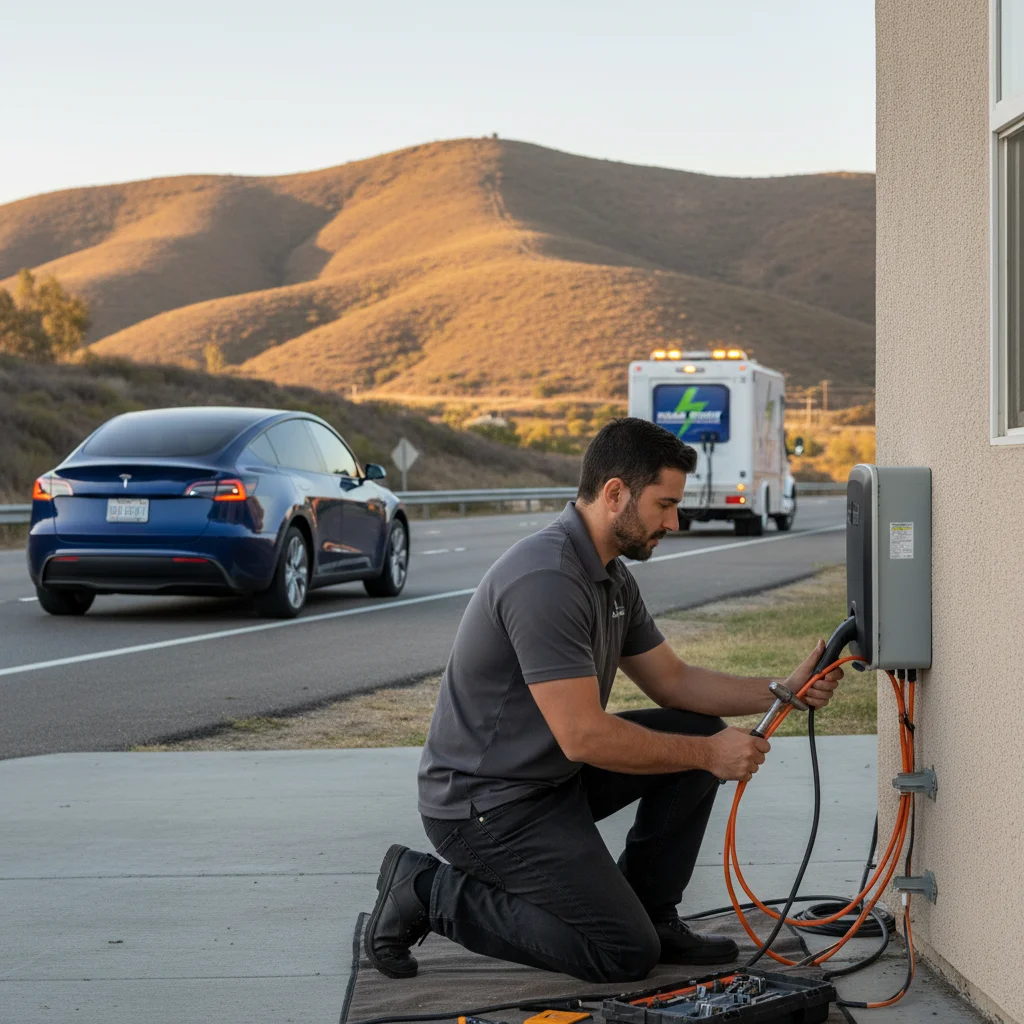
Sun City West is a CDP on the far northwest edge
Sun City West sits northwest of Sun City. It’s unincorporated. The Census Bureau treats it as a CDP, not a city. About 27,425 people live here. The land area is 11.9 square miles. The ZIPs are 85375 and 85387. It’s a 55-plus retirement community. There’s no city government of its own. Maricopa County is the local authority.
RH Johnson Boulevard is the everyday corridor. US-60 in this part of the Valley is Grand Avenue. That’s the northwest diagonal toward Glendale. It isn’t the Superstition Freeway on the east side. Corte Bella sits nearby. Surprise, Peoria, Glendale, and Goodyear are the next West Valley names. You’re on the far northwest edge. A parked stall here sits farther out than a stall in central Phoenix. The work at the car is still the same.
Cars in a 55-plus community sit longer than commute cars. A morning charge at the house looks like enough. Then the car rests in a club lot. An RH Johnson stall sits in the same heat. Golf, lunch, errands. The 12-volt is the part that gives up first. The car didn’t climb a mountain. It baked.
Newer houses than Sun City, same parked-car failure
Only 20.4 percent of Sun City West housing was built before 1980. In Sun City, 88.9 percent of homes predate 1980. That difference in age is the local contrast. Newer construction makes a 240-volt home circuit more realistic. Overnight charging is common in this kind of West Valley stock. It still doesn’t save a 12-volt that sat in the sun all day.
The traction battery can be nearly full. The 12-volt still runs the screens. It also runs the door handles. And it runs the contactor that ties in the main pack. A DC-DC converter only recharges that small battery while the car is on. Charging does the same. Tesla features like Sentry Mode keep drawing while you shop. Cabin Overheat Protection does the same in parked heat. When the 12-volt dies, the car looks bricked. It isn’t always empty. It’s locked out.
The older-street version sits next door. Dead EV help in Sun City covers that pattern. The heat is the same. The housing isn’t.
What Valley heat does while the car sits
Phoenix averages about 111 days a year at or above 100F. About 21 days reach 110F or more. July highs average near 107F. August sits near 105F. Overnight summer lows still land in the mid-80s. Sun City West runs that same Valley heat. The far northwest edge doesn’t cool it off.
Recurrent reports EVs can lose 20 to 30 percent of range above about 95F. That dataset included 345,622 trips by 300 Phoenix-area EVs. AAA’s 2026 study found about a 10 percent efficiency drop at 95F versus 75F. Range loss in that study sat near 8.5 percent. NREL notes cabin cooling is one of the bigger draws. You feel that on Grand Avenue with the air on. You also feel it after hours on a hot driveway.
The Battery Council International studied starter-battery failures in heat. Battery University reports that work. Starter batteries last about 47 months in hot climates. They last about 59 months in cool ones. A battery that might last five years elsewhere can fail in two or three here. AAA calls heat the number-one cause of battery failure. It recommends AGM batteries for hot areas. In an EV, that small battery’s death strands you. The traction pack can still be healthy.
How to tell a dead 12-volt from an empty pack
Run the simple checks before you assume you need a charger. See if the screens light. See if the doors unlock. See if the charge port opens. If everything is dead, treat it as a 12-volt. Have someone test it. A car that shows range but won’t go into drive is the same story. Heat-worn 12-volts in the Valley are laid out in Tesla 12-volt failures in desert heat.
If the car is awake and the miles are gone, you need a charge. That’s a charge, not a jump. Don’t sit in the traveled lanes of Grand Avenue while you decide. ARS 28-871 limits where you may stop. You may not sit on the traveled part of a highway outside a business or residence district. Get off it when that’s practical. A vehicle disabled so badly it can’t move is exempt. Leave room for traffic to pass. Stay visible 200 feet in each direction.
ARS 28-775 is the Move Over law. Other drivers must change lanes or slow for warning lights. That’s for your safety while someone works the shoulder.
What the operator brings to a Sun City West stall
Charge Pro PHX doesn’t own trucks. It doesn’t employ technicians. It’s a referral line. We connect you with independent mobile rescue operators. The pros we connect you with are licensed and insured. The operator quotes you before any work starts. That operator bills you directly.
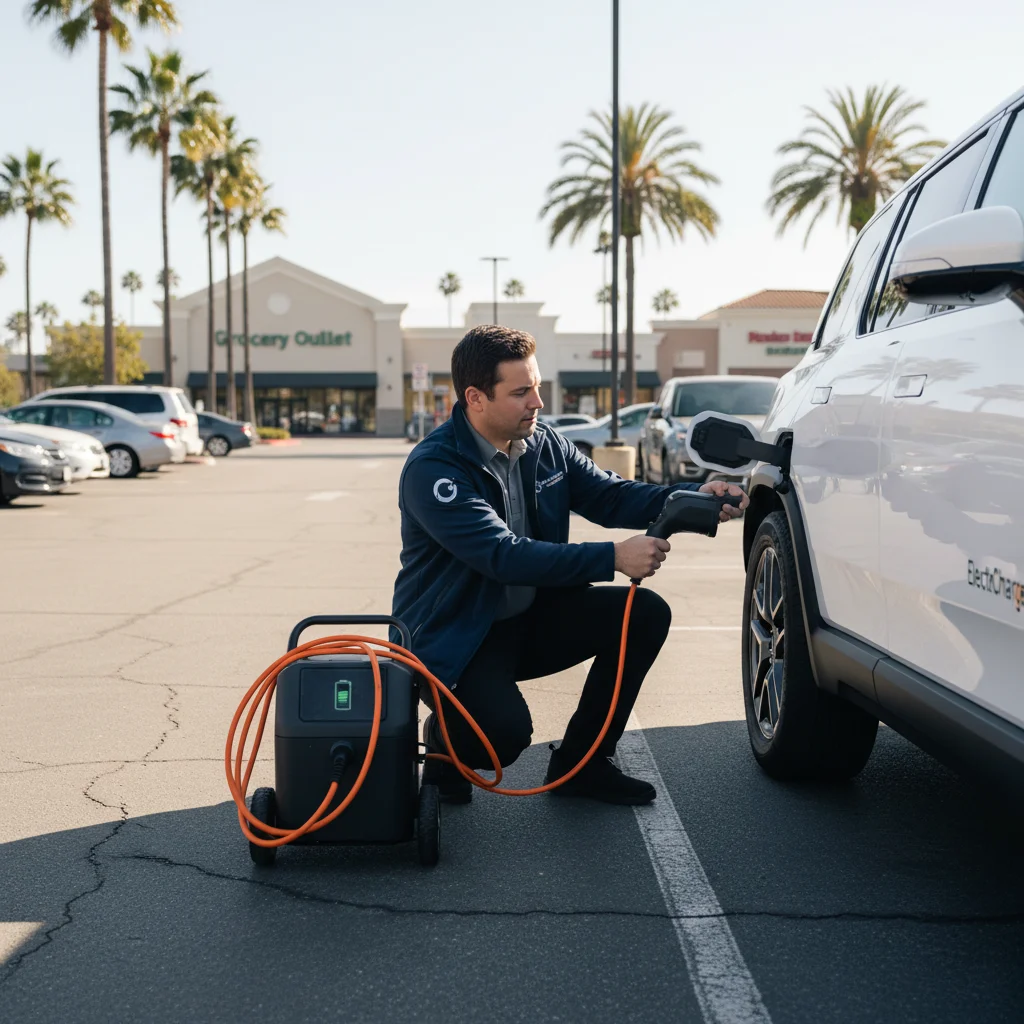
If the 12-volt is dead, they jump or replace it. That can happen on the driveway, a club lot, or the shoulder. A Tesla 12-volt jump is the first move when the car is silent. If the traction pack is actually empty, they bring a 240V Level 2 source. Teslas get a native NACS plug. Other brands use a CCS or J1772 adapter. Charging time is typically 15 to 30 minutes. That usually adds 10 to 20 miles of range. That’s charging time. It isn’t a promise of when someone arrives.
Arizona’s free motorist programs don’t advertise this work. DPS Roadside Motorist Assistance changes tires. It brings gasoline or diesel. It jump-starts batteries. Its published materials name gasoline and diesel. They don’t mention charging an EV that’s out of range. ADOT’s Incident Response Unit works Phoenix-area freeways on weekdays from 5am to 8pm. It clears debris. It helps stranded motorists. It also doesn’t advertise an on-site EV charge. Tesla factory roadside, for an empty pack, tows toward a Supercharger or service center. It doesn’t charge you where you sit.
Charge, jump, or tow from RH Johnson and Grand Avenue
A tow still has a place. A damaged suspension may need a flatbed. So may a car the operator can’t wake. Arizona sets no statewide private tow rate cap. Cities and counties may set local maximums. Confirm the bill with the towing company before you sign. Private property tows need the owner’s written authorization or a police request.
For a car that simply won’t wake, start with a jump. A short Level 2 charge is the other path. You skip the load. You skip the shop wait. You skip a second handoff at a public stall. Compare those paths in charge it, jump it, or wait for a tow. Mobile EV charging covers the empty-pack stop. EV roadside assistance is the broader on-site help.
Stay with the car if it’s safe. Note whether screens, locks, and port lights respond. Tell the operator that detail. The operators we match handle Tesla and every major EV brand. Adapters ride with the truck. You shouldn’t need to supply one.
When you’re ready to match an operator
You’re in a 55-plus CDP past Sun City. It’s the far northwest Valley edge. The housing is newer than Sun City’s. The 12-volt still dies after a parked day. Charge Pro PHX will match you with a local independent operator. Call (602) 932-0920 when you want that match. The operator sets the price. We don’t.