Your EV died in Sacaton, and this isn’t a Phoenix suburb problem. You’re on Gila River Indian Community land south of Chandler. Charge Pro PHX is a referral line. We match you with an independent operator. That’s EV roadside assistance in Sacaton, an on-site charge or a 12-volt jump.
Sacaton is Gila River land, not a Valley suburb
Sacaton is the seat of the Gila River Indian Community. That’s a sovereign nation between Phoenix and Casa Grande. It isn’t a Chandler neighborhood that spilled over the county line. The community has its own government and police. District roads and the townsite sit under tribal jurisdiction. A stalled EV here isn’t the same as a stall in a city garage.
The 2023 Census Gazetteer lists about 9.3 square miles of land. ZIP 85147 covers the townsite, and ACS 2020-2024 counts 3,429 residents. This is a small place on the southeast and Pinal belt. A match from the central Valley is a long-haul dispatch. The operator talks timing when they quote the job. We don’t publish arrival times, and we don’t promise one.
About 19.6 percent of housing here was built before 1980. Some drivers charge at home on a 240-volt circuit. Others share an outlet and wake up short. The calls that matter still happen on the road. Townsite streets, district community roads, and I-10 are where cars stop.
Chandler sits north of Gila River land. Casa Grande sits south along the interstate. Maricopa, San Tan Valley, and Apache Junction share the wider belt. Maricopa the city is in Pinal County, not Maricopa County. Blackwater and Casa Blanca are Gila River communities on the same nation. None of those names change the ground under your tires. Until you leave it, you’re on sovereign land. For matching details, use the Sacaton EV charging page. If the day started as a Chandler commute, EV roadside assistance in Chandler covers that pattern.
I-10 between Chandler and Casa Grande
I-10 is why Sacaton shows up in roadside calls. The interstate runs between Chandler and Casa Grande across open desert. Heat sits on that pavement with almost no shade. Summer range loss of 20 to 30 percent is the main issue here. A morning cushion in the East Valley can vanish on the southbound pull.
This isn’t the I-17 climb toward Black Canyon City. I-10 south toward Casa Grande sits around 1,380 feet. Phoenix and Sky Harbor sit about 1,135 feet. You’re not burning a posted 6 percent grade. You’re losing range to heat, speed, and air conditioning.
Cabin cooling, highway speed, and sun on the pack all add up. Recurrent reported EVs can lose 20 to 30 percent of range above about 95F. Loss ran near 31 percent at 100F in that set. AAA’s 2026 study found about a 10 percent efficiency drop at 95F versus 75F. Range loss in that study was about 8.5 percent. In summer, plan with the harsher number. The nav still prefers the cooler one.
If the car loses propulsion on I-10, get off the traveled lanes if you can. ARS 28-871 covers highway stops outside a business or residence district. You may not stay on the traveled part when leaving it is practical. A vehicle disabled so badly it can’t be moved is exempt. Leave room for other traffic to pass. Keep the car visible 200 feet in each direction. Turn on the hazards and stay out of live lanes.
Arizona’s Move Over law is ARS 28-775. Drivers who approach a stopped vehicle with flashing lights must move over a lane if they can do it safely. If they can’t, they have to slow down. That rule exists because shoulder work is dangerous. Keep the traffic-side doors shut. Wait in the vehicle when that’s the safer choice.
Arizona DPS Roadside Motorist Assistance can change a tire. It can bring gasoline or diesel, jump a conventional battery, add water, and call a tow. ADOT’s Incident Response Unit works Phoenix-area freeways from 5am to 8pm weekdays. Published materials for both programs name gasoline and diesel. They don’t advertise charging an EV or recovering an empty pack. An independent mobile operator is who brings a 240-volt source to the car.
Peace officers can order a disabled or obstructing vehicle removed under ARS 28-872. Owners pay tow and storage costs before release. If the only problem is an empty pack or a dead 12-volt, a charge or jump on site can keep you out of that chain. If the car is wrecked or blocking a live lane, a tow is the honest call. ARS 28-674 says to move a minor-crash vehicle off the traveled roadway when it’s safe. You’re not at fault merely for moving it.
For the wider interstate pattern, read out of charge on I-10 in the heat. Sacaton is the Gila River pin on that south run.
Heat, range, and the small 12-volt
Sacaton runs full desert heat on that exposed I-10 corridor. Phoenix averages about 111 days a year at or above 100F, per NWS Phoenix. About 21 days hit 110F or more. July highs average near 107F, with overnight lows still in the mid-80s. The cabin never really cools in the dark.
NREL reports climate-control loads can cut EV range. Cabin cooling is one of the biggest draws. You feel it during a parked wait with the AC on. You feel it again on the next highway pull. Don’t treat a morning range number as an evening promise. Monsoon season runs June 15 to September 30. Haboobs can drop visibility to near zero. If dust is on you, stay in the car until you can see.
The other heat failure is the 12-volt auxiliary battery. In an EV, that small battery runs door handles, screens, and the contactor for the high-voltage pack. A DC-DC converter only recharges it while the car is on or charging. If the 12-volt dies, the car can sit with a full traction battery and still refuse to wake. Tesla features like Sentry Mode and Cabin Overheat Protection draw power while parked.
Battery Council International work, via Battery University, found starter batteries last about 47 months in hot climates versus 59 in cool ones. A battery that lasts five years elsewhere can fail in two or three in the desert. AAA calls heat the number-one cause of battery failure. If the fob does nothing, the handles stay dead, or the car boots and dies, think 12-volt first. That isn’t a range problem.
Operators in this network jump or replace a dead 12-volt on site. They handle Tesla and every major EV brand. If the car is locked and silent, start with Tesla 12-volt battery jump. Tell the matcher the make and model. Jump points differ by brand. Don’t assume a gas-car pack and random clamps are the right move.
Empty pack versus a car that won’t start
Two Sacaton calls look the same from the shoulder. They aren’t the same job.
An empty traction pack means the car drove until it couldn’t. You need energy into the high-voltage system. The operator brings a 240-volt Level 2 source to the car. Native NACS covers Tesla and other NACS-native vehicles. CCS or J1772 adapters cover everyone else. Typical charging time adds 10 to 20 miles of range in 15 to 30 minutes. That’s plug time, never a promise of when someone arrives. It’s often enough to reach a charger you pick, once you confirm the stall is working.
A dead 12-volt means the car won’t start, unlock, or stay awake. Jumping or replacing that small battery is the job. Charging the main pack won’t help until the 12-volt lets the contactors close.
Carmaker roadside doesn’t always do what drivers expect. Tesla won’t charge on site. It tows to the nearest Supercharger or service center, and that tow is billed. Ford tows to the nearest charger, home, or dealer within 50 miles. Rivian and Hyundai/Kia owners have documented trouble getting a dead EV towed. They’re told to request a tow in plain words. None of that is a Gila River-only rule. It’s why a local operator with a plug still matters when factory dispatch wants a flatbed.
Confirm live public charging in the U.S. Department of Energy AFDC station locator. I-10 is a designated NEVI corridor, with construction underway in 2026. Don’t assume a pin on a map is up. Check the app, then decide if you can drive to it.
What the operator actually brings
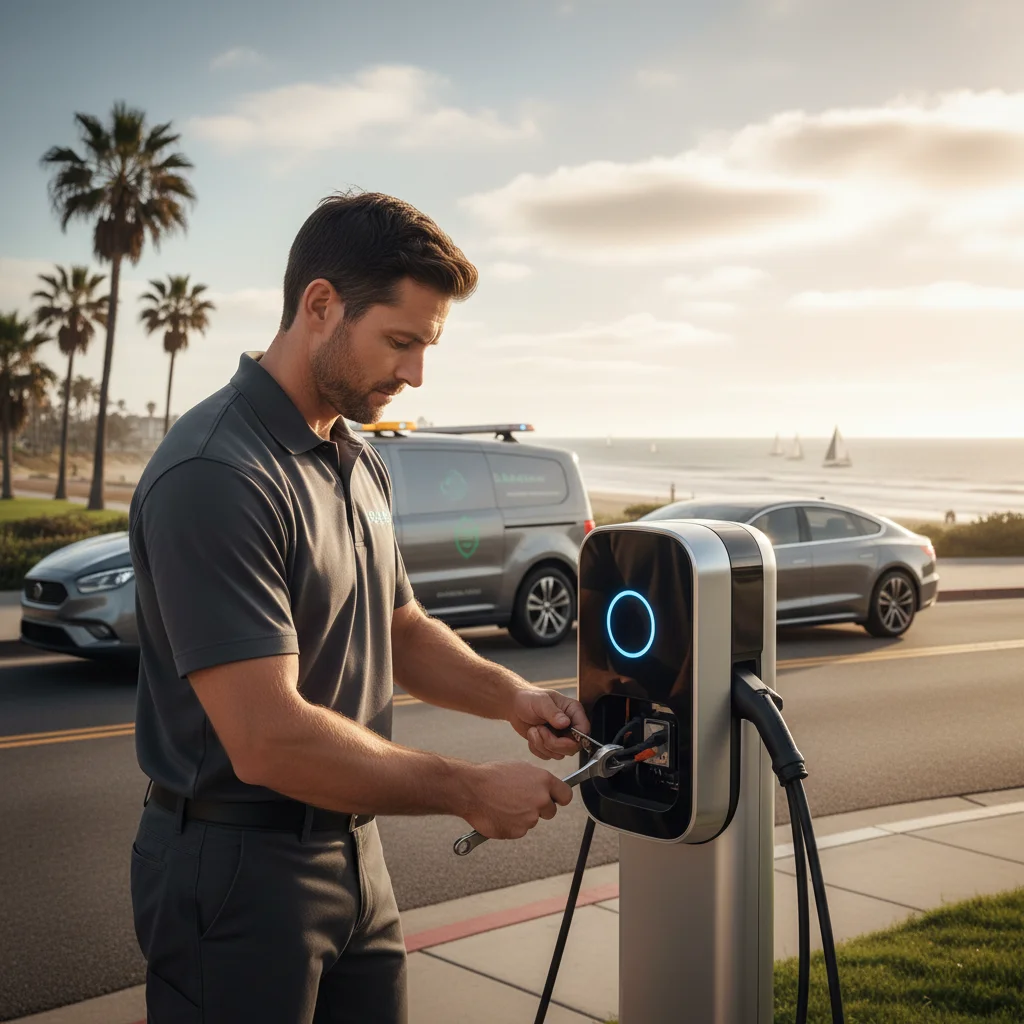
Charge Pro PHX doesn’t own trucks, yards, or chargers. We don’t employ technicians, and we don’t set prices. The independent operator quotes you before work starts and bills you directly. If the quote isn’t right, you can decline.
Those operators bring a 240-volt Level 2 source to the car. They carry a native NACS plug. They carry CCS or J1772 adapters for non-Tesla EVs. They typically add 10 to 20 miles in 15 to 30 minutes of charging. They jump or replace a dead 12-volt on site. They handle Tesla and every major EV brand.
That’s mobile EV charging at the vehicle, not a dealership drop. For a pack that hit zero, out-of-charge recovery is the matching path. If you’re choosing between a plug and a flatbed, charge it, jump it, or wait for a tow walks through the fork.
Stay with the car if you can do so safely. Share the mile marker, a cross road, or a landmark on Gila River land. Townsite, a district road, and an I-10 shoulder all change access. Tribal jurisdiction means you may also be talking with Gila River police, not a city officer. Be plain about where you are. The matcher can’t guess a district road from a freeway pin.
Home charging questions belong to your utility and your address. The Valley splits among APS, SRP, Mesa Municipal Electric, ED3, and ED2. Sacaton is Gila River land, so a city-level utility map is the wrong tool. Confirm power and any EV rate at the meter you actually use.
Frequently asked questions
Can a mobile operator help on Gila River land in Sacaton?
Yes, Sacaton is in the Charge Pro PHX service area for the Phoenix area. We match you with an independent operator for the townsite, district roads, and I-10 between Chandler and Casa Grande. The operator quotes before starting. We don’t hold a trade license, and we don’t roll a branded fleet.
What if the EV won’t unlock or power on?
Treat that as a 12-volt failure until proven otherwise. The traction pack can still hold range while the small battery is dead. Operators in the network jump or replace that 12-volt on site. Give the make, model, and year so they bring the right lead location. Don’t keep cycling the fob in the heat. It doesn’t refill a cooked auxiliary battery.
Should I wait for a tow or ask for a charge?
If the car is intact and the problem is an empty pack or a dead 12-volt, on-site charging or a jump is the usual fix. A tow moves an empty car, and you still have to charge it later. If there’s crash damage, a mechanical failure, or a live-lane blockage, a tow is the right call. Factory Tesla roadside is built around a tow to a Supercharger, not a charge at the bumper.
When you’re ready to match with an operator in Sacaton, call (602) 932-0920. Tell them you’re on Gila River land, on I-10, or in the townsite. The operator quotes the work before it starts.