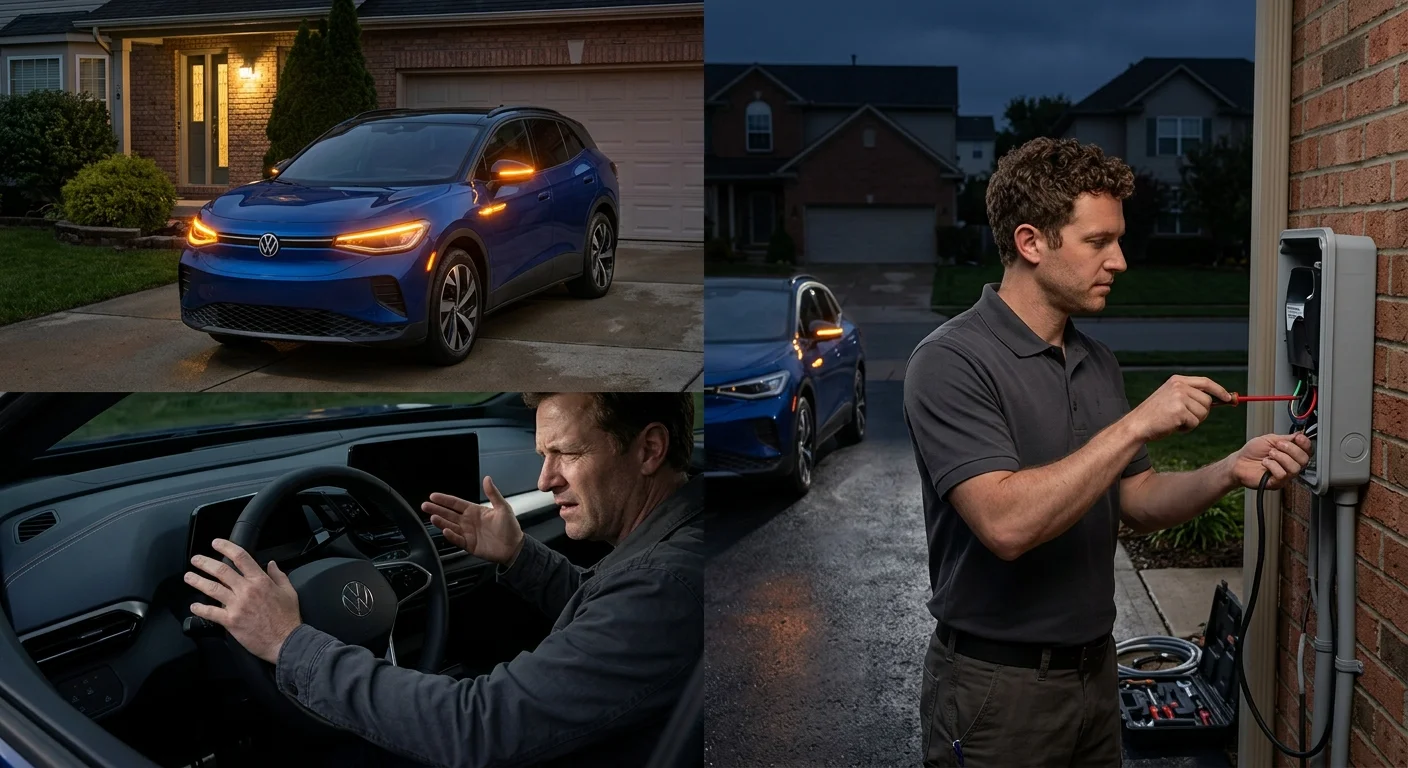
Your Volkswagen ID.4 sat in the Phoenix driveway through another 110-degree day, and now the screens won’t wake. The big battery has range. The small battery is dead. ID.4 12-volts fail early in desert heat and strand a full-pack car. Here is what to do.
Why an ID.4 in the desert goes dark
Every modern EV, including the ID.4, runs on two power systems. A high-voltage traction pack drives the wheels, and a 12-volt auxiliary battery runs the computers and the contactor that connects the main pack. If the 12-volt dies, the car is completely asleep even with a charged traction battery.
Heat is the killer. Independent research summarized by Battery University puts 12-volt service life at about 47 months in hot climates versus 59 in cool ones. Phoenix averages about 111 days a year at or above 100F and about 21 days at or above 110F. A 12-volt that would last five years in a temperate garage can fail in two or three on a Valley driveway.
The ID.4 has a 12-volt that has been reported by owners to fail earlier than the platform’s design target. VW issued technical service bulletins for early-build cars related to 12-volt management. A driver in Tempe or Mesa who parked an early-build ID.4 in the sun for a year may see the failure sooner than a 12-volt normally would.
What the failure looks like at the car
When the 12-volt is dead, the ID.4 shows the same pattern as other modern EVs:
- The fob stops responding and the cabin won’t unlock
- The flush door handles stay tucked in
- The dash, infotainment, and interior lights stay dark
- No welcome chime, no clunk as you walk up
If instead the car wakes, throws a warning, and then goes dark again, that points to a different fault and a dealer scan. For the “nothing happens at all” version, start with the 12-volt.
For the wider view of what a hot parked day does to an EV, see what happens when an EV 12-volt dies in heat.
Getting into a locked ID.4 when the 12-volt is dead
Use the mechanical key blade hidden in the fob. Slide the small release on the fob body and pull the metal blade out.
The ID.4 driver-side door has a lock cylinder behind the handle. Pull the handle out, expose the cylinder, insert the key blade, and turn to unlock. You are in the cabin now even with zero power in the car. The same trick works on other modern EVs; for the parallel, see Tesla 12-volt rescue.
Where the 12-volt lives and how to jump it
The ID.4 12-volt sits under the hood, with a red-capped positive post. A dead 12-volt keeps the hood latch from releasing electrically, so the first step is to get into the cabin through the driver’s door. The hood release is the conventional pull inside the car.
Once the hood is up, the 12-volt is in plain sight. Jump it with a portable jump pack or a properly sized donor battery. Connect the red clamp to the positive post. Connect the black clamp to bare, unpainted metal on the chassis, not the negative terminal. That keeps any spark away from the battery. Let the donor feed for two to three minutes, then try to power the car up.
If the car still won’t wake after a clean jump, stop. A deeper electrical fault can mimic a dead 12-volt, and forcing another jump is not safe. For the full walk-through, see how to jump an EV safely in the heat.
When a mobile operator is the right call
If the manual key won’t turn, if the hood won’t release, or if the car won’t wake after a clean jump, stop there. That is also the right move for a dead ID.4 at a Chandler mall, at a Scottsdale resort valet, or on the shoulder of Loop 101 with the AC off.
Charge Pro PHX matches you with an independent local operator who carries a jump pack sized for an ID.4, opens the car without forcing handles, load-tests the 12-volt, and quotes a replacement on site if the battery is at end of life. For the broader view of how this works, see non-Tesla EV rescue in the Phoenix area.
What to do this week if you drive an ID.4
If your 12-volt is original, replace it before it strands you. The cost of a planned swap is one number. The cost of a tow plus an emergency swap at the mall is another. Confirm the spec against your owner’s manual before you buy, and consider an AGM battery for the Valley climate.
If the ID.4 already sits dark in your driveway or in a Glendale lot, call (602) 932-0920. Have your location and the model year ready. The operator quotes before any work starts and bills you directly.
Frequently asked questions
Why does the ID.4 12-volt fail in Phoenix heat?
Heat shortens 12-volt life. The Valley averages about 111 days a year at or above 100F. A 12-volt that would last five years elsewhere can fail in two or three here. Early-build ID.4s have additional reported sensitivity.
Can I jump an ID.4 12-volt myself?
Yes, with the right steps. Use the red-capped positive post under the hood and ground the black clamp to bare metal on the chassis, not the negative terminal. Let it feed for two to three minutes before trying to start.
What if the ID.4 still won’t wake after a jump?
Stop. A deeper electrical fault can mimic a dead 12-volt. Calling for a mobile operator or a flatbed is safer than another jump.
Does Charge Pro PHX service the VW ID.4?
Yes. We match you with an independent local operator who carries the gear to open the car, jump the 12-volt, and replace it on site if needed. The operator quotes and bills you directly.