You left sentry on in a Sky Harbor East Economy stall, or in a Chase Field lot, and walked back to a dark screen. Phoenix heat plus cameras and cabin overheat protection wear the small battery, even when the high-voltage pack still holds range.
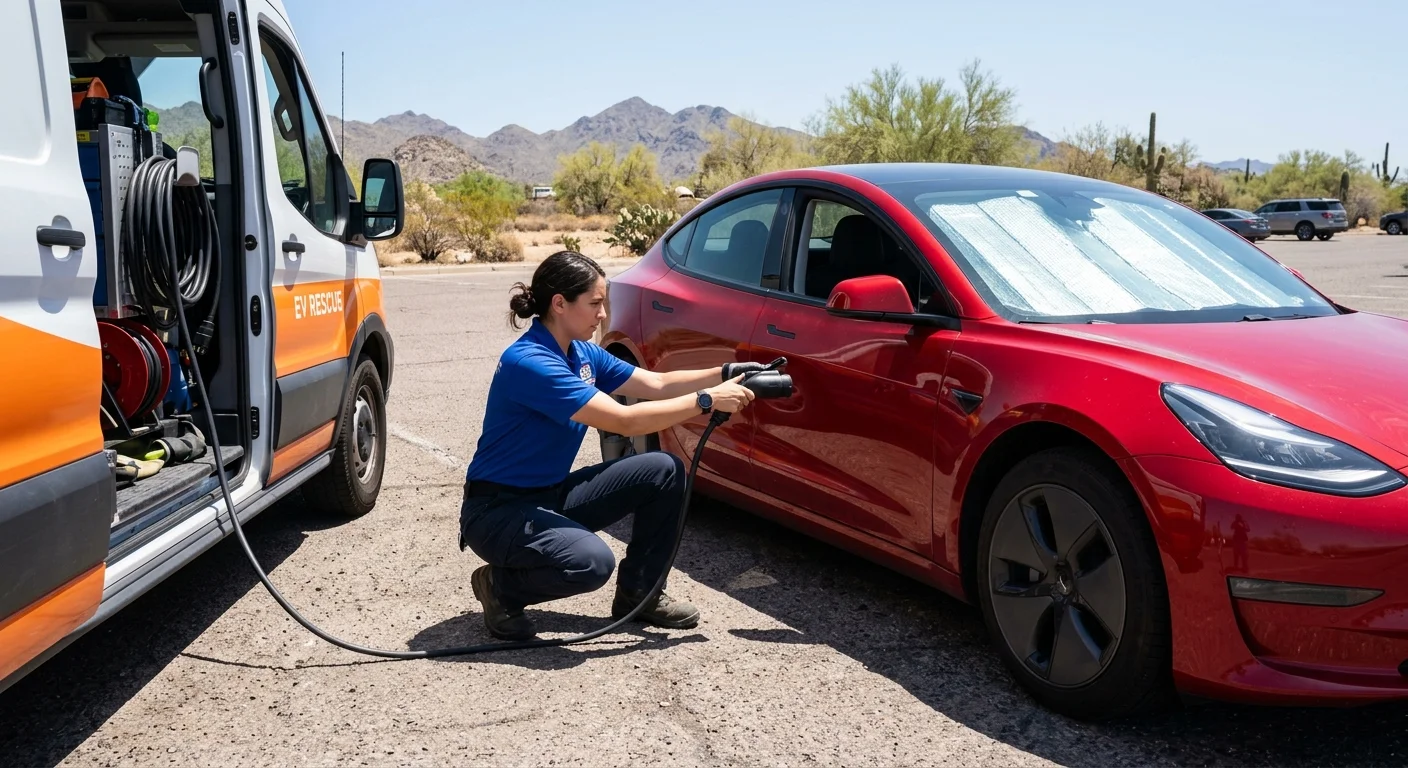
How sentry and cabin overheat wear the small battery
Sentry mode keeps the cameras awake after you park. Cabin overheat protection can keep the climate system working so the interior does not cook. Both draw from the low-voltage system that wakes the computers and pops the handles. The big pack stores driving range. It does not, by itself, let the car wake up.
Phoenix makes that split worse. The city averages about 111 days a year at or above 100F, and about 21 at or above 110F, per NOAA normals via NWS Phoenix. July highs sit near 107F. August sits near 105F. Overnight summer lows stay in the mid-80s. Monsoon season runs from June 15 through September 30, so a late-September sit still feels like summer.
Tesla does not publish a sentry-mode drain figure we can cite. There is no verified amp-hour number in Tesla’s owner docs for cameras plus cabin overheat on hot asphalt. Use the car’s energy app and the current owner’s manual for your model. If the app shows high parked-day use, sentry and cabin climate are the first settings to check. The Tesla app shows sentry status while the 12-volt still has power.
A current Model Y uses a lithium-ion low-voltage battery, per Tesla’s Model Y owner’s manual. Battery type and the jump-post procedure vary by model and year, so confirm yours in the vehicle information. Heat still shortens small batteries here. Battery Council International work, via Battery University, found starter batteries last about 47 months in hot climates versus 59 in cool ones.
Uncovered lots in Mesa, Gilbert, and Chandler bake in open sun. West Valley asphalt in Goodyear, Buckeye, and Surprise often has less shade. Scottsdale garages help, but they are still hot. That is why a Tesla 12-volt failure in desert heat often starts as a parked-day problem, not a driving one.
Signs the 12-volt is dying after a hot parked day
A failing 12-volt after a hot parked day rarely starts with a tow. It starts with small glitches. The screen is slow to wake. Door handles stay flush. The app shows the car as offline even though you parked with plenty of range. Bluetooth drops in a Tempe Marketplace lot. The camera view in the app is blank.
When the 12-volt is fully dead, the car looks bricked. Screens stay black. Handles do not present. The charge port may not open. You cannot shift. People assume the main pack is empty. Often it is not. Range can still sit in the app from the last wake, or the app cannot reach the car at all. That lockout pattern is the same one in locked out after the 12-volt dies.
Tesla does not publish a remaining-hours figure after a low-voltage warning. We could not confirm a countdown in Tesla’s owner docs. Treat a warning as a now problem in Phoenix, especially after sentry sat through a 100F afternoon.
Watch for repeat drain. You restore it, drive home, and the same symptoms return after the next workday in a sun lot. That is a worn pack, not a one-off. Lithium low-voltage packs fail in heat too. The lithium 12-volt dead in Phoenix heat pattern is the same lockout, with a different chemistry and a different jump procedure.
Downtown parking near Chase Field keeps cameras busy. East Economy at Sky Harbor adds long sit time. A car that was fine on a short Scottsdale errand can be dead after eight hours at the airport.
What you can check from the curb before a jump
Stay off the traveled lanes. ARS 28-871 says you may not stop on the traveled part of a highway outside a business or residence district if it is practical to get off it. A dead Tesla in a lot is a lot problem. A dead Tesla on I-10, Loop 202, or the I-17 shoulder is a traffic problem. Move out of the lane if you can and put on hazards.
From the curb, check the app first. If the car still answers, look at sentry status, cabin overheat, and the last known range. Open the energy app if the screen still wakes. Tesla does not publish a sentry drain number, so that graph is the evidence you have.
If the app is dead and the handles are flush, stop yanking. Repeated key commands will not wake a flat 12-volt.
Tesla’s current Model Y manual is specific about the hood. The wires behind the tow-eye cover only release the hood latches. They cannot charge the low-voltage battery. Disconnect them once the hood unlatches. Tesla says those cables must not stay connected more than 30 seconds. Jump posts are reached after the hood is open. Procedures differ by model. A Model Y cannot jump another vehicle. Tesla’s manual says doing so can result in damage.
If you are not sure which terminals are which, wait for a Tesla 12V battery jump from a matched local operator. Arizona DPS Roadside Motorist Assistance will jump-start dead batteries statewide, but its published materials name gasoline and diesel and say nothing about EV charging or Tesla low-voltage procedures.
Jump versus a mobile charge versus a tow
A dead 12-volt and an empty high-voltage pack are different jobs. If the screens are black and the handles are dead, restoring low-voltage comes first. A mobile Level 2 charge cannot talk to a car that will not wake. Charge Pro PHX is a referral service. We connect you with independent local operators. The operator quotes and bills you. We set no price and promise no arrival time.
A typical rescue charge, once the car can accept power, is 10 to 20 miles of range in 15 to 30 minutes of Level 2 charging. That is charging time, not travel time. It helps when the main pack is low and the car already wakes. It does not replace a 12-volt jump.
Tesla roadside assistance is requested in the Tesla app under Roadside. Tesla’s policy says assistance for a depleted battery is available but is not a financially covered service, regardless of warranty status. Tesla typically arranges transport to the nearest Supercharger or service center. That is a tow path, not an on-site 12-volt repair.
Tow is the right call when you are on a freeway shoulder, in a tow-away stall at Sky Harbor, or the car will not hold a jump. ARS 28-872 lets police order a disabled or obstructing vehicle removed. Owners pay reasonable tow and storage costs before release.
If you are in a lot at Mesa Riverview or Tempe Marketplace, a jump plus a short drive is often enough. If sentry also flattened range, the operator may need both a low-voltage restore and a Tesla roadside rescue charge. The U.S. Department of Energy explains how EV systems split high-voltage traction from 12-volt accessories.
How a matched local operator handles a lockout
When the 12-volt is dead, you may not get in. Flush handles, a silent app, and a dark cabin are a lockout, not a range problem. The matched operator’s first job is access and low-voltage restore, using the procedure for your model.
On a current Model Y, that means opening the hood the Tesla way, then using the jump posts. The tow-eye terminals only unlatch the hood. They cannot charge the low-voltage battery. The operator should disconnect them as soon as the hood is up. Other models differ. A lithium pack is not jumped like an old lead-acid starter battery. Chemistry and post location change by year.
Once the car wakes, the operator checks whether the high-voltage pack still has range. If it does, you may drive to a charger or home. If sentry and cabin overheat also used up usable range, a Level 2 rescue charge can add 10 to 20 miles in 15 to 30 minutes of charging. If the car will not hold voltage, or you are blocking a travel lane, a flatbed is safer than another jump.
Charge Pro PHX does not jump the car, own trucks, or send a crew. We match you with an independent local operator who does the work and bills you directly. No brand warranty attaches to that work. Ask the operator what they found.
After you are moving, turn sentry off for long airport sits if you can accept the camera tradeoff. Use a covered stall when you can, including the Terminal 3 and Terminal 4 garages at Sky Harbor, where Level 2 charging is confirmed.
When to call us
A dark Tesla after a hot Phoenix park is a 12-volt rescue, not a guess at the main pack. If the app is offline, the handles are flush, and you cannot get in, you need a matched local operator.
Call us at (602) 932-0920 and we’ll connect you with a local EV rescue operator.