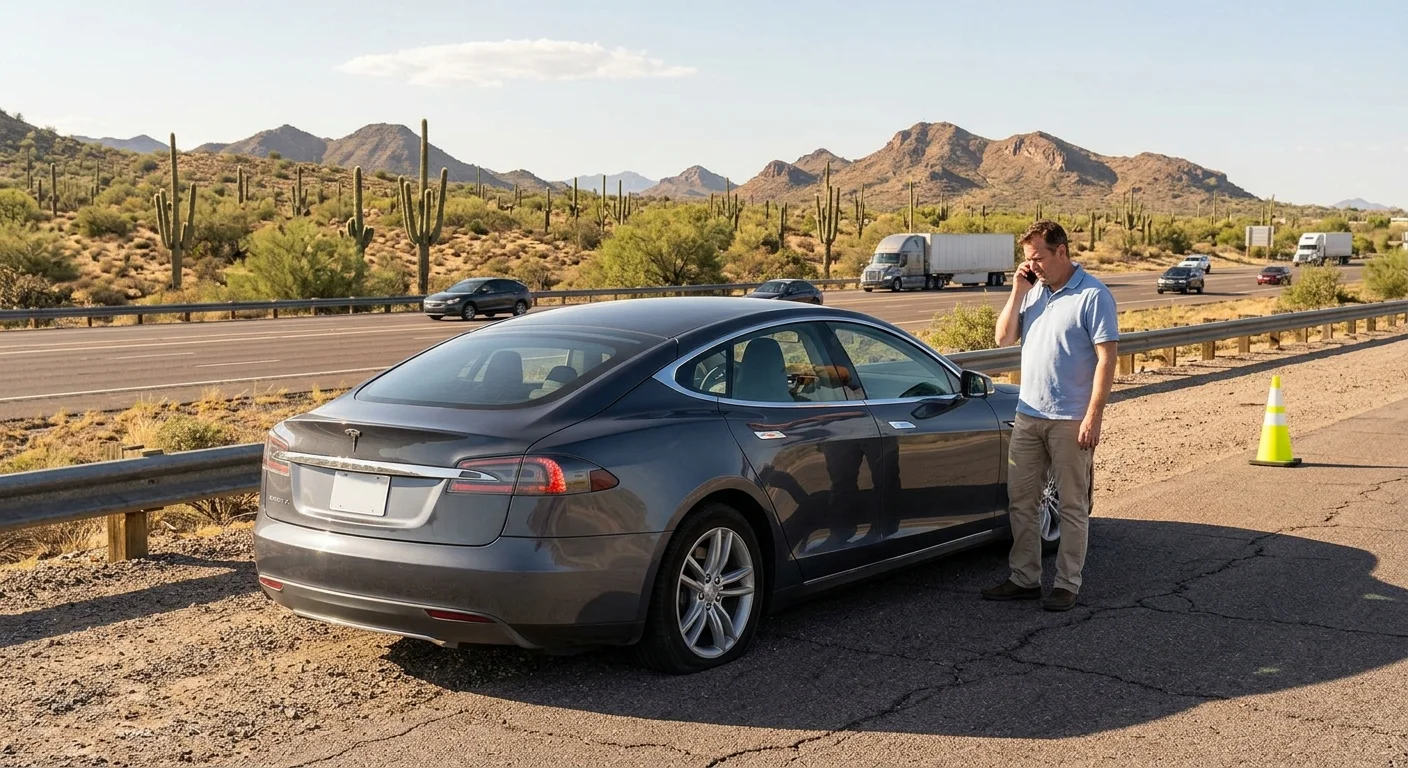
The car is a Tesla. The tire is gone. You are on a Phoenix freeway shoulder in afternoon heat, typing tesla roadside assistance for a flat tire into the app because there is no spare in the trunk. Factory roadside is one path. A matched local operator is another. They are not the same job, and Tesla does not publish the dollar answers most drivers want before they tap request.
What Tesla roadside actually does for a flat tire
Start in the Tesla app, then read the current roadside page on Tesla.com. Those two places are the only public list of what factory help will try for a flat. Charge Pro PHX will not invent a coverage menu. Tesla’s public materials change, and a guessed plug, spare, or tow promise is worse than a gap.
What a Phoenix driver actually needs to know is narrower. Will someone plug the tire on the shoulder. Will they mount a spare you do not have. Or will they only arrange a tow to a shop. That split, what they fix versus what they move, is the subject of our Tesla tire repair coverage versus local rescue page. This page is the search you run while the car is already down.
Get off the traveled lanes first. Arizona law (ARS 28-871) says you may not stop or park on the traveled part of a highway outside a business or residence district if it is practical to get off it. A vehicle disabled so badly it cannot be moved is exempt. When you are stopped you must leave room for other traffic to pass and be visible 200 feet in each direction. Hazard lights on. People out of the live lane if they can move. Arizona’s Move Over law (ARS 28-775) tells other drivers to change lanes or slow for a stopped vehicle with flashing lights. Fines run $275, then $500, then $1,000 for repeats within five years.
I-10 through central Phoenix, Loop 202 around South Mountain, and the East Valley stretch of US-60 are the usual shoulders. Arizona has no toll roads, so you are not sitting in a priced lane. You are sitting in heat, on low-profile rubber, with traffic that does not expect a silent EV on the fog line.
Tesla roadside assistance for a flat tire is still a request to Tesla, not a promise that a tire tech is rolling. Wait times, contractor type, and whether the stop is a plug or a tow could not be confirmed on Tesla.com for this page. Open the app, read the live offer, and do not treat a forum screenshot as policy.
If the pack is also low, that is a second problem. Factory tire help does not become a charger because the car is a Tesla. For a dead or dying pack on Valley roads, Tesla roadside rescue is the local referral path Charge Pro PHX uses to connect you with an independent operator.
Cost questions Tesla does not answer in public
“Is Tesla roadside assistance free for a flat tire” is the next search. Tesla does not publish a current Phoenix flat-tire fee, waiver, or included-miles figure that we can cite. It could not be confirmed on Tesla.com or in the Tesla app for this writing. Check those two sources, plus the paperwork from your purchase, lease, or Tesla Insurance policy. If a dollar amount is not on the screen in front of you, it is not a fact.
The same gap covers shop work after the shoulder. How much it costs to fix a Tesla flat in Phoenix is not a factory number. It is a tire shop quote. Rubber, speed rating, and whether the sidewall is cut all change the bill. Charge Pro PHX sets no prices. The operator or shop you hire quotes and bills you directly.
Will Tesla replace your tires for free. Not confirmed. Warranty language, if any, lives in your Tesla account and the tire maker’s papers, not in a blog. Will Tesla replace just one tire. Also not confirmed in public Tesla materials we can verify. Some shops refuse a single new tire on an axle because of tread mismatch. That is a shop rule, not a statute. Ask the installer before they order.
Arizona sets no statewide tow-rate cap. Cities and counties may set maximums locally (ARS 9-499.05 for cities, ARS 11-251.04 for counties). A factory dispatch that turns into a tow is still a tow. Confirm the current rate with the yard before you pay. Do not assume Tesla roadside assistance flat tire cost is zero because the request started in the app.
If you carry Tesla Insurance, read that policy separately. Roadside in the car’s warranty and roadside in an insurance add-on are not automatically the same list. Nothing in Arizona law forces Tesla to eat a blowout bill because the car is new.
A useful check while you wait: the U.S. Department of Energy’s electric vehicle pages cover cars and charging, not tire pricing. Tires remain a mechanical job. The high-voltage pack being fine does not make the flat free.
Run-flats, no spare, and Valley heat blowouts
Most Model 3 and Model Y cars on Phoenix roads do not carry a spare in the trunk. If yours does not, Tesla roadside cannot mount what is not there. Run-flat versus standard low-profile rubber is a separate question. We unpacked that on do Teslas have run-flat tires in Phoenix. Do not assume the tire will limp you to a Supercharger.
Valley pavement is the other half. Phoenix averages about 111 days a year at or above 100F and about 21 at or above 110F (NOAA 1991-2020 normals via NWS Phoenix). July highs average near 107F, August near 105F, with overnight summer lows in the mid-80s. That heat sits in the asphalt. Low-profile Tesla tires already run a short sidewall. A pothole on 7th Street, a seam on I-10, or debris after a haboob is enough.
Monsoon season is officially June 15 to September 30. It brings dust walls that drop visibility to near zero, then sudden water across the pavement. ARS 28-910, the Stupid Motorist Law, can bill you up to $2,000 if you drive around a barricade into a flood. A flat in standing water is still a flat. Do not add a flooded motor to it.
If the tire is destroyed, do not drive on the rim to “make the next exit.” That turns a tire into a wheel, control, and possible pack-adjacent damage. If you can creep onto a wide shoulder or a frontage road, do that. If you cannot, stay put, lights on, and treat it as disabled under ARS 28-871.
Heat also cuts range. AAA’s 2026 study found about a 10% efficiency drop and an 8.5% range loss at 95F versus 75F. Recurrent, using 345,622 trips by 300 Phoenix-area EVs, reports losses of 20 to 30% above about 95F, near 31% at 100F. A flat plus a thin pack means you may not reach a service center even if the car can still roll on three tires. That is when a local operator, not a distant factory slot, is the practical call.
Arizona DPS motorist assist versus a local operator
Arizona DPS Roadside Motorist Assistance is statewide. It changes tires, provides gasoline or diesel, jump-starts dead batteries, adds water, and calls tows. It was originally funded by the Maricopa Association of Governments. In 2018 it assisted 75,235 motorists statewide. Published DPS materials name gasoline and diesel and say nothing about EV charging or out-of-charge situations. Hours and specific corridors are not published. Confirm current coverage with DPS, not with a blog.
ADOT’s Incident Response Unit covers Phoenix-area freeways, 5am to 8pm weekdays. It is a 14-member unit, sponsored by State Farm since 2020, with 10,400-plus responses since October 2019. It clears crashes and debris, changes tires, and helps stranded motorists. There is no EV-specific mention in ADOT’s public write-up.
A DPS or ADOT tire change still needs a spare or a usable donut. Many Teslas do not have one. A gas-and-diesel assist does not put range in a Model Y. That gap is why we keep Tesla flat tire help versus Arizona DPS as its own page. Factory Tesla roadside, DPS, and a matched local operator are three different phones.
If you are on a freeway shoulder during IRU hours, a marked ADOT truck may be the first vehicle that can get you off the traveled way. That is a safety assist, not a Tesla service center. If they cannot mount a tire you do not have, the next step is still a tow or a shop. Police may order a disabled or obstructing vehicle removed (ARS 28-872). Owners pay reasonable tow and storage costs before release.
Do not sit in a live lane waiting for Tesla while DPS or ADOT could already be working the same corridor. Call what is in front of you. Then decide whether the remaining job is a tire, a tow, or an EV that also needs charge.
When a matched local operator is the better call
Call a local path when Tesla’s app will not confirm a tire service, when there is no spare, or when the car is also low on charge. Charge Pro PHX is a referral service. It matches you with independent local operators. It does not patch tires, mount wheels, own a truck, or perform the work. The operator quotes you. You pay that operator.
A matched operator is the better call on a Loop 202 shoulder at 3 p.m. in July, when factory scheduling is a black box and the pavement is over 100F. It is the better call in Tolleson, Guadalupe, or Maryvale if you want someone who already runs Phoenix streets, not a national queue. It is the better call if the pack is too low to reach a shop after a plug. Emergency EV roadside assistance is the broader Valley line. Tesla-specific dispatch still goes through Tesla roadside rescue.
Arizona had about 141,800 battery EVs as of 2025 (DOE AFDC). Plenty of those cars are in Phoenix, Mesa, and the East Valley. The housing and commute patterns are not one city. A Model 3 that died on I-10 in Buckeye is not the same stop as a Model Y in Scottsdale traffic. Local operators know which shoulders ADOT actually works and which frontage roads let a truck sit without blocking a lane.
Do not wait on a promised factory window that Tesla does not publish. Do not assume DPS will treat your Tesla like a Camry with a spare. If the tire is done and the car cannot move, you need a local operator who can quote a tow or on-site help in this metro. Charge Pro PHX connects that call. It does not hold the trade license and it does not set the price.
When to call us
Call when a Phoenix Tesla is on a flat, Tesla roadside will not confirm the tire job, and you need a local operator rather than a guess from the app. That includes no-spare Model 3 and Model Y cars on I-10, Loop 202, and US-60, plus any stop where the pack is too low to limp to a shop. Call us at (602) 932-0920 and we’ll connect you with a local EV rescue operator.