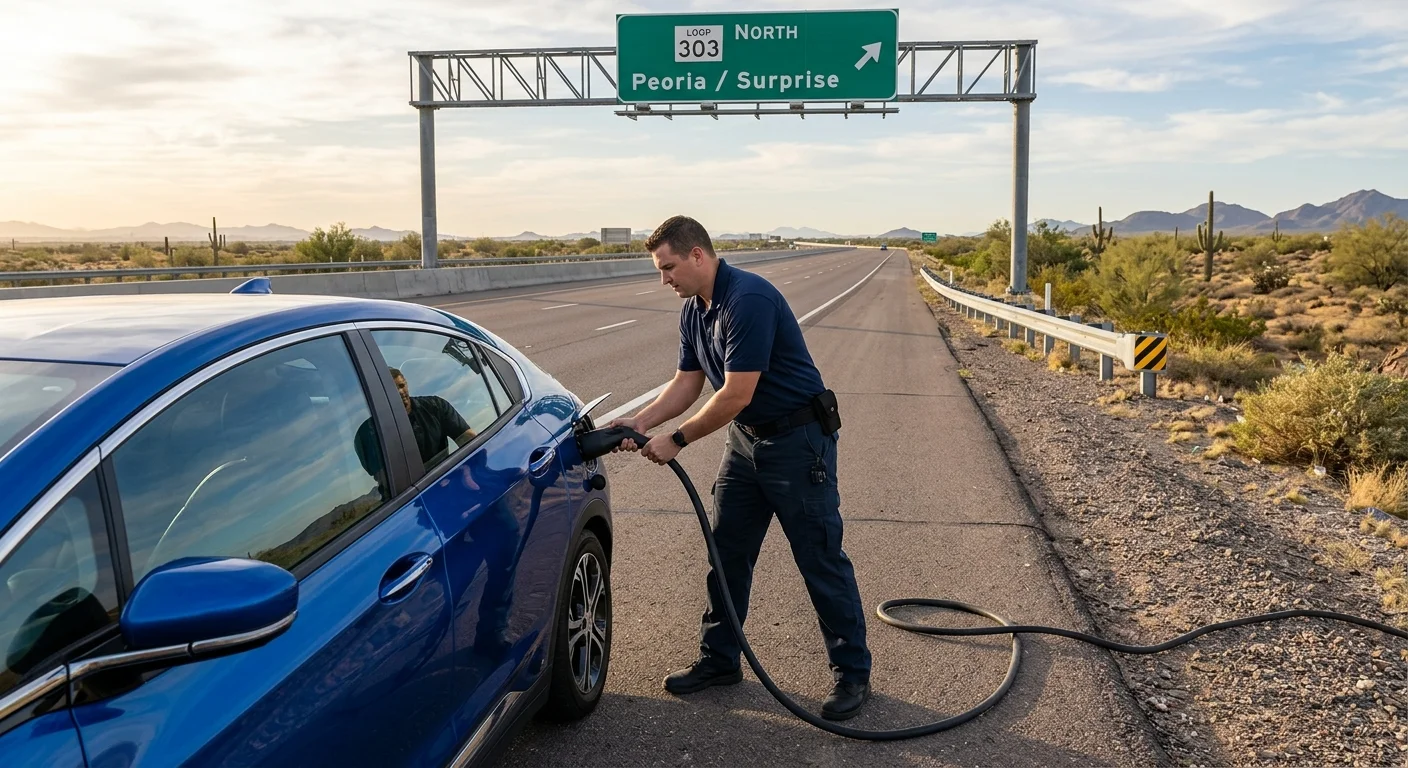
The Bob Stump Memorial Parkway, Loop 303, runs the West Valley from I-17 near Peoria down to I-10 in Goodyear. This belt is newer suburb and open desert, not a dense charging grid. When the pack hits zero here, the next public plug is often farther than the miles you have left.
Why Loop 303 is a thin charging corridor
Loop 303 is the far-west bypass of the Phoenix area. It ties I-17 on the north to I-10 on the south so you can skip the inner loops and downtown. That commute math is why people use it. It is also why an empty pack here feels worse than a stall closer in.
Charging money in Arizona follows the interstates. ADOT’s National Electric Vehicle Infrastructure plan puts about $76.5 million toward up to 69 DC fast-charging sites on designated corridors, 150 kW minimum, at least every 50 miles. Those corridors are I-10, I-17, I-8, I-19, I-40, and parts of US-60 and SR-347. Loop 303 is not on that list. The West Valley hole is the road in between funded routes.
The land use does not fill the gap. South of Surprise you still roll past open ground and the Northern Parkway split before Litchfield Park and the I-10 stack in Goodyear. North of Grand Avenue the freeway bends past Sun City West toward Happy Valley Parkway and Lake Pleasant Parkway, then meets I-17. Exits sit farther apart than on the 101. A plaza with a working public post is not a given between them.
Heat makes the gap larger. Phoenix averages about 111 days a year at or above 100F and about 21 at or above 110F, from NOAA 1991-2020 normals via NWS Phoenix. July highs average near 107F. August highs sit near 105F. Overnight summer lows stay in the mid-80s, so the pack never gets a cool soak. Recurrent reports EVs can lose 20 to 30% of range above about 95F, with loss near 31% at 100F, from 345,622 trips by 300 Phoenix-area EVs. AAA’s 2026 study found about a 10% efficiency drop and an 8.5% range loss at 95F versus 75F. NREL lists cabin cooling among the biggest cuts to range. A West Valley errand that looked fine at 8 a.m. can die after a stop in Surprise heat.
If you learned this loop by driving the Agua Fria on Loop 101, do not copy that plan. The 101 sits closer in, with more retail and more plugs. Mobile charging along Loop 101 is a backup when those plugs are down or full. On the 303, treat public charging as unconfirmed until PlugShare or your car’s app shows a stall in use and available. A pin on a map is not a live charger.
The U.S. Department of Energy’s electric vehicle pages still put the burden on you to match remaining range to a working plug. On this corridor, that match is thin.
Goodyear, Surprise, and the 303 to I-10 interchange
The south end of Loop 303 is Goodyear. The freeway meets I-10 in a stack interchange, then the numbered route ends near Van Buren. That junction is where West Valley traffic dumps onto the interstate toward downtown, the airport, or California. It is also where a low pack gets risky. I-10 is a designated NEVI corridor. The 303 approach to it is not. If you leave I-10 with just enough range to “make Surprise,” summer headwinds and cabin AC can spend that buffer before Greenway.
From the I-10 stack, the 303 runs north through Litchfield Park country, then Surprise, then Peoria on the way to I-17. Grand Avenue (US-60) crosses the loop in Surprise. That parclo is a common stall point because drivers treat Grand as a familiar surface street and forget the freeway gap they just used. APS serves all of Surprise, Goodyear, and Litchfield Park. Home charging on APS plans does not help you on the shoulder. The public plugs you need are the ones your app says are actually on.
ADOT has been rebuilding the Loop 303 tie-in toward I-17, including work between Lake Pleasant Parkway and the interstate. Specific lane drops, overnight closures, and detours change and could not be confirmed as current for this page. Check ADOT’s alerts before you trust a detour with a low pack. A signed push onto 43rd Avenue or Dove Valley with 4% showing is how West Valley drivers turn a close call into a dead car.
Goodyear, Surprise, Peoria, and Litchfield Park are all inside the Phoenix-area service map Charge Pro PHX covers. That does not mean a truck sits in a West Valley yard. Charge Pro PHX is a referral service. It matches you with an independent local operator. The operator quotes and bills you. The brand sets no price and promises no arrival window. For the Goodyear end of this belt, start with EV roadside assistance in Goodyear so you already know the I-10 stack, Cotton Lane area, and the run north toward Surprise.
If you still have miles, get off at a named exit and sit in a lot, not in a travel lane. Indian School, Northern Parkway, Grand Avenue, Happy Valley Parkway, Lake Pleasant Parkway, and the I-10 ramps are the landmarks operators can find. “I’m on the 303” is not a location. “Northbound 303, shoulder, south of Grand Avenue in Surprise” is.
Empty pack versus a dead 12-volt on the 303
Two different failures look the same from the shoulder. One is a traction pack at 0%. The other is a dead 12-volt (or lithium low-voltage) battery that will not boot the car. Mix them up and you ask for the wrong help.
An empty pack usually still talks to you on the way down. You saw the range fall. The car may creep to the shoulder in turtle mode. Lights, hazards, and the screen still work. Climate control may have been on full in 100F air. That is a candidate for out-of-charge recovery: a mobile Level 2 charge that puts about 10 to 20 miles of range on in 15 to 30 minutes of charging time. That window is charging time, not a promise about when someone arrives.
A dead 12-volt is quieter. The car may have had range on the display an hour ago. Then the doors will not release, the screen is dark, and the charge port will not open. Heat is the usual story in the West Valley. Battery Council International work, via Battery University, found starter batteries last about 47 months in hot climates versus 59 in cool ones. AAA calls heat the number-one cause of battery failure. Phoenix heat fits that pattern. On a current Tesla Model Y, Tesla describes a lithium-ion low-voltage battery with its own jump-post procedure. Battery type and steps vary by model and year. Confirm the type in the vehicle information and use the current manual. Jump posts behind a Model Y tow-eye cover only release the hood latches. They do not charge the low-voltage battery, and those cables must not stay connected more than 30 seconds.
Tesla’s roadside policy says help for a depleted high-voltage pack is available but is not a financially covered service, warranty or not. Tesla typically arranges transport to the nearest Supercharger or service center. That is a tow plan, not a charge-on-the-shoulder plan. A 12-volt no-start is a different ticket. Say which one you have.
Factory programs do not fill every West Valley stall. AAA offers mobile EV charging in select markets through a pilot with Level 2 trucks, enough range to reach home or the nearest station, at no extra charge to members. Whether the Phoenix area is in that pilot on the day you stall could not be confirmed here. Check AAA, do not assume the 303 is covered. Ford Roadside Assistance will take an out-of-charge Ford EV to the nearest public charger, home, or a preferred Ford dealer within 50 miles of the breakdown. Beyond 50 miles it tows to the nearest charge station or Ford EV-certified dealer. Coverage runs five years or 60,000 miles from purchase.
Arizona DPS Roadside Motorist Assistance changes tires, provides gasoline or diesel, jump-starts dead batteries, adds water, and calls tows. Published materials say nothing about EV charging or out-of-charge cars. ADOT’s Incident Response Unit covers Phoenix-area freeways 5 a.m. to 8 p.m. weekdays, clears crashes and debris, changes tires, and helps stranded motorists. No EV-specific mention. A patrol may make you visible. It will not refill the pack.
Public charging along the 303 versus a truck to the car
Do not plan this corridor around a remembered charger. Live stalls change, and a count invented for this page would be wrong by next week. Open PlugShare, your car’s in-dash map, and the network app (Electrify America, Tesla, ChargePoint, or whoever you actually use). If the pin is not green and in use, treat it as closed. The U.S. Department of Transportation’s EV charging work is aimed at corridor gaps. Loop 303 is still one of those gaps on the ground.
If a public DC fast site is truly a few miles ahead and your car will still roll, that is the cheaper path in most cases. Confirm it is online before you spend the last 8%. Extreme heat also derates fast charging. Field measurement of DC fast chargers found offered power dropping by up to 35 to 40 kW once rectifier temperature approached 55C, with charge time stretching from 86 minutes in winter to 169 minutes in extreme summer. Your car’s battery management system will also request lower current when it is hot. A “20-minute splash” on a 110F afternoon on the 303 may not be 20 minutes.
If the car will not roll, a public plug does not matter. That is when mobile EV charging is the point. An independent operator brings Level 2 power to the car. DOE’s AFDC describes Level 2 output from 2.9 to 19.2 kW. Most residential-style Level 2 units run up to 30 amps, about 7.2 kW. Roadside trucks vary. What you can count on from the verified ledger is the typical rescue: 10 to 20 miles of range in 15 to 30 minutes of Level 2 charging. That is usually enough to reach a working public stall or a home plug in Goodyear, Surprise, or Peoria. It is not a full pack.
A tow is the other fork. Tesla, Ford, and many insurers default to a haul toward a charger or dealer. On Loop 303 that can mean a long hook through I-10 or I-17 traffic, plus storage if the yard is not EV-aware. Arizona sets no statewide tow-rate cap. Cities and counties may set local maximums. Confirm the current rate with the tower before you sign. ARS 28-872 lets police order a disabled or obstructing vehicle removed, with the owner paying reasonable tow and storage before release. If you are blocking a lane in a work zone near I-17, you may not get to choose a gentle wait.
Stay off the traveled way when you can. ARS 28-871 says you may not stop or park on the traveled part of a highway outside a business or residence district if it is practical to get off it. A vehicle disabled so badly it cannot be moved is exempt. When you are stopped you must leave room for other traffic to pass and be visible 200 feet in each direction. ARS 28-775, the Move Over law, requires other drivers to move over a lane if they safely can, or slow down, when they approach a stopped vehicle with flashing or warning lights. Fines run $275, then $500, then $1,000 for repeats within five years. Hazards on, as far right as you can get, people in the car if the shoulder is narrow.
What to tell an operator from the shoulder
The operator you get connected with cannot see your milepost. Lead with geography a West Valley driver would recognize.
Give direction: northbound toward I-17, or southbound toward I-10. Give the last exit you passed and the next one you can see. Useful names on this belt are the I-10 stack in Goodyear, Indian School, Northern Parkway, Grand Avenue in Surprise, Happy Valley Parkway in Peoria, Lake Pleasant Parkway, and the I-17 tie-in. “Near Surprise” is weak. “Northbound 303, right shoulder, just south of Grand Avenue” is usable.
Say empty pack or dead 12-volt, and how you know. Remaining percent, turtle mode, dark screen, charge port stuck, doors locked. Make, model, and year matter because port doors and jump posts differ. Say CCS, NACS, or CHAdeMO. A Level 2 rescue needs the AC inlet, not a DC adapter story. Rivian’s J1772 AC adapter is for AC chargers only and must not be used with a DC charger.
Say whether the car still rolls. If it does, a short drive to a lot off the 303 is safer than a truck squeezed against a concrete barrier. If it does not, say how wide the shoulder is and whether you are in a work zone. ADOT work between Lake Pleasant Parkway and I-17 has used lane drops and overnight closures. An operator needs that before they commit to a setup.
Say who else you already called: Tesla app roadside, Ford, AAA, DPS, or a tow you have not signed yet. Tesla roadside is requested in the app by selecting Roadside, choosing the issue, and confirming details. Do not double-book a tow and a charge without telling both.
Keep people visible and off the lanes. Phoenix-area summer pavement and mid-80s nights still dehydrate you. Water, shade in the cabin if the car still powers, hazards on. Charge Pro PHX does not roll a truck and does not quote on the call as a shop. It connects you with an independent local EV rescue operator who quotes you directly.
When to call us
Call when the pack is empty on Loop 303, or the 12-volt has killed the start, and you need a mobile charge or a clear next step instead of a long tow. That is the West Valley case for an out-of-charge recovery referral, from the I-10 stack in Goodyear up through Surprise and Peoria to I-17. Call us at (602) 932-0920 and we’ll connect you with a local EV rescue operator.