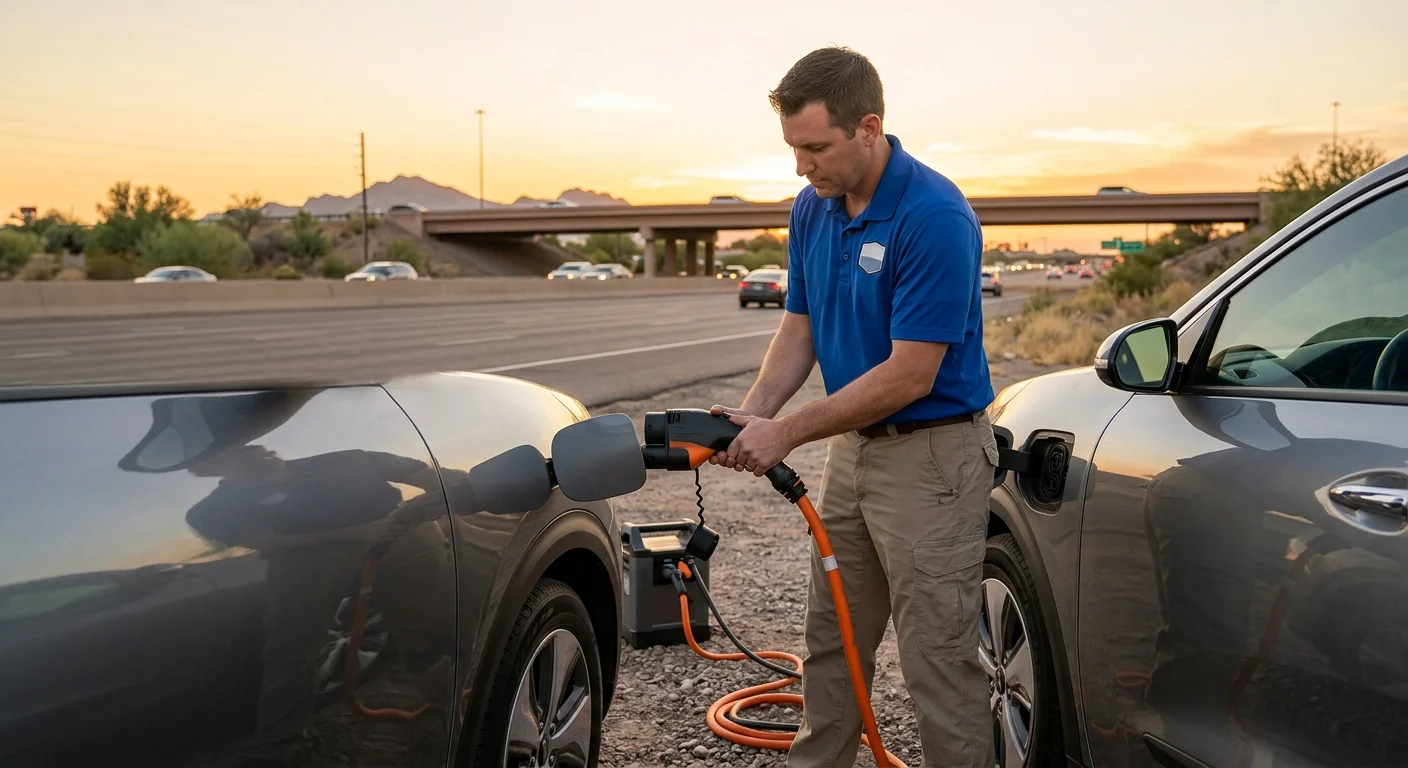
A CCS or J1772 EV can go dead on a Mesa arterial while Tesla drivers keep filling at Superchargers. Those stalls are NACS, so they do not feed a CCS inlet on their own. Charge Pro PHX matches you with an independent East Valley operator for a mobile charge, and that operator quotes you directly.
Why CCS and J1772 cars stall in Mesa
Mesa is the East Valley’s largest city, with 511,764 residents in the Census ACS 2020-2024 5-year count. Gilbert, Chandler, and Glendale each sit between 250,000 and 280,000. The commute here is its own pattern: long east-west runs on US-60, north-south cuts on Loop 202, and a Superstition climb that starts as soon as the grid ends. A page written for Gilbert does not describe this.
Heat does the rest. Phoenix averages about 111 days a year at or above 100F, and about 21 at or above 110F, per NOAA 1991-2020 normals via NWS Phoenix. July highs average near 107F. August sits near 105F. Overnight summer lows still land in the mid-80s. Recurrent, using 345,622 trips from 300 Phoenix-area EVs, reports 20 to 30% range loss above about 95F, and loss near 31% at 100F. AAA’s 2026 study found about a 10% efficiency drop and an 8.5% range loss at 95F versus 75F. NREL notes cabin cooling as one of the biggest draws. A CCS driver who left Phoenix-Mesa Gateway with a comfortable buffer can still land short on the Superstition Freeway.
The plug is the other trap. The U.S. Department of Energy’s Alternative Fuels Data Center describes J1772 and J3400 (NACS) as AC connectors. A CCS inlet includes the J1772 portion for AC and adds separate DC pins for fast charging. A CCS DC adapter alone does not establish AC compatibility. Tesla Superchargers are built around NACS. That is why a public CCS versus Tesla Supercharger mismatch shows up so often in Mesa, even when a Tesla stall looks close on the map.
Downtown adds a third wrinkle. Mesa Municipal Electric serves about 5.5 square miles around downtown, more than 18,000 customers, with an Electric Vehicle Time-of-Use rate (E1EV). SRP serves much of the rest of Mesa. Home rate plans differ by which wires you are on. They do not change what happens when the pack is already empty on the street. For that you need non-Tesla EV rescue that can speak CCS or J1772, not a Supercharger pin.
US-60, Loop 202, and Superstition gaps
US-60, the Superstition Freeway, is Mesa’s east-west spine. Loop 202’s Red Mountain Freeway cuts the north side toward the Salt River and the 101. The Superstition run keeps going toward Apache Junction at about 1,700 ft, then Superior at about 2,890 ft. That is a real climb, not a flat East Valley grid. Range that looked fine at Dobson can vanish by Gold Canyon.
If the car stops, Arizona law is blunt. ARS 28-871 says you may not stop or park on the traveled part of a highway outside a business or residence district if it is practical to get off it. A vehicle disabled so badly it cannot be moved is exempt. When you are stopped, you must leave room for other traffic to pass and be visible 200 feet in each direction. ARS 28-775, the Move Over law, tells approaching drivers to change lanes if they safely can, or slow down. Fines run $275, then $500, then $1,000 for repeats within five years.
Call 911 first if you are in a live lane. Arizona DPS Roadside Motorist Assistance is statewide. It changes tires, provides gasoline or diesel, jump-starts dead batteries, adds water, and calls tows. Published DPS materials name gasoline and diesel and say nothing about EV charging or out-of-charge situations. Hours and specific corridors are not published. ADOT’s Incident Response Unit covers Phoenix-area freeways from 5am to 8pm weekdays. It is a 14-member unit, sponsored by State Farm since 2020. It clears crashes and debris, changes tires, and helps stranded motorists. There is no EV-specific mention. Neither unit is a mobile CCS charger.
That is the Mesa gap EV roadside assistance in Mesa does not close for a CCS inlet. A Supercharger-weighted map still leaves the wrong plug in the wrong place. Get as far from live lanes as you can. Stay belted, hazards on. Then request a match. The operator, not Charge Pro PHX, decides whether that shoulder or lot is a safe place to run a Level 2 session. A freeway stop is a last resort under ARS 28-871, not a planned charge site.
Superchargers that still leave CCS drivers hunting
Tesla built Superchargers around its own plug, now standardized as NACS, SAE J3400. Some non-Tesla cars now ship with NACS. Many still wear a CCS combo inlet. Opening Superchargers to more brands does not turn every Mesa stall into a CCS DC post. If your inlet is CCS, you still need a CCS-capable fast stall, a maker-approved adapter, or an AC session on J1772.
Electrify America and ChargePoint remain the networks CCS drivers hunt when a Supercharger pin will not mate. We did not verify a live stall-by-stall Mesa inventory for this page, so treat the apps as the source of truth, not a blog list. Check the network app for a working CCS post before you roll the last 10%. If the stall is offline, occupied, or derated in the heat, you can still end up stranded two miles from a charger that cannot help you.
Heat cuts charging power too. Field measurement of DC fast chargers in extreme heat found offered power declining by up to 35 to 40 kW once rectifier temperature approached 55C, with efficiency dropping about 5 to 8 percent, and charging duration rising from 86 minutes in winter to 169 minutes under extreme summer conditions. The car’s battery management system also requests lower current when thermal headroom is limited. A CCS stall that looks fast at 7 a.m. can crawl at 4 p.m. in July.
Rivian’s J1772 AC Adapter is a useful example of the AC-only rule. Rivian says it is for AC chargers only, for charging R1 model-year 2026 vehicles with NACS ports at J1772 AC chargers, and must not be used with a DC charger. Confirm your own adapter in the owner’s manual. Do not force a DC CCS adapter onto an AC-only rescue cable. For the wider Valley pattern, see non-Tesla EV rescue in the Phoenix area. Mesa’s version is the US-60 and Red Mountain mismatch, not a generic city swap.
Factory help versus a matched East Valley operator
Automaker roadside is often a tow, not a charge. Ford Roadside Assistance takes an out-of-charge Ford EV to the nearest public charger, the owner’s home, or their preferred Ford dealer within 50 miles of the breakdown. Beyond 50 miles it tows to the nearest charge station or Ford EV-certified dealer. Coverage runs five years or 60,000 miles from purchase. That can be the right call. It is still a flatbed plan, and it still dumps you at a public stall that has to accept your inlet.
We could not confirm a factory mobile-charge promise that covers every CCS brand in Mesa. AAA offers mobile EV charging in select markets through a pilot with Level 2 trucks, enough range to reach home or the nearest charging station, at no additional charge to members. Mesa is not named in the materials we hold, so do not assume a membership truck is rolling to Broadway. Confirm with AAA if you carry it. Then compare that with a local match.
Charge Pro PHX is a referral service. We do not own a truck, hold a trade license, or set a price. The independent operator quotes you and bills you. A typical rescue charge, from the brand’s published story, is 10 to 20 miles of range in 15 to 30 minutes of Level 2 charging. That is session time on the cable, not an arrival window. We do not publish ETAs. Most residential Level 2 gear runs up to 30 amps and about 7.2 kW, per the U.S. Department of Energy. A Level 2 unit can range from 2.9 to 19.2 kW. Once you have enough range, you drive to a CCS or J1772 stall you can actually use, or you go home.
If the pack is empty in a garage, a lot at Phoenix-Mesa Gateway, or a Superstition shoulder you cannot safely occupy, mobile EV charging is the on-site version of that same match. The operator brings Level 2 energy to the car. You are not waiting on a Tesla-shaped network that was never built for your inlet. The U.S. Department of Energy’s electric vehicle pages are a clean primer on charging levels if you want the connector map before you call.
What to have ready when you request a match
Have the car in front of you, not a guess. Make, model, and year matter because some lines switched from CCS to NACS. Say whether the inlet is CCS, J1772, or NACS. Say whether you have a maker-approved adapter in the frunk. Rivian-style AC adapters do not belong on a DC post. Confirm the procedure in the current owner’s manual for your exact model and year.
Give a Mesa location the operator can plot. US-60 east or west, last exit, Loop 202 Red Mountain, Superstition toward Apache Junction, a lot at Phoenix-Mesa Gateway, or a street near downtown’s Mesa Municipal Electric pocket. If you are on the traveled lanes, say so. Call 911 for a live-lane stop before you request a charge. ARS 28-872 lets police order a disabled or obstructing vehicle removed, and owners pay reasonable tow and storage costs before release. A short Level 2 session in a parking lot beats an impound.
Share pack percent if the screen still works. If the car is dark, say that too. A 12-volt or low-voltage failure can lock the charge port even when the traction pack is not empty. Do not guess a jump procedure from another brand’s manual. Tesla’s Model Y hood-release terminals are not your CCS car’s procedure.
The operator quotes the session. Charge Pro PHX does not. Arizona sets no statewide tow-rate cap. Cities and counties may set maximums locally. There is no published brand fee for a Mesa rescue. Confirm the number with the operator before they unroll a cable. If the spot is unsafe, they may tell you a charge cannot happen there. That is the honest answer. For corridor gaps farther from the grid, the U.S. Department of Transportation’s rural EV charging notes match what Superstition drivers already feel: stalls get thin as the grade goes up.
When to call us
Call when a CCS or J1772 car is dead in Mesa and a Supercharger cannot feed the inlet. Call when you are off the traveled lanes and you need a mobile Level 2 session instead of a factory tow to the wrong plug. Call us at (602) 932-0920 and we’ll connect you with a local EV rescue operator.