A GMC Sierra EV that hits empty in the Phoenix area needs a 240V source at the bumper. An independent operator typically adds 10 to 20 miles in 15 to 30 minutes of charging. That’s time on the cable, never a promise of when someone arrives. Charge Pro PHX matches you with those operators. We don’t own the trucks, and we don’t send employees.
That’s the search behind gmc sierra ev emergency charging. The truck is a work pickup with a large pack. Heat, grades, payload, and a long day still win. When the estimate collapses, you want electrons on the shoulder. You don’t want a flatbed as the first move unless the truck can’t take a charge.
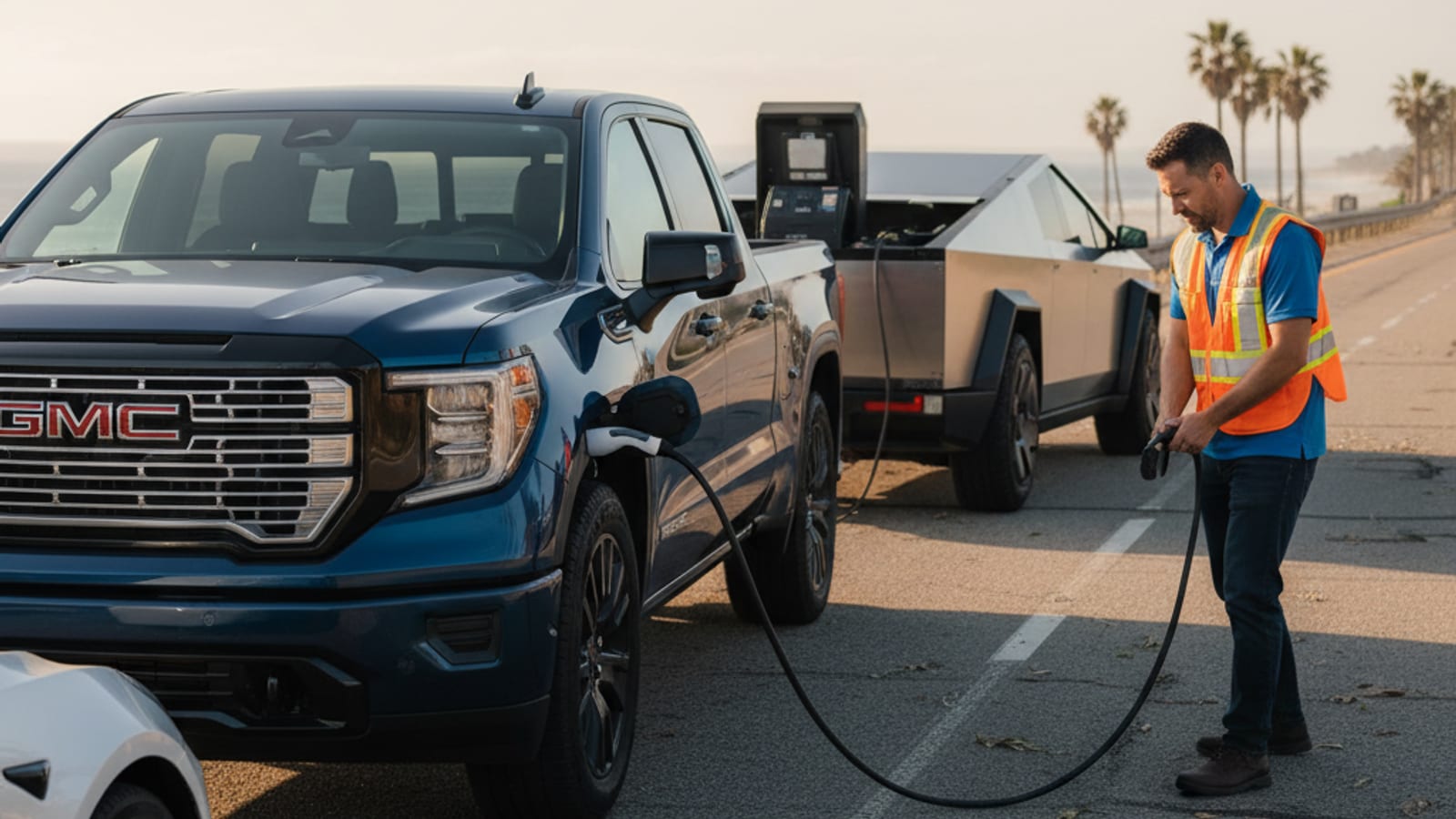
Empty pack or a truck that won’t wake
Watch the Sierra EV as it fades. Power often drops before the wheels stop. The pedal goes dull. Climate may shut off. Infotainment may go dark to save propulsion. Some trucks still creep to a shoulder. Others stop in the lane. Get out of the travel lane as soon as the truck will roll.
Then name the failure. A traction pack at zero can still show a display for a while. Hazards may still blink. Locks may still answer. That’s an energy problem. A silent cabin, a dead fob, and dark screens are often the 12-volt. The small battery runs computers, door handles, and the contactor that ties in the high-voltage pack. If that battery is dead, the Ultium pack can sit with miles left and still leave you stuck.
A DC-DC converter recharges the 12-volt only while the truck is on or charging. Parked electronics keep sipping. Tesla’s Sentry Mode and Cabin Overheat Protection are the famous parked drains. A Sierra EV has its own modules that stay awake. Tell the operator which pattern you have. A 12-volt jump won’t fill an empty drive pack. A Level 2 boost won’t wake a truck that can’t close its contactors.
Battery Council International work, via Battery University, timed starter batteries in heat. They last about 47 months in hot climates versus 59 in cool ones. A battery good for five years elsewhere can fail in two or three in the desert. AAA names heat as the number-one cause of battery failure. It recommends AGM batteries for hot areas.
Why this metro empties a Sierra EV faster than the sticker
GMC’s range number is a mild-day, light-load figure. Phoenix isn’t that day. The city averages about 111 days a year at or above 100F. About 21 days reach 110F or more. Those are NOAA 1991-2020 normals via NWS Phoenix. July highs average near 107F. August sits near 105F. Overnight summer lows hang in the mid-80s. Cabin cooling never really clocks out.
AAA’s 2026 study found about a 10 percent efficiency drop at 95F versus 75F. Range loss in that study was about 8.5 percent. Recurrent used 345,622 trips from 300 Phoenix-area EVs. It reports 20 to 30 percent range loss above about 95F. Loss sits near 31 percent at 100F. NREL flags climate-control loads as a large draw. None of those figures is a GMC factory rating. They’re published heat penalties. Use them as a warning, not a promise for your truck.
The Sierra EV is also a work truck. Payload and towing share the same pack as the motors. Hard launches from a job-site light cost more than a smooth roll. Highway speed on I-10 costs more than a 35 mph street in Tempe. Accessory loads add up. GMC’s ProPower Onboard system, on trucks that have it, feeds AC tools and outlets. That power comes from the pack. It isn’t a designed way to fill another EV’s traction battery.
North and east: the climbs
I-17 north of the Valley is a range problem, not a flat interstate. ADOT posts a 6 percent maximum grade on the northern stretch. Phoenix and Sky Harbor sit about 1,135 feet. Anthem is about 1,860. New River is about 2,140. Black Canyon City is about 2,000. Sunset Point rest area is about 3,410. Cordes Junction is about 3,800 before the drop into Camp Verde around 3,150. Forum drivers on that climb have logged roughly 481 Wh/mi going up versus 293 coming down. That’s about 40 percent more energy uphill. The nav often undersells it.
Anthem, New River, and Black Canyon City are census-designated places, not incorporated cities. They have no city government of their own. If you stall there, say the exit name. Daisy Mountain Drive, Anthem Way, New River Road, and Rock Springs all work as locations.
Eastbound US-60 is the Superstition Freeway, not Grand Avenue. Those are different segments of the same route. Apache Junction sits about 1,700 feet. Superior is about 2,890. Top-of-the-World is about 4,530. Globe is about 3,510. Gold Canyon sits on that climb. A loaded Sierra EV that left Mesa with a thin buffer feels that pull.
SR-87, the Beeline toward Payson, posts a 7 percent grade into Slate Creek Canyon. Payson itself is about 4,920 feet. Fountain Hills sits on the approach. Don’t treat that run like Loop 101 Price.
South, west, and the interchanges
I-10 south toward Casa Grande is about 1,380 feet. That’s milder than I-17. Heat still sits on the pack. Maricopa the city is in Pinal County, not Maricopa County. SR-347 is the commute into that town. ED3 serves Maricopa and much of northern Pinal. I-8 west toward Gila Bend drops toward about 700 feet.
West Valley miles mix heat and distance. Surprise, Goodyear, Buckeye, Avondale, Tolleson, and El Mirage bake in the same summer. APS serves those cities. Home charging is common in the newer belts. Surprise and Sun City West have under 3 percent of housing built before 1980. The stranded calls still happen on the road after a long day.
Downtown routing is its own mess. The Stack is I-10, I-17, and US-60. The Mini Stack is I-10, SR-51, and Loop 202. Loop 101 is Agua Fria on the west, Pima on the northeast, and Price on the southeast. Loop 202 is Red Mountain, Santan, and South Mountain. Arizona has no toll roads and no toll express lanes. ADOT confirms that. Texts about unpaid Arizona tolls are scams. Ignore them.
First moves on the shoulder
Hazards on. Then get the body of the truck out of the lane. ARS 28-871 covers stops on a highway outside a business or residence district. You may not stop on the traveled part if it’s practical to get off it. A vehicle disabled so badly it can’t be moved is exempt. When you’re stopped, leave room for other traffic to pass. Be visible 200 feet in each direction.
Stay in the cab if the cabin is intact. If you must exit, go out the passenger side and stand well off the pavement. Don’t walk the shoulder hunting a better bar of cell signal.
ARS 28-775 is the Move Over law. Drivers approaching a stopped vehicle with flashing or warning lights must move over a lane if they safely can. Otherwise they slow down. That rule protects you and the operator at the fender. Keep the hazards on the whole time.
If this was a minor crash, ARS 28-674 says move the vehicle off the traveled roadway when it’s safe. You’re not at fault merely for moving it. Police can order a disabled or obstructing vehicle removed under ARS 28-872. Owners pay reasonable tow and storage costs before release. Arizona sets no statewide private-tow rate cap. Cities and counties may set their own maximums. Private tows need the property owner’s written authorization or a police request.
Give a real location when you call. Northbound or southbound. The last exit. A mile marker. Loop 101 Agua Fria isn’t Loop 101 Price. Grand Avenue isn’t the Superstition Freeway. A garage level at Chase Field isn’t a shoulder on I-17.
Monsoon season is officially June 15 to September 30. Haboobs can drop visibility to near zero. Flash floods follow. ARS 28-910 is the Stupid Motorist Law. Drive around a barricade into a flooded area and you can be billed for the emergency response. Don’t send a Sierra EV into standing water. SR-88, the Apache Trail, has been partly closed by 2026 monsoon damage. Don’t treat it as a through route.
What DPS and ADOT will do for you
Arizona runs free motorist help. Two programs cover the Phoenix metro. Neither one advertises charging an empty EV.
Arizona DPS Roadside Motorist Assistance, RMA, is statewide. It changes tires. It provides gasoline or diesel. It jump-starts dead batteries. It adds water and calls tows. In 2018 it assisted 75,235 motorists statewide. Its published materials name gasoline and diesel. They say nothing about EV charging or out-of-charge recovery. Confirm current coverage on azdps.gov.
ADOT’s Incident Response Unit works Phoenix-area freeways from 5am to 8pm weekdays. It clears crashes and debris, changes tires, and helps stranded motorists. No EV-specific mention appears in the public write-up. Confirm on azdot.gov.
Those crews can keep you safer. They can handle a tire or a 12-volt jump in some cases. They aren’t a published GMC Sierra EV emergency charging option. If the traction pack is empty, you still need a 240V source or a tow to a charger.
What a mobile 240V stop actually adds
Public DC fast charging is a stall you drive to. A mobile boost is the other direction. An independent operator brings a 240V Level 2 source to the Sierra EV. Charge Pro PHX doesn’t own that truck. It doesn’t employ the technician. It matches you with a local pro. The operator quotes you before any cable goes in. Then they bill you directly.
Operators bring a native NACS plug. They also bring a CCS or J1772 adapter for non-Tesla EVs. The Sierra EV uses CCS for DC fast charging. It uses a J1772-style connection for AC Level 2. On the roadside, the adapter is how a NACS-native rig talks to your port. You don’t need to carry the adapter yourself for this call.
What you get isn’t a full pack. The usual on-site result is a 10 to 20 mile add in 15 to 30 minutes of charging. That’s enough to roll to a public stall, a lot you’re allowed to use, or home if you’re already close. It isn’t a fill to 80 percent. It isn’t a Supercharger session. For the truck layout, read How a mobile EV charging truck actually helps you. The service path is mobile EV charging.
A portable 120V Level 1 cord isn’t a freeway plan. You need an outlet you’re allowed to use, and you sit a long time. That outlet isn’t on an I-10 shoulder.
If the truck can still limp
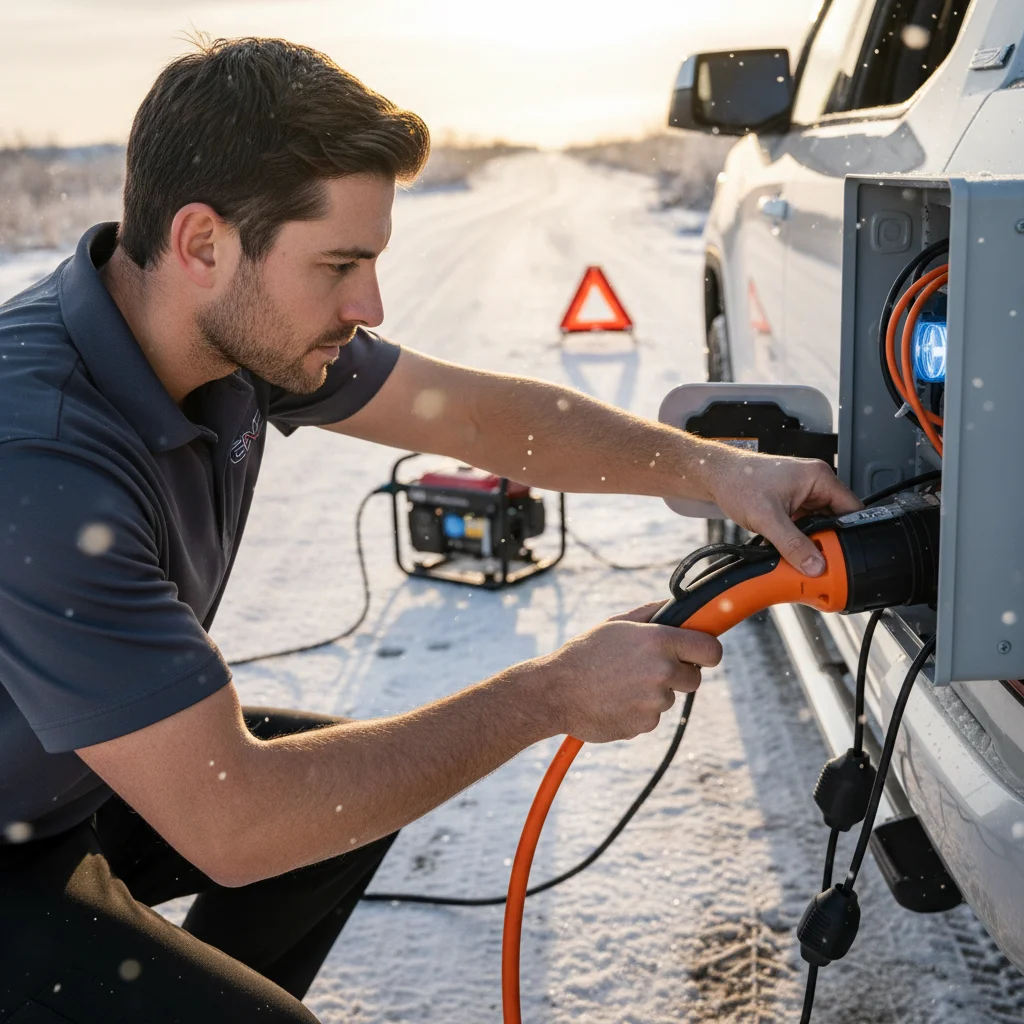
If limp mode still moves you, a public CCS stall can be the whole fix. Use the truck’s nav. Use PlugShare or ChargePoint. Filter for CCS. Confirm the stall is actually working before you spend the last miles. Charging apps to check before you’re stuck on the shoulder covers that order. The DOE Alternative Fuels Data Center at afdc.energy.gov is a public lookup. This page doesn’t estimate how far your nearest stall is. Distances like that weren’t verified here.
Some sites are namable from official pages. Phoenix Sky Harbor lists Level 2 charging in the Terminal 3 garage. Look on Level 1 west side, Level 3, and Level 7. The Terminal 4 garage has charging on Level 4 east end, zone B. The 24th St. station has charging too. EVPassport installed charging at PHX in 2022. A week in a hot garage still kills a 12-volt. Chargers in the same structure don’t wake a truck that can’t close its contactors.
Phoenix-Mesa Gateway has Hourly, Daily, and Ray Road Economy lots. Whether AZA has on-site EV charging is unresolved. Sources conflict. The official amenities list doesn’t show it. Confirm on gatewayairport.com before you count on a stall there.
ADOT’s NEVI plan is adding DC fast-charging sites along designated corridors, with construction underway in 2026. Those corridors include I-10, I-17, I-8, I-19, I-40, and parts of US-60 and SR-347. A pin on a map isn’t a free stall. Confirm live status before you roll in on a thin pack.
Arizona had about 141,800 battery EVs as of 2025, per DOE AFDC. Arizona doesn’t publish a verified Maricopa County EV count.
If you can’t roll, don’t hunt a stall on foot along a freeway. Call for a mobile boost or a recovery. Out of charge recovery is the path for a pack at zero. Non-Tesla EV rescue is the path that assumes CCS or J1772.
When a tow is the right tool
A Sierra EV is long, heavy, and not a flat-tow hobby. Drive wheels and an unpowered pack shouldn’t be dragged. A flatbed is the usual safe method. That means loading a full-size pickup, then still charging at the other end. If the destination is a busy dealer, you may wait again for a stall.
Towing has a place. Mechanical damage, a crash, or a truck that can’t accept a charge still needs a bed. An empty pack by itself usually doesn’t.
Factory roadside plans vary by brand. Tesla won’t charge on site. It tows to the nearest Supercharger or service center. Ford tows to the nearest charger, home, or dealer within 50 miles. Rivian and Hyundai/Kia owners have documented trouble getting a dead EV towed. They’re advised to specifically request a tow. GMC’s own roadside terms for your VIN weren’t confirmed in the research for this page. Read the booklet that came with the truck. Call GMC or OnStar and ask whether they charge on site or only tow. Don’t assume a 240V visit is included.
Lot tows are a separate trap. Private-property tows need written authorization or a police request. That matters in garages at Chase Field, Mortgage Matchup Center, and State Farm Stadium in Glendale, Arizona. If a lot wants the truck hooked, confirm the paperwork before you walk away.
Home charging won’t meet you on I-17
Daily charging still belongs at home. Rescue is the backup when the day ran long. The Valley is split among five utilities. Service often splits a single city block by block. Treat any city-level assignment as directional. Confirm your own address.
APS serves large parts of Phoenix. It also serves Surprise, Goodyear, Buckeye, Queen Creek, Apache Junction, and San Tan Valley. Litchfield Park, El Mirage, Youngtown, Sun City, Anthem, and Gila Bend are APS too. It shares Chandler, Gilbert, Glendale, Scottsdale, Tempe, Peoria, Avondale, and Paradise Valley with SRP. APS names the R-EV residential EV rate plan, marketed as EV Overnight Charging from 11pm to 5am weekdays. It also names a Level 2 smart-charger rebate, APS Smart Charge, and Take Charge AZ. Confirm current terms on aps.com. Amounts aren’t published here.
SRP serves much of Mesa and shares the East Valley and central cities. Its Electric Vehicle Price Plan is closed to new enrollment as of a February 2025 board decision. Existing customers may stay until the November 2029 billing cycle. SRP also names an Electric Vehicle Export Price Plan for solar customers. It names a Level 2 EV charger rebate through the SRP Marketplace, EV Smart Charge, and Business EV Charging, BizEV. Confirm on srpnet.com.
Mesa Municipal Electric covers about 5.5 square miles around downtown Mesa, with an Electric Vehicle Time-of-Use rate, E1EV. ED3 serves the city of Maricopa and much of northern Pinal with EV TOU 2-10 and EV smart-charger on-bill financing. ED2 serves Casa Grande, Coolidge, and Florence. No EV-specific program was found on its site.
Housing age changes the panel conversation. Sun City has 88.9 percent of housing built before 1980, so older panels are common there. Newer Pinal and far-suburb belts charge at home more often. Only an electrician can judge a specific panel. This page doesn’t guess whether yours needs an upgrade.
Federal clean-vehicle credits ended for vehicles acquired after September 30, 2025. Arizona has no state EV rebate or tax credit. Arizona also has no annual EV registration surcharge as of 2026. EVs are exempt from Arizona emissions testing. Maricopa County is Area A. Hybrids aren’t exempt. Arizona has no annual safety inspection.
Work lots, tribal roads, and parked heat
A Sierra EV used as a family truck will sit through Cactus League lots and downtown arenas. Sloan Park in Mesa hosts the Cubs. Salt River Fields sits on Salt River Pima-Maricopa land by Scottsdale. Camelback Ranch is in Glendale, Arizona. Peoria Sports Complex, Surprise Stadium, Goodyear Ballpark, Tempe Diablo, and Scottsdale Stadium round out the map. Chase Field is the Diamondbacks. Mortgage Matchup Center is the downtown arena, renamed from Footprint Center in October 2025. State Farm Stadium is in Glendale, Arizona. Phoenix Raceway is in Avondale, not Phoenix, despite the name.
Long soaks in a hot lot drain the 12-volt. Plan a wake-up check when you get back.
Sovereign tribal nations sit inside the metro. They have their own government and police. Salt River Pima-Maricopa land sits between Scottsdale, Tempe, Mesa, and Fountain Hills. Gila River land includes Sacaton, Blackwater, and Casa Blanca, south of Chandler. Fort McDowell Yavapai is northeast of Scottsdale. Ak-Chin is south of Maricopa. They aren’t Phoenix suburbs. If you stall on those roads, say so on the call.
Paradise Valley the town is a separate incorporated town from the Paradise Valley urban village inside the City of Phoenix. Qualify which one. Glendale, Arizona, isn’t Glendale, California. Peoria, Arizona, isn’t Peoria, Illinois.
Arizona doesn’t observe daylight saving time. Clock mix-ups on summer trips north are a real way people miss a charging window.
The metro hub for city pages is EV charging in the Phoenix area.
How the referral call works
Charge Pro PHX is a referral line for the Phoenix area. We match stranded EV drivers with independent local mobile rescue operators. We hold no trade license. We employ no technicians. We own no equipment. We publish no hours. We promise no arrival time. We set no prices. The operator quotes you before starting and bills you directly.
Say it’s a GMC Sierra EV. Say CCS. Say whether the dash is alive. Say whether you can shift to park and open the charge port. A port that won’t unlatch is a different job than an empty pack. Give year, color, and the exact place. I-10, Loop 202 Santan, US-60 Superstition, Grand Avenue, a Buckeye surface street, and a Queen Creek cul-de-sac aren’t one dispatch.
Don’t plan on a passerby EV as a charger. Some trucks advertise bidirectional power. It isn’t a standard roadside method. The Sierra EV’s ProPower Onboard outlets feed tools. They aren’t a practical way to fill another traction pack, or to take a pack fill from the next lane. Can one EV charge another when you’re both low? walks through that dead end.
Keep software current. Follow the maintenance schedule in GMC’s owner’s materials.
Frequently asked questions
Who quotes the price for a Sierra EV charge?
The operator on the call, not Charge Pro PHX. Where you are, when you call, and how many miles you need all change the quote. A boost on Loop 101 Agua Fria isn’t the same dispatch as one in Wickenburg or Casa Grande. The operator quotes you before any charging starts and bills you directly. No verified operator rate for this metro is published here. If the number doesn’t work, you can decline. No cable goes in on a mystery bill.
How much range does a mobile 240V stop add?
Operators typically add 10 to 20 miles in 15 to 30 minutes of charging. That’s charging time on the curb. It isn’t a promise of when the truck arrives. The goal is enough range to reach a stall or home if you’re close. It isn’t a full charge. Efficiency, cabin load, and grade after you leave all change how far those miles go. A northbound I-17 mile isn’t a Tempe surface-street mile.
What if the Sierra EV is dark but the pack isn’t empty?
Treat that as a 12-volt failure until you prove otherwise. The range number is the high-voltage pack. It doesn’t tell you whether the 12-volt can close the contactors. Operators we match can jump or replace a dead 12-volt on site. That’s a different job from a pack-empty charge. Tell the matcher which problem you have. A silent cabin after a week at Sky Harbor is the classic version of this. So is a truck that sat through a night game at Chase Field.
If you’re empty now, call Charge Pro PHX at (602) 932-0920. We’ll connect you with a local operator who can quote a 240V boost on the spot. We serve the Phoenix area. The operator performs the work. We don’t.