The first warning in Queen Creek rarely happens in a garage. It happens on Ellsworth Road after a stop at Schnepf Farms. It also happens on Ironwood while you’re still short of home in Queen Creek. The miles remaining drop in Valley heat. You’re away from the outlet you rely on. That’s the usual ev roadside assistance call here. The car charged at home. Then it stalled on the road.
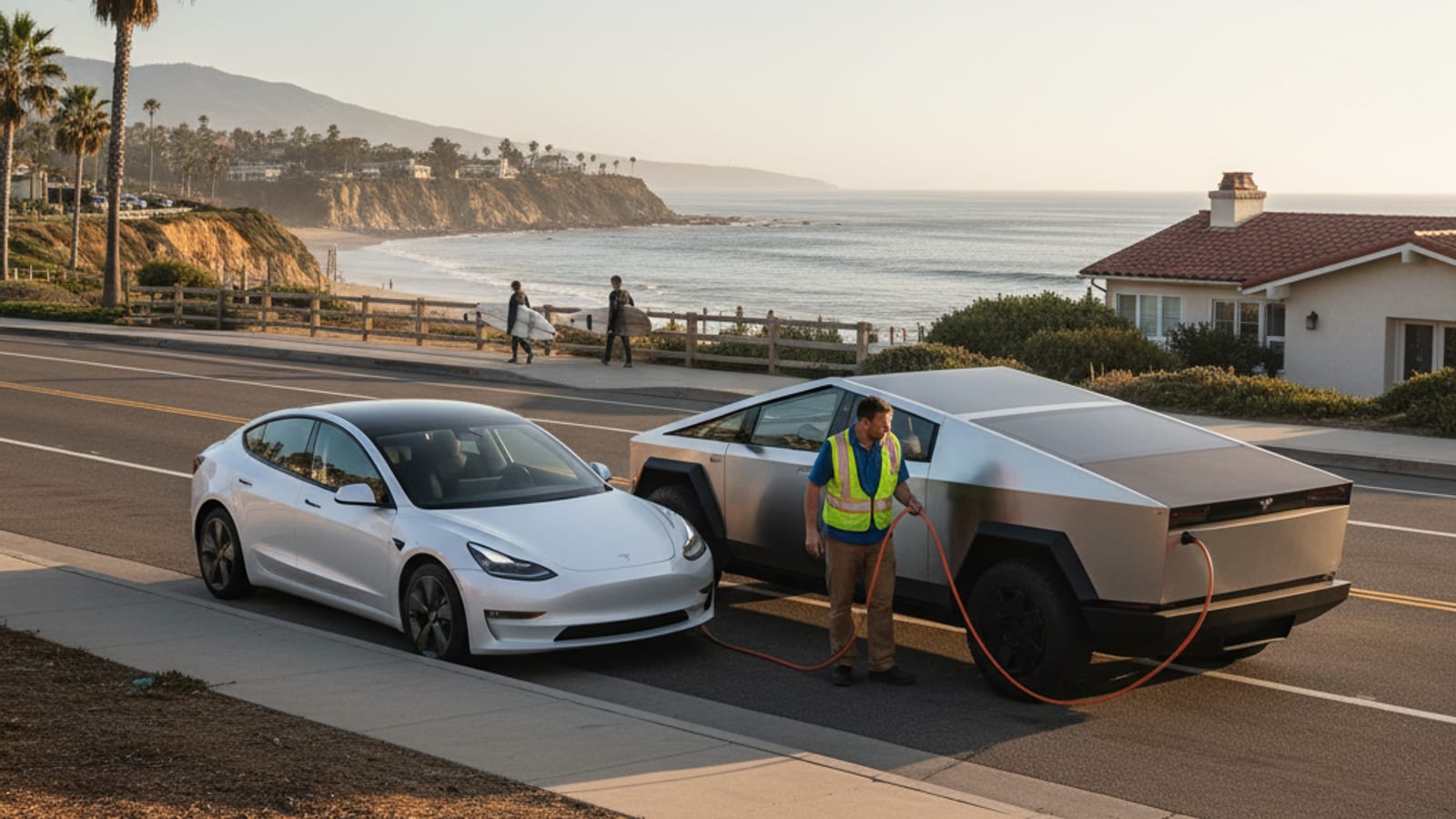
Charge Pro PHX doesn’t send its own truck. We’re a referral line for the Phoenix area. We match stranded drivers with independent local operators. The operator quotes you before any work starts. Then they bill you directly.
Why Queen Creek stalls happen on the road
Queen Creek is a growing East Valley city of about 71,867 people. That figure is from the ACS 2020-2024 5-year estimates. The city covers about 42.1 square miles. It sits at the far southeast edge of the built-up Valley. Only 3.1 percent of the housing was built before 1980. Newer homes are the norm in Church Farm and Cortina. They’re also the norm in Encanterra and Hastings Farms. Queen Creek Station and Sossaman Estates fit the same pattern.
Newer stock is why home charging is common here. Arizona Public Service serves Queen Creek. APS publishes the R-EV residential EV rate plan. It’s marketed as EV Overnight Charging from 11 p.m. to 5 a.m. on weekdays. APS also names a Level 2 smart-charger rebate. It names APS Smart Charge. It names Take Charge AZ for public and workplace charging. Confirm the current plan rules on your own APS bill. Program names are public. Any rebate figure belongs on the APS site, not here.
When most charging happens on a wall box, the stranding changes. You’re not fighting a shared garage stall. You’re on Loop 202 Santan or SR-24. You’re on Ellsworth or Ironwood. The pack is lower than you planned.
The land south and east opens into farmland. Then it meets the San Tan Mountains. San Tan Mountain Regional Park sits to the south. Those longer, more exposed runs are where heat and wind hit the pack. That’s about how this city is shaped. It’s not a claim about charger counts on any road.
What to do in the first minutes on a Queen Creek shoulder
Get the car as far off the traveled lane as you can. Arizona Revised Statutes 28-871 covers that stop. You may not stop on the traveled part of a highway outside a business or residence district. That applies when it’s practical to leave the lane. A vehicle disabled so badly it can’t move is exempt. You still need to leave room for traffic to pass. You also need to be visible 200 feet in each direction.
Turn on your hazards. Stay in the car if the shoulder feels exposed. If you had a minor crash and the car can roll, move it. ARS 28-674 says you must move it off the traveled roadway when it’s safe. You’re not at fault merely for moving it.
Other drivers have a duty too. Arizona’s Move Over law is ARS 28-775. Approaching traffic should change lanes when they can do it safely. If they can’t change lanes, they should slow down. That rule exists because a person by a stalled car is exposed. Don’t walk along Ellsworth or the Santan looking for help.
Heat is the Queen Creek range problem, not a driveway problem
Queen Creek runs the same Valley heat as Phoenix. It also has more open farmland exposure to the south and east. Phoenix averages about 111 days a year at or above 100°F. It averages about 21 days at or above 110°F. Those are NOAA 1991-2020 normals via NWS Phoenix. July highs average near 107°F. August sits near 105°F. Overnight summer lows stay in the mid-80s.
That weather cuts range. AAA’s 2026 study found about a 10 percent efficiency drop at 95°F versus 75°F. It found about an 8.5 percent range loss in the same comparison. Recurrent used 345,622 trips from 300 Phoenix-area EVs. That work reports losses of 20 to 30 percent above about 95°F. The loss sits near 31 percent at 100°F. NREL notes that cabin cooling is one of the biggest draws. A/C on a slow Ironwood crawl spends pack energy you thought you still had.
None of those figures come from Tesla. tesla.com wasn’t a source we could cite here. Treat them as published range studies. Then watch your own display.
Parked cars have a second problem. Tesla features such as Sentry Mode draw power while the car sits. Cabin Overheat Protection does the same. After a long stop near the Queen Creek Olive Mill, the traction pack may still look healthy. A day at San Tan Mountain Regional Park can look the same. The small 12-volt may not.
Empty pack or a 12-volt that cooked in the heat
These two failures feel the same from the curb. The screens are dark. The handles may not pop. The car won’t go into drive. They’re not the same job.
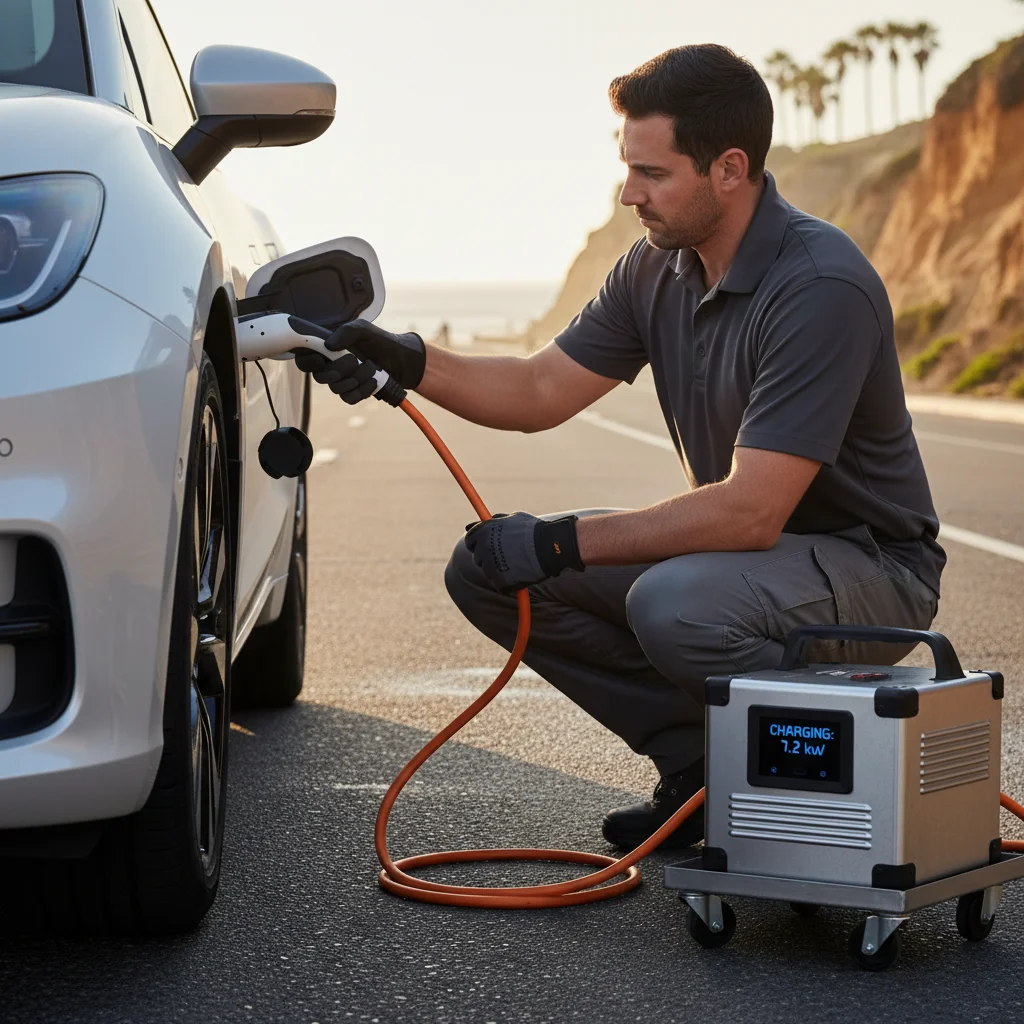
If the traction pack is empty, you need energy in the high-voltage battery. The operators we match bring a 240-volt Level 2 source to the car. They use a native NACS plug for Teslas. They use a CCS or J1772 adapter for other brands. In 15 to 30 minutes of charging, they typically add 10 to 20 miles of range. That’s charging time. It’s not a promise about when someone arrives. It’s enough to reach a charger you already chose. It can also get you home to the APS outlet you meant to use.
That on-site boost is mobile EV charging. If you already know the pack is at zero, ask for a charge at the car.
If the 12-volt is dead, a charge cable won’t wake the car. The 12-volt runs the door handles and the screens. It also runs the contactor that connects the main pack. A DC-DC converter only replenishes that small battery while the car is on or charging. Battery Council International work, via Battery University, found starter batteries last about 47 months in hot climates. They last about 59 months in cool ones. AAA calls heat the number-one cause of battery failure. A battery that lasts five years in a mild city can fail in two or three here.
Operators can jump or replace a dead 12-volt on site. That includes Tesla work. Read Tesla 12-volt battery jump if the car is silent. Use it when the last screen still showed miles.
What state motorist help will and will not do
Arizona has two roadside programs. Neither one advertises an EV charge.
Arizona DPS Roadside Motorist Assistance, or RMA, is statewide. It changes tires. It brings gasoline or diesel. It jump-starts batteries. It adds water and calls tows. In 2018 it assisted 75,235 motorists statewide. Its published materials name gasoline and diesel. They say nothing about charging an empty EV.
ADOT’s Incident Response Unit works Phoenix-area freeways from 5 a.m. to 8 p.m. on weekdays. It’s a 14-member unit. State Farm has sponsored it since 2020. It clears crashes and debris. It changes tires and helps stranded motorists. It also doesn’t list EV charging.
If you’re on the Santan or SR-24, those units may still help a flat or a crash. They’re not a substitute for a Level 2 rescue when the pack is empty. Factory Tesla roadside tows toward a Supercharger or a service center. It’s not an on-site charge. Confirm that with Tesla when you call them. Ford’s published path is a tow to the nearest charger, home, or dealer within 50 miles. Use a factory desk if your app offers one. Then decide whether you want the car hauled or charged in place.
Charge on the shoulder, or wait for a tow
A tow is the right tool when the car can’t take a charge. It’s also right when a wheel is damaged or you need a shop. Many EVs need a flatbed so all four wheels leave the pavement. Wheel-lift tows can stress motors and regeneration hardware. Ask the tower how they’ll load an EV before they hook it.
A tow also moves the problem. You still need a charger or a 12-volt at the other end. On a Queen Creek shoulder, that can mean a long flatbed ride toward Mesa, Gilbert, or Chandler. Then you wait again.
Mobile charging keeps the car where it already is. The operator connects, adds range, and you drive out under your own power. That’s why most road calls here are charge or jump calls. They’re not shop tows.
Arizona sets no statewide tow-rate cap. Cities and counties may set local maximums. Private-property tows need written authorization from the property owner, or a police request. That’s under ARS 9-499.05 and 11-251.04. If someone wants to hook your car in a lot, ask who authorized it. Ask for the written authorization and the quoted total before the winch moves.
Police can order a disabled or obstructing vehicle removed under ARS 28-872. Owners pay the tow and storage before release. If you can take a charge and roll off the shoulder first, you stay out of that process.
What a Queen Creek operator actually brings
The people we match are independent. Charge Pro PHX doesn’t own their trucks. We don’t set their prices. We don’t employ their technicians. We don’t hold a trade license for the work. The operator does the work. You pay the operator.
They bring a 240-volt Level 2 source on the vehicle. They bring a native NACS plug for Tesla. They bring a CCS or J1772 adapter for other brands. They bring jump gear. In many cases they can replace a 12-volt on the spot.
Non-Tesla EV rescue matters in newer East Valley neighborhoods. Ford, Hyundai, Kia, Rivian, and Chevy sit next to Teslas on Ellsworth. The plug has to match the car you have.
Level 2 is slower than a Supercharger. It’s also enough to leave the shoulder. If you need a longer fill, pick your next stop after the car will move.
Corridors and neighborhoods where these calls start
Loop 202 Santan Freeway is the northwest edge for a lot of Queen Creek driving. It ties this city toward Gilbert, Chandler, and the rest of the East Valley. If you stall on that freeway, start with the shoulder rules above. Then read Loop 202 in the East Valley for the freeway-specific steps.
SR-24, the Gateway Freeway, runs along the north edge. Ellsworth and Ironwood are the north-south spines people use when they’re not on a freeway. Those surface roads feel local until the pack is low. The next stretch can be farm-edge open land.
South of town, San Tan Mountain Regional Park draws weekend traffic. East and south, the built grid thins toward San Tan Valley. San Tan Valley is a census-designated place, not an incorporated city. Mesa, Tempe, Chandler, and Gilbert sit closer in. Queen Creek is the corner where the East Valley’s newer housing meets longer, hotter surface miles.
Neighborhood names help a dispatcher more than a vague city pin. Church Farm, Cortina, Encanterra, and Hastings Farms are real places here. So are Queen Creek Station and Sossaman Estates. ZIP codes 85142, 85140, 85212, and 85298 are in use. Say the cross street. Say whether you’re on the Santan, SR-24, or a neighborhood collector.
Most Queen Creek EV miles still start from a house on APS. If the wall box tripped, you may still be in a driveway. A lot of Queen Creek calls aren’t that. The house charge worked. The driver left Encanterra or Sossaman Estates with what looked like enough range. Heat, A/C, and a slower Ironwood run spent it.
What actually moves the quote
Charge Pro PHX doesn’t publish a price. We don’t set one. The operator quotes you before they start.
Distance matters. Queen Creek sits at the far southeast corner of the built-up East Valley. An operator coming from the inner East Valley covers more ground than a Mesa in-town hop. That travel is part of their bid. It’s not a published arrival clock.
Time of day matters. Late night changes the job. Weekend park traffic changes it too. Weekday Santan congestion changes how long they’re committed to your call. Ask them how they price that.
How much range you need matters. A bump to the next charger you already picked is a shorter session. Filling toward a long run home takes more time at the car. The 10 to 20 miles in 15 to 30 minutes of charging is typical. It’s not a guarantee for every pack. Your car’s charge rate, the heat, and the 12-volt all change the session.
If the job is a 12-volt jump or a replacement, say that up front. Get the quote. If it doesn’t work for you, say no before they connect. They bill you directly. There’s no Charge Pro PHX invoice behind theirs. For a longer walk-through of that conversation, see how mobile EV charging is quoted.
How to place the call without wasting the first five minutes
Stay off the traveled lane. Hazards on. If you can, drop a pin and read the nearest named road. Name Ellsworth by a neighborhood gate. Name Ironwood south of the built streets. Name SR-24 before the next interchange. Those details beat a city-only pin.
Tell the matcher the brand and the inlet. Tesla NACS is one setup. CCS or J1772 is another. Say whether the car is silent or the pack display still shows a number. Say whether the doors unlock. That’s how they tell a 12-volt job from an empty pack. Say you want an on-site charge or a 12-volt fix. Ask for a flatbed only if you already know you need one.
Charge Pro PHX will match you with an operator who covers this part of the Phoenix area. The operator calls you, quotes the job, and comes to the pin if you accept. We don’t promise when that happens. Queen Creek is a real drive from the inner East Valley. Traffic on the Santan is its own variable.
Keep kids and pets in the car with the A/C only if the pack can spare it. If the traction pack is already critical, use the hazards and shade.
Monsoon season runs June 15 to September 30. Haboobs can drop visibility to near zero. Don’t walk into a wash. Don’t drive around a barricade. ARS 28-910 lets the state bill you for the emergency response. That applies if you drive into a flooded, barricaded area. The billed maximum is set in statute. Read the current text at azleg.gov. If dust is coming, stay in the car.
When you’re ready to request a match, call (602) 932-0920. That number reaches Charge Pro PHX. It’s not a clock. It’s not a promise that a truck is around the corner. It’s how we start matching you with a local operator who will quote the work.
Frequently asked questions
How much range does a mobile charge add in Queen Creek
The operators we match typically add 10 to 20 miles in 15 to 30 minutes of charging. That’s Level 2 time at the car, not travel time to you. Your inlet, the heat, and how empty the pack is will change the session. Ask the operator what they expect for your brand before they plug in.
Do you help non-Tesla EVs stuck in Queen Creek
Yes. Charge Pro PHX matches Tesla and every major EV brand. Operators bring a native NACS plug and a CCS or J1772 adapter. Ford, Hyundai, Kia, Rivian, Chevy, and the rest are ordinary calls on these East Valley roads. Confirm the inlet when you call so the truck that is offered actually fits your port.
What should I have ready before the operator quotes me
Your location, the brand, the inlet, and whether the car is silent or just low. Say how much range you think you need to reach a charger or your driveway. The operator sets the price from that, plus distance and time of day. Charge Pro PHX doesn’t set it. If the quote isn’t a fit, decline before they start.
Queen Creek is still adding houses on APS service. The home charge is what most people trust. The stall usually comes on Ellsworth, Ironwood, the Santan, or SR-24. You’re away from that wall box. A local operator can put 240 volts or a 12-volt jump on the car where it sits. We connect you. They do the work.