Your EV died in Litchfield Park after sitting in the heat. Or the West Valley commute ran remaining range too thin. The next step is usually a 12-volt jump or a Level 2 charge. Charge Pro PHX matches stranded drivers with independent local operators. Those pros quote before they start and bill you directly.
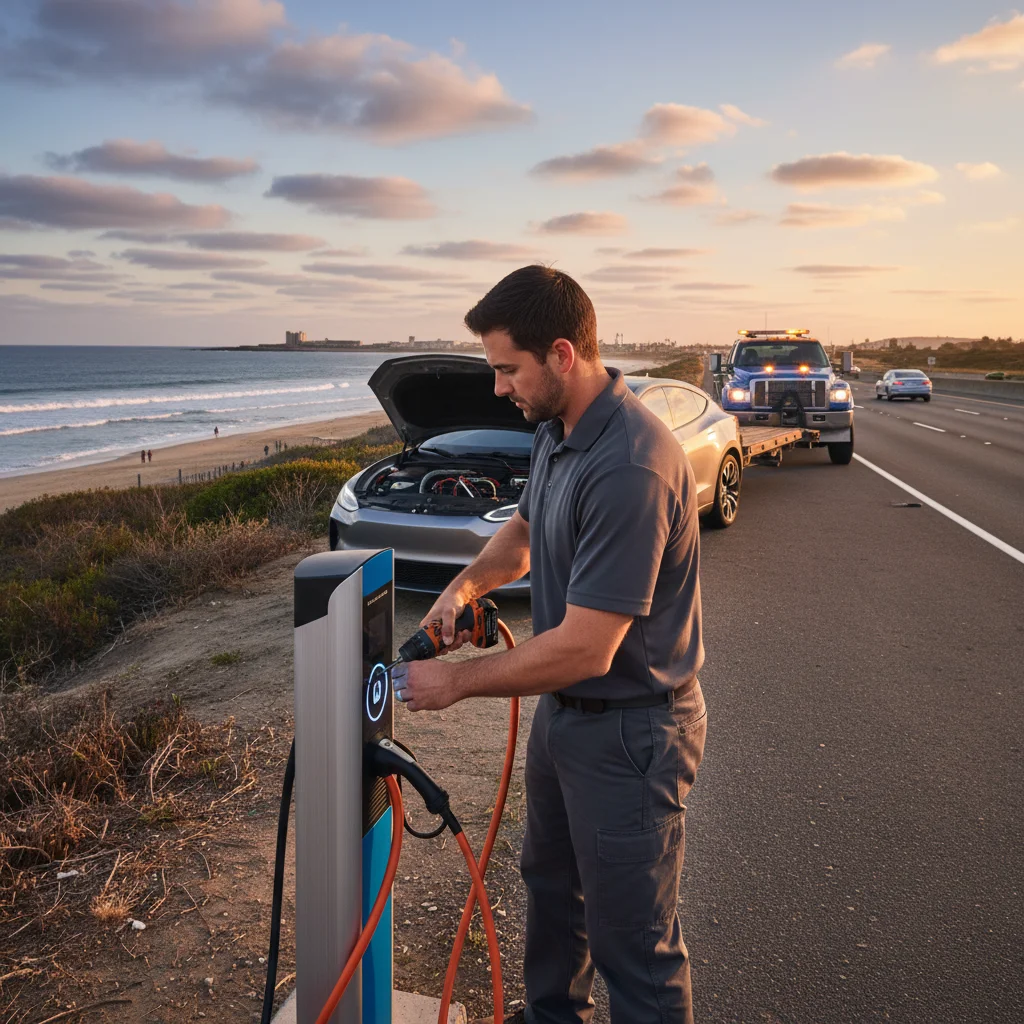
A small West Valley city with two stall patterns
Litchfield Park covers about 3.3 square miles. The Census puts the city near 6,916 residents per ACS 2020-2024. It sits in the West Valley on ZIP 85340. Litchfield Road and Camelback Road are the in-town spines. I-10 and Loop 101 sit just beyond that compact grid. Nearby cities include Goodyear, Peoria, Surprise, and Glendale, Arizona.
The city’s built around the Wigwam Resort. Luke Air Force Base sits about two miles north. Those two anchors shape the stranded-car calls here. Resort valet lots produce parked-and-drained cars after long events. The base-adjacent commute produces evening range calls on the way home. Old Litchfield, Wigwam Creek, and The Villages at Litchfield Park are named neighborhoods.
About 34.2 percent of housing here was built before 1980. That’s older than much of the far-suburb belt. It doesn’t tell you whether a given house has a wall box. It does mean plenty of cars still bake in uncovered lots and driveways. APS serves Litchfield Park, though Valley service can split block by block. Confirm your own address with the utility before you assume the rate plan.
APS names the R-EV residential EV rate plan. It’s marketed as EV Overnight Charging from 11pm to 5am on weekdays. APS also publishes a Level 2 smart-charger rebate. APS Smart Charge and Take Charge AZ are on the same site. Take Charge AZ is for public and workplace charging. Dollar amounts weren’t confirmed for this page, so don’t guess. Check APS for the current offer before you enroll.
Heat here hits the small battery and the pack
Litchfield Park runs the same desert heat as the rest of the Valley. Phoenix averages about 111 days a year at or above 100F. About 21 days reach 110F or more. Those figures are NOAA 1991-2020 normals via NWS Phoenix. July highs average near 107F, and August highs average near 105F. Overnight summer lows hang in the mid-80s.
Range falls in that weather, and the dash won’t warn you early enough. Recurrent reports EVs can lose 20 to 30 percent of range above 95F. Loss sits near 31 percent at 100F in that set. That finding used 345,622 trips by 300 Phoenix-area EVs. AAA’s 2026 study found about a 10 percent efficiency drop at 95F versus 75F. Range loss in that test was about 8.5 percent. NREL notes climate-control loads cut range in a meaningful way. Plan the West Valley miles with that penalty. A dash number that looked fine at 8am can lie by evening.
The lockout story is the 12-volt, not the traction pack. It runs door handles, screens, and the contactor for the traction battery. If that small battery’s dead, a full pack won’t wake the car. The DC-DC converter recharges it only while the car’s on or charging. Battery Council International work, via Battery University, timed starter batteries in heat. They last about 47 months in hot climates versus 59 in cool ones. AAA calls heat the number-one cause of battery failure.
Tesla’s Sentry Mode and Cabin Overheat Protection keep drawing while the car sits. After a parked day at the Wigwam, that draw plus heat is a factor here. Read when Tesla 12-volt batteries fail in desert heat if the car’s a Tesla. The same 12-volt stall happens on other brands.
A hot parked day at the Wigwam
The Wigwam is the local landmark, not a freeway exit. People leave cars with valet through long events. You return, the app won’t connect, and the handles stay flush. That’s the parked-and-drained pattern the research flags for this city.
Don’t keep rapping the window or cycling the key fob. Check whether any lights answer a button press. If the car’s fully dark, treat it as a 12-volt job first. Tesla 12-volt battery jumps are the on-site path for Tesla owners. Network operators also jump or replace a dead 12-volt on other EVs. They work at the car and quote you before they start.
If the dash still works and the miles are low, that’s a charge call. Independent operators bring a 240-volt Level 2 source. Tesla cars take a native NACS plug, and other EVs use CCS or J1772. Typical charging adds 10 to 20 miles in 15 to 30 minutes of charging. That window is charging time only, not an arrival estimate. Mobile EV charging is how that match is described on this site.
This page won’t guess which public stall you’ll reach. Research didn’t confirm named charging sites inside Litchfield Park. Open your charging app from a safe spot and read what it actually lists.
The Luke commute and the last West Valley miles
Luke Air Force Base sits about two miles north. Heat-worn 12-volt batteries are a factor at the base and the resort. A car that sat through a shift can fail like a valet car. A car that still wakes may be short on range toward Glendale.
On-base access rules weren’t verified for this article. If you’re inside a gate, follow the base’s own process. On public streets, a matched operator can come to the car. Litchfield Road runs north-south, and Camelback Road runs east-west.
If you still have a few miles, don’t spend them looping. Pull into a legal parking stall in Old Litchfield or along a side street. Use hazard lights if you’re on a shoulder. Then call for a charge at the car, not a hope at the next interchange.
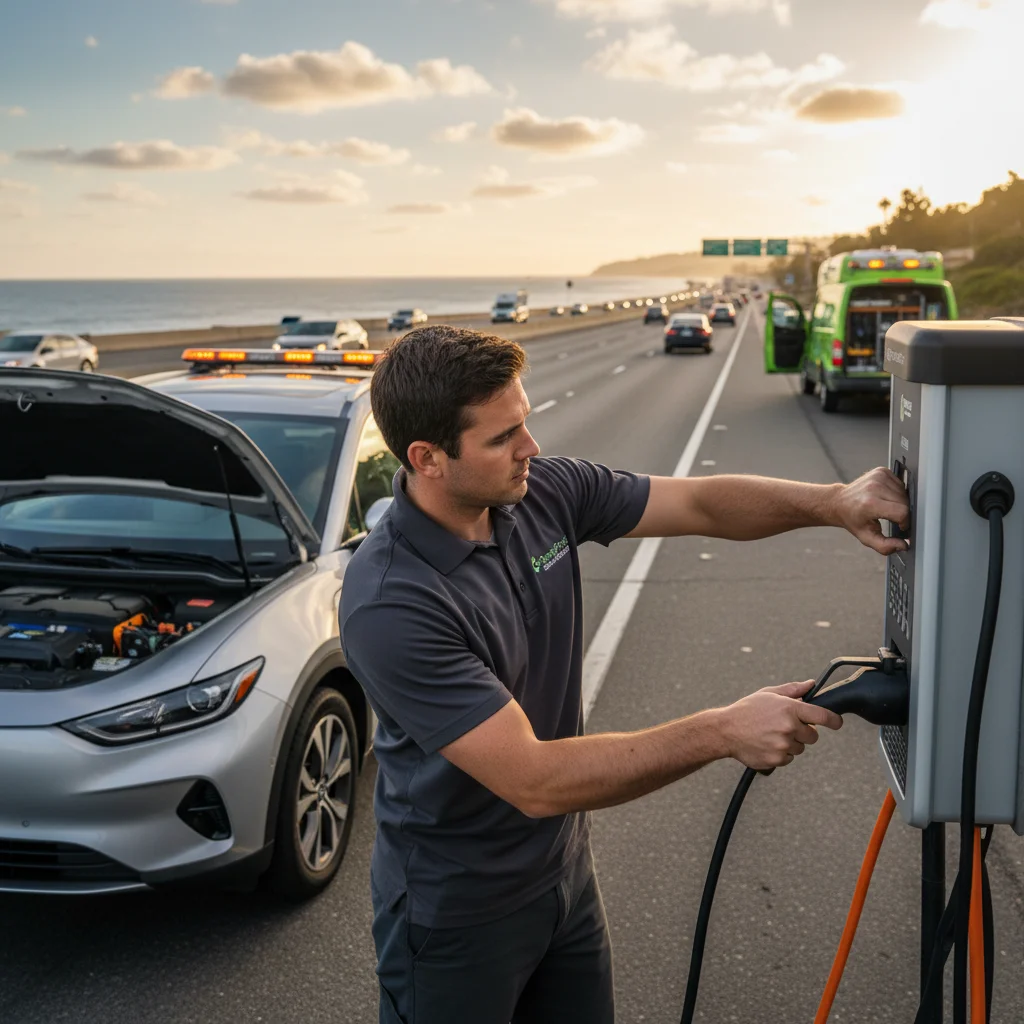
I-10 and Loop 101 Agua Fria when the pack is already thin
The far-west commute uses I-10 and the Agua Fria leg of Loop 101. Litchfield Park is the small city between those corridors and the resort core. Arizona has no toll roads and no toll express lanes, per ADOT. You’re managing heat, traffic, and a pack that sat hot all day.
If you stop on a freeway, get off the traveled lanes if you can. ARS 28-871 bars stopping on the traveled lanes when you can get off them. That rule applies outside a business or residence district. A vehicle disabled so badly it can’t move is exempt. Leave room for others to pass, and stay visible 200 feet each way. Other drivers must change lanes or slow for a stopped vehicle with warning lights. That’s ARS 28-775, the Move Over law.
Arizona does run free motorist help. DPS Roadside Motorist Assistance changes tires and brings gasoline or diesel. It also jump-starts batteries, adds water, and calls tows. In 2018 it assisted 75,235 motorists statewide, per DPS. Its published materials name gasoline and diesel only. They say nothing about charging an EV or recovering an empty pack. ADOT’s Incident Response Unit works Phoenix-area freeways from 5am to 8pm weekdays. It’s a 14-member unit, sponsored by State Farm since 2020. It’s logged 10,400-plus responses since October 2019. It clears crashes and debris and helps stranded motorists. It doesn’t advertise EV charging on those freeway shifts.
Use those programs if you need a tire change or a safer shoulder. For an empty EV, you still need an operator who can charge or jump. That’s out-of-charge recovery, matched through the referral line.
What to say so the right operator is quoted
Charge Pro PHX doesn’t perform the work. It doesn’t own trucks, a yard, or equipment. It doesn’t employ technicians and holds no trade license. It doesn’t set prices and doesn’t promise an arrival time. You call the line, and we connect you with an independent local operator. That person quotes the job, and you accept or you don’t.
Lead with the exact place, not just the city name. Litchfield Park is only 3.3 square miles. A Wigwam valet stall isn’t an I-10 shoulder. Say Litchfield Road, Camelback Road, Wigwam Creek, or The Villages. Share a map pin from your phone if you can.
Then split the failure into dark-car versus low-pack. Tell us if the car’s dark, and if the handles still work. Tell us the miles on the dash if there are any. A 12-volt lockout and a low traction pack are different visits.
Name the vehicle and the plug so the operator brings the right lead. Tesla uses NACS, and many other EVs need CCS or J1772. The operators we connect you with bring the native NACS plug and those adapters.
Stay out of live lanes and get as far right as you can. Keep warning lights on while you wait on the shoulder. If you’re on I-10 or Loop 101, wait behind a barrier when you can.
The Litchfield Park city page collects local charging and rescue context. EV roadside assistance is the service page for the match itself.
The operator on scene charges or jumps, then you drive out. A tow’s a different job if the car can’t take a charge. Call (602) 932-0920 to be matched with a local operator.