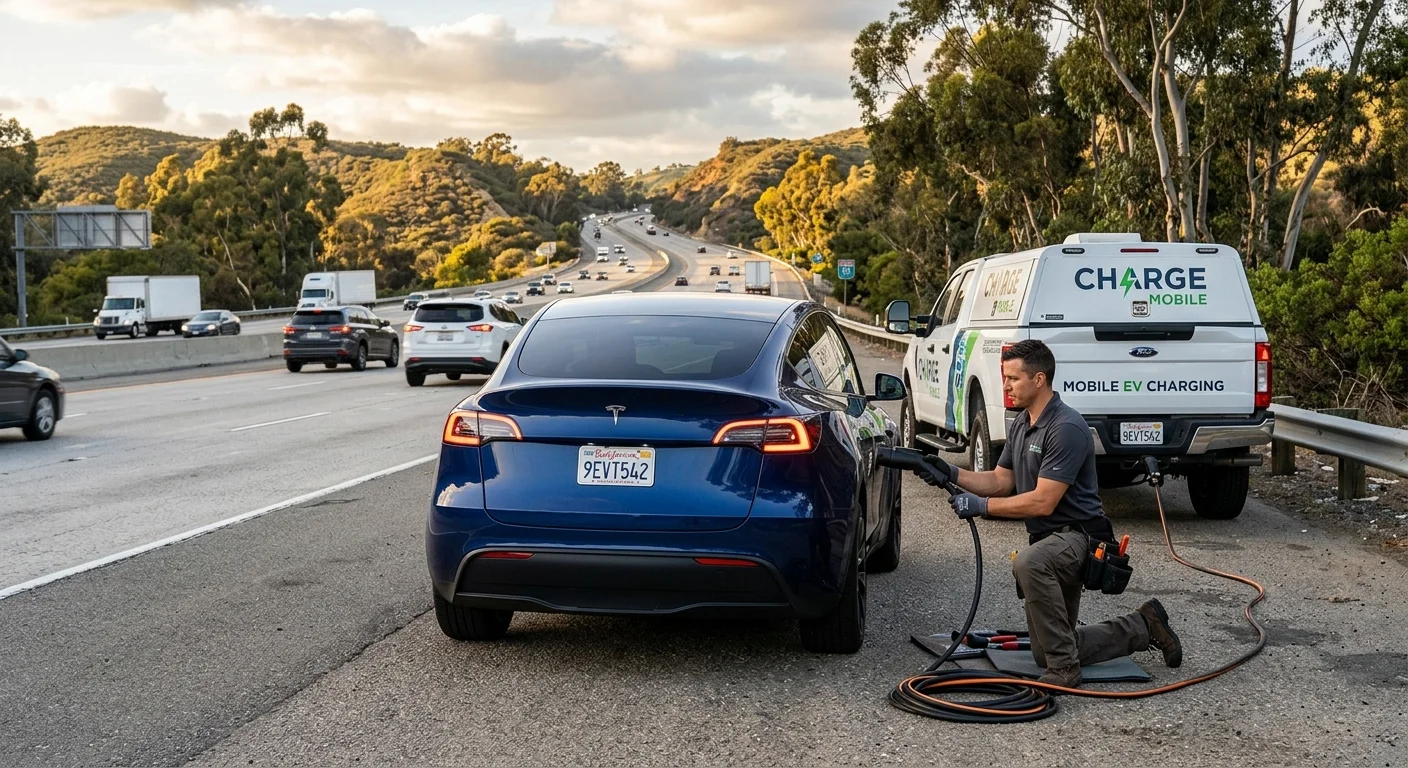
Your EV died in Black Canyon City on the I-17 north climb. You need EV roadside assistance: a charge or a 12-volt jump at the car. This stretch sits at the heart of the Black Canyon climb. The town is near 2,000 feet on that grade. ADOT posts a 6% maximum on the northern I-17. Nav apps often undercount the cost toward Sunset Point. Charge Pro PHX is a referral line, not a shop. We match stranded drivers with independent mobile operators. The operator quotes you before any work starts. They bill you directly when the job is done.
Why the I-17 climb through town eats range
Black Canyon City is a small I-17 community. The Census ACS 2020-2024 5-year count is 2,181. Land area is about 24.6 square miles in ZIP 85324. Rock Springs sits on the same corridor as the townsite. The Rock Springs Cafe is the stop most Valley drivers know. Phoenix and Sky Harbor sit near 1,135 feet. Anthem is about 1,860 feet. New River is about 2,140 feet. Black Canyon City is about 2,000 feet. Sunset Point rest area is about 3,410 feet. Cordes Junction is about 3,800 feet. Northbound cars pay for every one of those feet.
Forum drivers on this climb have logged the split. Uphill use has run about 481 Wh/mi. Downhill use on the same stretch has run about 293 Wh/mi. That’s about 40% more energy going up. Many trip planners still treat I-17 like a level freeway. Heat stacks on top of the grade. Phoenix averages about 111 days at or above 100F. AAA’s 2026 study found about a 10% efficiency drop at 95F versus 75F. Range in that test fell about 8.5%. Recurrent used 345,622 trips by 300 Phoenix-area EVs. It reported 20 to 30% range loss above about 95F. Loss was near 31% at 100F. Cabin cooling is one of the bigger draws. You’re climbing, cooling, and holding freeway speed at once.
A driver who left Anthem with a thin buffer can still stall here. The same miss happens after New River when the screen looked fine. The next rise toward Sunset Point is where that buffer disappears. People pointed at Flagstaff feel it first. Southbound is a different story. Regen helps on the descent. Northbound is the classic stall on this run.
Townsite, Rock Springs, and the interstate shoulder
Stops land in a few real places. The Black Canyon City townsite off the interstate is one. The Rock Springs stretch is another. The I-17 shoulder on the climb itself is the third. The long grade toward Sunset Point is the fourth. This is a corridor rescue, not a short neighborhood miss. People are often aimed at Flagstaff or Camp Verde. The nav promised they had the miles. The 6% pitch took them instead. This town is the classic corridor-rescue spot on the Flagstaff run.
If the car can still roll, get it off the travel lanes. ARS 28-871 bars stopping on the traveled part when you can get off it. A vehicle that’s disabled and can’t be moved is exempt. Leave room for other traffic to pass. Stay visible 200 feet in each direction. Put the hazards on and stay out of the lanes. Arizona’s Move Over law is ARS 28-775. Drivers approaching a stopped car with warning lights must move over. They change lanes if they can. If they can’t, they have to slow down. An operator working your car still needs that buffer. Arizona has no toll roads and no toll express lanes. You’re on a public interstate grade.
Confirm live stalls in your own charging app. ADOT’s NEVI plan names I-17 as a designated interstate corridor. Construction on that build-out is underway in 2026. We won’t guess which stall is closest.
What DPS and ADOT can do, and what they don’t
Arizona DPS runs Roadside Motorist Assistance statewide. The program changes tires and can bring gasoline or diesel. It can jump-start a conventional battery, add water, and call a tow. In 2018 it assisted 75,235 motorists statewide. Its published materials name gasoline and diesel. They don’t mention charging an out-of-range EV. ADOT’s Incident Response Unit covers Phoenix-area freeways. Published hours are 5am to 8pm weekdays. It clears crashes and debris, changes tires, and helps stranded motorists. It also doesn’t advertise EV charging.
Those programs can still help with a tire or a wreck. They won’t refill a traction pack. A standard jump pack may wake a 12-volt. It won’t put miles in the big battery. That’s why EV roadside assistance in Black Canyon City means a mobile operator at the car. Factory Tesla roadside won’t charge you on site. Tesla tows to a Supercharger or a service center. Ford’s published roadside tows to the nearest charger, home, or dealer within 50 miles. Rivian and some Hyundai and Kia owners have documented tow trouble. Those owners are told to specifically request a tow. If you want miles where you sit, ask for mobile EV charging.
Empty pack or a cooked 12-volt
Two failures look the same from the shoulder. The traction pack can be empty after the climb. The 12-volt can also be dead from heat. In an EV, the 12-volt runs door handles and screens. It also runs the contactor that connects the main battery. A full pack with a dead 12-volt still leaves you stranded. A DC-DC converter recharges the 12-volt only while the car is on. It also charges while the car is charging. Tesla features like Sentry Mode draw parked power.
Battery Council International work, via Battery University, put numbers on heat. Starter batteries last about 47 months in hot climates. That’s versus about 59 months in cool ones. A battery good for five years elsewhere can fail in two or three years in the desert. AAA calls heat the number-one cause of battery failure. If the car is dark, locked, and silent, start with the 12-volt. If the car is awake and the range reads zero, the pack needs energy. The pros we connect you with can jump a dead 12-volt on site. They can replace it on site too. They also bring a 240-volt Level 2 source to the car. They handle Tesla and every major EV brand.
What a mobile charge actually adds
This is not a Supercharger on a truck. The operators we connect you with bring 240-volt Level 2 power. Teslas take a native NACS plug. Other EVs use a CCS or J1772 adapter. Typical add is 10 to 20 miles of range. That’s in 15 to 30 minutes of charging time. Charging time is not an arrival time. We don’t publish arrival times or set prices. The operator quotes you before they start.
Ten to twenty miles is often enough to leave the shoulder. You can then reach a charger you already mapped. You can also turn south toward Anthem or New River. We won’t name a closest public site. Confirm that pin yourself. For the longer I-17 picture, read out of charge on I-17 north. For out-of-charge recovery, that’s the matching path when the pack is empty. A tow still has a place. Charging won’t fix a mechanical fault. If you need a shop, a wrecker is the right tool. If you only need enough range to get off the grade, charge first. Keep hazards on while you wait.
How a Black Canyon City call gets matched
Give the matcher a real pin, not just the town name. I-17 northbound or southbound matters. Milepost, exit, townsite, or Rock Springs helps. Say whether the screens are on. Say whether the range reads zero. Say Tesla or another brand. Say NACS, CCS, or J1772 if you know it. We’ll connect you with an independent operator. That person quotes the job before they start. They bill you directly.
This is a long-haul dispatch from the Valley. Ask the operator about timing when they quote. We don’t promise a clock. We don’t own trucks, a yard, or a fleet. We don’t employ technicians. We don’t hold a trade license. The brand connects you, and the pro does the work. For the town page, use EV charging in Black Canyon City. Call (602) 932-0920 when you want that match. Stay off the travel lanes and let the operator quote, then decide.