You walk out to the ID.Buzz after a long Sunday brunch in Arcadia, palm tree shadows sliding across the hood, and nothing happens. The fob does nothing. The door handles stay flush. The screen stays dark. The traction battery still shows a full pack on the app, but the van will not wake up. In Phoenix, this is almost never the big battery. It is the small one.
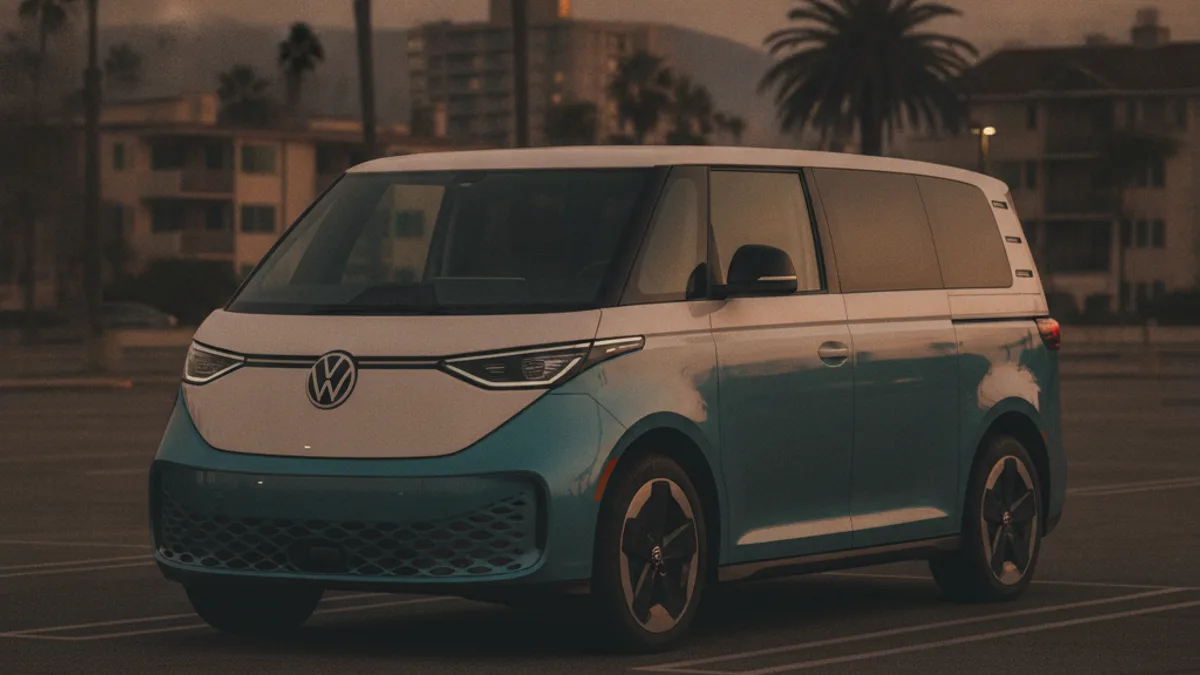
The ID.Buzz has two batteries, and only one of them is the problem
Every ID.Buzz carries a high-voltage traction pack that drives the wheels. It also carries a small 12-volt battery, just like a gas car, that runs the computers, the door handles, the infotainment screen and the contactor that closes the circuit between the two. When the 12-volt is dead, the van will not start, will not shift and will not charge. The traction pack being full does not help. The two systems do not talk without the small one awake.
Phoenix cooks that small battery faster than almost any other climate in the country. NOAA’s 1991 to 2020 normals, read through NWS Phoenix, put the Valley at about 111 days a year at or above 100F, with July highs averaging near 107F and overnight lows still in the mid-80s. Battery Council International work, via Battery University, found starter batteries last about 47 months in hot climates versus about 59 in cool ones. A 12-volt that would have lasted five years in the Pacific Northwest can fail in two or three summers here. AAA has called heat the number-one cause of battery failure for years.
The signs are specific, and they point the same way
A dead traction pack and a dead 12-volt feel very different from the driver’s seat, and on the ID.Buzz the 12-volt failure has a few telltale signs.
The fob does not unlock the doors. Touching the recessed handle does nothing. If you open the door with the mechanical key, the dashboard is dark and the center screen does not light up. The drive selector stays locked. The hazard button might still work for a while because it draws power directly, but that is the last thing standing.
If you can wake the app, the app may still show the traction pack as nearly full. That detail confuses people, because it feels like the car is lying. It is not. The app reads the big battery through a separate channel. The 12-volt is what boots the car, and the car has to be awake for the app to talk to it at all, so a fully responsive app on a totally dead van is rare. More often the app reports last seen hours ago.
One important detail for ID.Buzz owners: the key fob hides a mechanical key blade. A small release on the fob slides the blade out. The driver door has a small cover over the key cylinder, usually near the handle. Pop the cover, insert the blade, and turn to unlock the door mechanically. This is the way in when the 12-volt is dead.
Where to jump the 12-volt on the ID.Buzz
The jump point on the ID.Buzz is under the hood, in the front compartment. There is no traditional engine bay, but the hood release is on the driver’s side and the 12-volt sits toward the front of the front trunk area. VW marks a positive jump terminal under a small red cover and a chassis ground point nearby. Owners should check their manual for the exact location before they need it, because reading a diagram with a dark dashboard is harder than reading it at the kitchen table.
A modern EV is not jump-started like a 1970s truck. The procedure is the same idea: positive cable to the positive terminal, negative cable to a chassis ground away from the battery, never the negative post itself, then wake the donor vehicle, let the small battery take a charge for a few minutes, and try the ID.Buzz again. Revving the donor helps push current. Once the ID.Buzz wakes up and the screen lights, leave it in accessory mode or plug it in so the DC-DC converter can top off the 12-volt on its own.
A few cautions worth noting in Phoenix heat. A warm 12-volt off-gasses more than a cool one. Eye protection is not optional. Battery acid on skin after a summer of electrolyte loss is a real burn risk. If the battery case looks swollen, cracked or wet, do not jump it. Call for help instead. Independent mobile operators carry AGM-compatible jump packs sized for European EVs, and they can also test the battery on the spot and replace it if it will not hold a charge.
Why this hits Phoenix ID.Buzz owners harder than most
The ID.Buzz came to the U.S. market relatively recently, and a lot of them live in garages that face west, parked outside at Scottsdale Quarter or Tempe Marketplace, or sitting at Phoenix-Mesa Gateway Airport on a long trip. The Battery Council work shows that any car sitting in Phoenix summer heat loses 12-volt life faster than the same car in Flagstaff or Sedona.
Sentry Mode, in Teslas, draws on the 12-volt while parked. VW’s over-the-air features and alarm systems draw their own small current. A van parked at Sky Harbor for a week, or a van parked curbside in Sun Lakes for a Sunday brunch, comes back to a small battery that has been trickling for days in 105-degree heat. The traction pack is fine. The 12-volt is the casualty.
Recurrent, using data from 300 Phoenix-area EVs, reports 20 to 30 percent range loss above about 95F, with losses near 31 percent at 100F. AAA’s 2026 study found about a 10 percent efficiency drop and an 8.5 percent range loss at 95F versus 75F. The 12-volt is the part most people do not think about until the dashboard goes dark.
What to do on a Phoenix street with a dark ID.Buzz
If the van is in a parking lot or a driveway, the safest move is to call a mobile operator who carries a 12-volt jump pack and an AGM replacement. Tesla 12-volt jump covers the same kind of visit for any EV with a low-voltage wake-up battery, including the ID.Buzz. If the van will not shift into neutral because the contactor will not close, EV roadside assistance is the broader category.
If the van is on a street shoulder or a freeway ramp, the rules are different. ARS 28-871 says you may not stop or park on the traveled part of a highway outside a business or residence district if it is practical to get off it, and a vehicle that cannot move is exempt. ARS 28-871 also asks that a stopped vehicle be visible from 200 feet in each direction. Hazard lights on. Move as far right as possible.
Approaching drivers owe the stopped van room. ARS 28-775 is Arizona’s Move Over law. Move over a lane if you can. Otherwise slow down for a stopped vehicle with flashing or warning lights. That is the reason any operator working an ID.Buzz on the Loop 101 Pima or the US-60 Superstition wants the lights on and the car pulled far right. Our Loop 202 East Valley guide covers a related freeway-stop pattern.
A quick home check before you call
Three things are worth trying before a tow shows up.
First, the fob battery. A weak fob looks like a dead car. VW fobs take a small coin cell, and a fresh battery is cheaper than a service call.
Second, the door cycle. With the mechanical key, unlock the driver’s door manually, sit in the seat, and try the start button. Some ID.Buzz models need to see weight on the seat and a foot on the brake before they will boot. A dead screen and a flashing key icon usually means the fob is not recognized, not a 12-volt failure.
Third, the charge port. If the van will not wake, it will not open the port either. There is usually a manual release in the front trunk area that pulls the latch. Knowing where it is before the car dies saves a future argument with a locked port.
When the small battery really is the problem
If the screens wake but the van will not drive, the 12-volt is not the failure. That is a different call, and mobile EV charging is the right page. If the van will not wake and the screens stay dark, the 12-volt is the failure. Either way, an independent mobile operator can handle both at the car.
The pros we send carry Level 2 mobile charging, J1772 and CCS adapters for non-Tesla EVs, AGM-compatible jump packs and replacement 12-volt batteries. For non-Tesla EVs specifically, non-Tesla EV rescue is the matching service. The operator quotes you before starting and bills you directly. We are the referral line, not the truck.
One number for Phoenix
If your ID.Buzz will not wake and you are stranded anywhere in the Phoenix area, from Scottsdale to Chandler, the call is the same. Have the location ready: the cross street, the parking lot, the mile marker. Call (602) 932-0920 and we connect you with an independent operator who works at the car.
Frequently asked questions
Can I jump a VW ID.Buzz from another car?
Yes. Use the under-hood positive terminal and a chassis ground. Avoid the negative post itself if the battery case is warm or off-gassing.
Will a dead 12-volt in an ID.Buzz unlock the doors?
No. The door handles are powered by the 12-volt. Use the mechanical key blade hidden in the fob, then pop the small cover on the driver’s door.
How long does a 12-volt last in Phoenix heat?
Starter batteries last about 47 months in hot climates versus about 59 in cool ones, per Battery Council International work via Battery University. Plan on two to four years in Phoenix.