If your Rivian is sitting on a Phoenix-area shoulder, you need two answers from the person who helps you. Which plug your truck takes. And whether your screens are dark, which means a different problem.
A Rivian is not one plug. It is two, depending on when the truck was built and which model it is. On a Valley roadside that distinction decides what kind of cable the operator reaches for.
What plug does a Rivian actually use
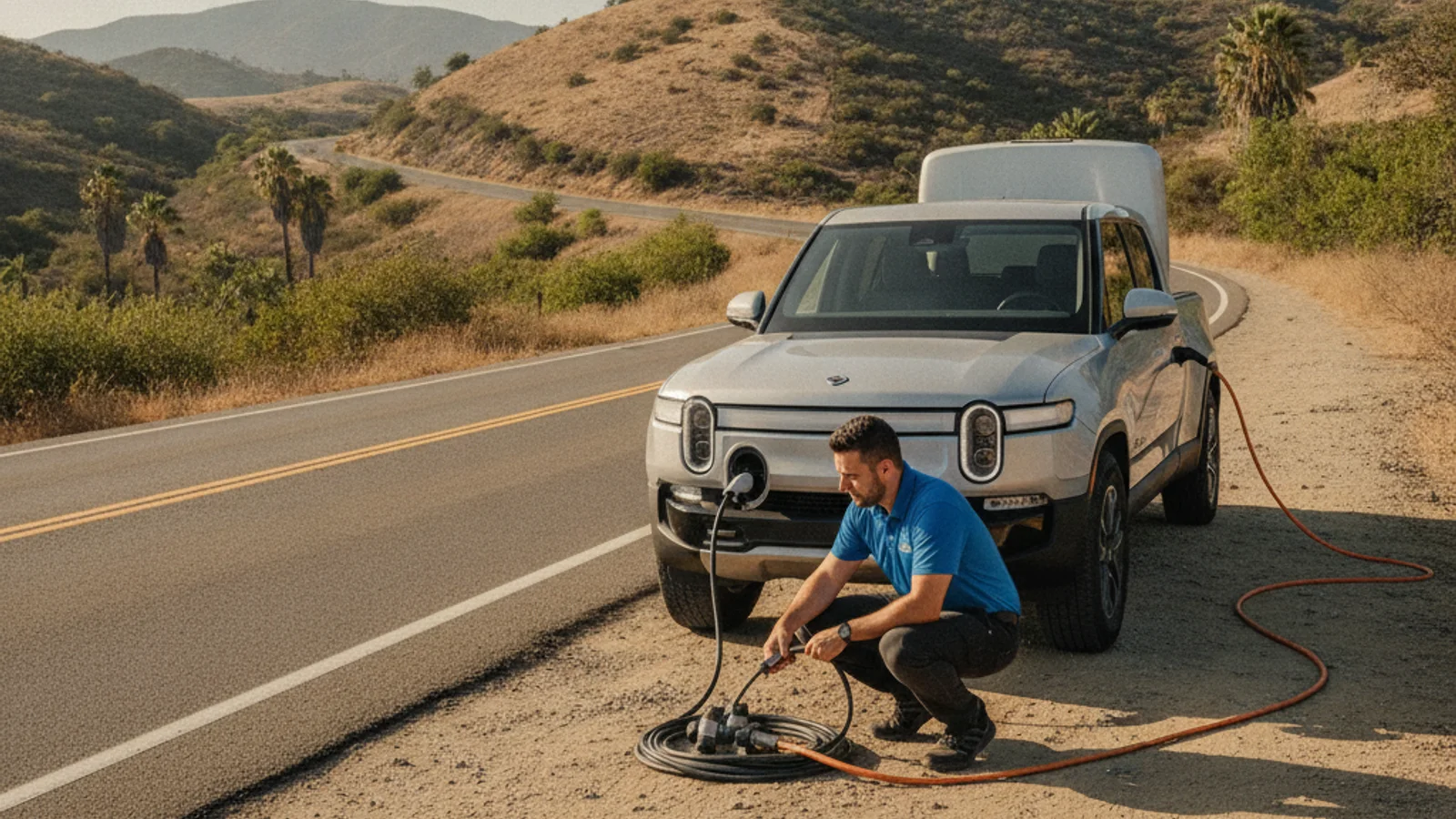
The original R1T pickup and R1S SUV shipped with a CCS1 port, the Combined Charging System connector most non-Tesla EVs use in North America. Rivian then committed to NACS, the connector Tesla designed and that the rest of the industry has been adopting. The R2 and R3 will be NACS native. Existing R1T and R1S owners moved to NACS through adapters, then through factory retrofits.
So a 2022 R1T is probably on CCS. A 2025 R1S is probably on NACS. Many trucks in between carry both, with the adapter in the frunk. The operator who shows up to a Phoenix roadside brings both cables, plus a J1772 adapter for the rare Level 1 fallback.
A 240-volt Level 2 source with the right plug is what reaches the truck. See mobile EV charging for the general idea, and non-Tesla EV rescue for the brand-specific version.
What a 240-volt visit looks like at the truck
The operator pulls up in a van or pickup with a portable Level 2 unit, generally in the 9 to 19 kilowatt range. They plug into your charge port, not your 12-volt, and the truck’s own charging system does the work. A typical 15 to 30 minute charging session adds about 10 to 20 miles of range, enough to limp to the next fast charger or to get home.
That is charging time, not a promise of when the operator arrives. The visit itself takes a few minutes to plug in, the charging window, and a few minutes to pack up.
For Rivian-specific coverage of the dead-truck case, see Rivian R1T and R1S won’t start in Phoenix heat.
Phoenix heat is the hidden problem
The Valley runs about 111 days a year at or above 100F (NOAA normals). July highs sit near 107F. Cabin cooling fights the heat, and the truck’s battery management system pulls power to keep the pack cool. Recurrent, using 300 Phoenix-area EVs, found drivers lose 20 to 30 percent of rated range above about 95F. AAA’s 2026 study showed about 8.5 percent range loss at 95F versus 75F.
Heat does a second thing to a Rivian parked outside. The 12-volt battery that wakes the truck up sits under the hood and bakes. In the desert, that battery can fail in two or three years instead of five. A full main pack does nothing if the 12-volt is dead, because the contactor that connects the pack needs the small battery to close. The screens go dark. The handles will not present. The truck thinks it is locked.
That pattern hits a Cave Creek ranch truck parked under a carport hard, but it also hits a work-truck Rivian at a job site in the West Valley and any older model-year daily driver left in the sun.
Where Rivians actually strand in the Valley
Three corridors and one town pattern cover most of the calls.
The I-17 north of Anthem is the biggest single range problem. The Black Canyon Freeway climbs thousands of feet toward Sunset Point and Cordes Junction, and the climb burns far more energy than flat driving. A Rivian that left the Valley with 80 percent and a headwind can arrive at the long grade with single digits and a warning. Forum drivers on the climb report roughly 40 percent more energy used uphill than the nav predicted. See Rivian rescue in Anthem for the I-17 entry point in more depth.
The far northeast Valley through Cave Creek, Carefree, and Rio Verde is the second pattern. Long desert roads, sparse charging, and weekend drivers who towed a boat up to the lakes or out to the ranches and watched the gauge fall. A driver who leaves the McDowell foothills low has few good options.
The far west run toward California through Buckeye and Goodyear is the third. The I-10 west of Buckeye is open desert, and a Rivian leaving low has a long wait for the next reliable charger.
The town pattern is the parked-and-drained Rivian in Old Town Scottsdale or one of the resorts in Paradise Valley. A weekend visitor parks for two days, the truck stays awake on Sentry Mode, and the 12-volt is dead when they come back. A mobile operator carries the 12-volt jump pack for that exact call.
What we connect you with
Charge Pro PHX is a referral line. We match stranded drivers with independent local operators who carry portable Level 2 units with both plug types, plus 12-volt jump packs and tow arrangements if the truck will not take a charge. We do not own trucks, employ technicians, set prices, promise arrival times, publish hours, or hold a license. The operator quotes you before any work starts and bills you directly.
For a breakdown of how the referral model compares to Tesla and Lucid’s own roadside programs, see roadside Level 2 charging what drivers need.
What to do on the shoulder
Get the truck as far off the travel lane as you can. Keep hazard lights on. On the I-17, treat the stop like any freeway breakdown: stay in the truck if that is safer, do not walk the shoulder unless you have to. ARS 28-871 lets you stop on a highway if your vehicle cannot be moved, and ARS 28-775 is the Move Over law that asks other drivers to give you room.
Check the screens. Dark screens and a truck that will not wake usually mean the 12-volt, not the main pack. A Rivian with range showing but a low battery takes a Level 2 charge from the operator’s portable unit. Either way, the next step is the same.
Call (602) 932-0920 when you need that match. Have a location ready: cross streets, exit number, or a mile marker. The operator quotes before any work starts.
Can an operator charge any Rivian model on a Phoenix roadside?
The operator carries both CCS and NACS cables, plus a J1772 adapter. Whichever plug your truck takes is the one that gets used. The 240-volt Level 2 source works for the R1T, R1S, and the upcoming R2 and R3.
Does a dead 12-volt on a Rivian in Phoenix mean a tow?
Not usually. The main pack is probably fine. A mobile operator carries a 12-volt jump pack for exactly this case, and they can do it on site in your driveway, a parking lot, or a shoulder.
What if my Rivian is dead on the I-17 north of Phoenix?
An operator can meet you on the freeway with a Level 2 source to add enough range to reach Camp Verde or turn back to the Valley. It is a long drive for any operator, so timing matters when you call.