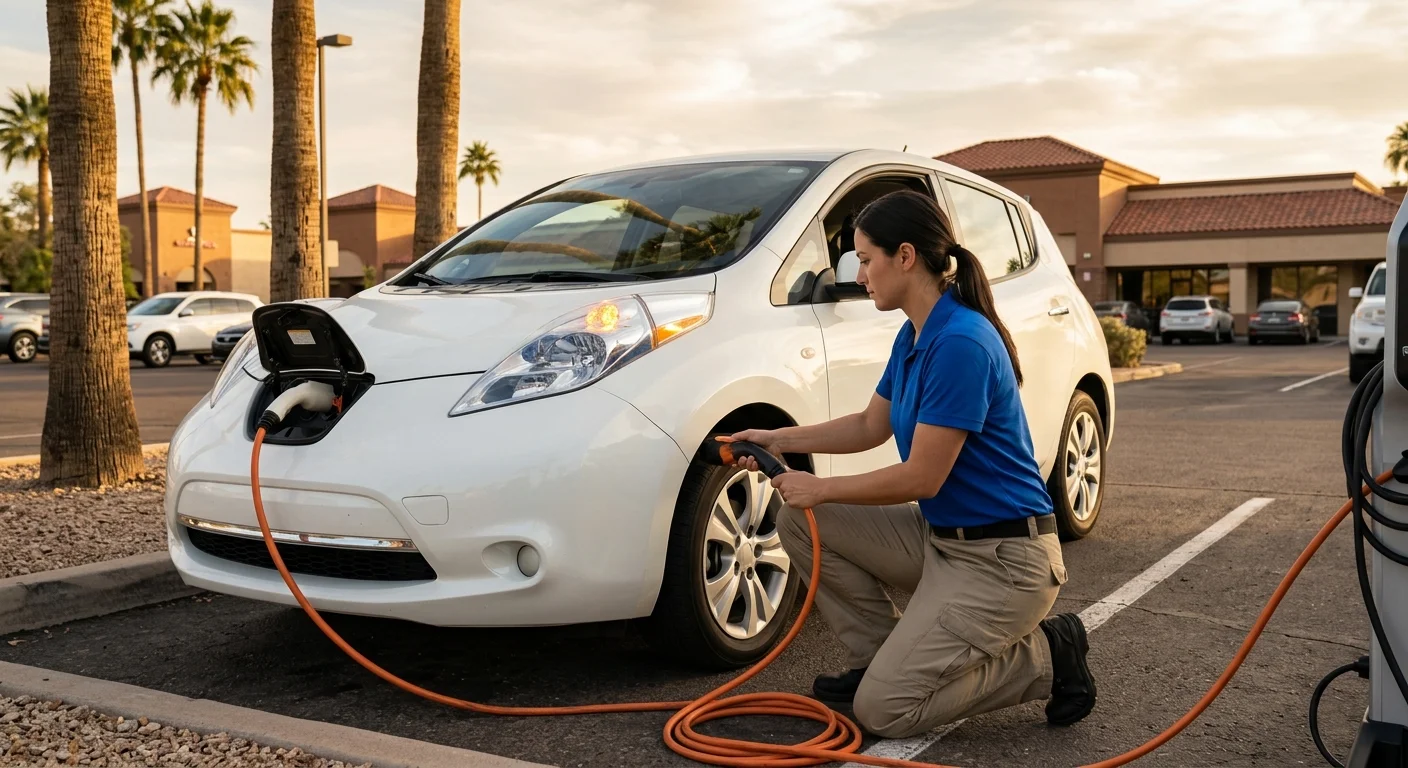
The car goes quiet in a Tempe surface lot after a Mill Avenue night, or on a Loop 202 shoulder with the pack at zero. You don’t need a flatbed if a mobile Level 2 session can add enough miles to roll to a working charger. Charge Pro PHX matches you with an independent operator who brings that charger to the stall.
Where Tempe EVs actually stall
Tempe is a small city with a big commute. About 188,065 people live here, packed between ASU, Mill Avenue, Town Lake, and the freeways that ring the East Valley. The stall pattern is not a quiet cul-de-sac. It is a paid lot that filled during a game, a street stall after last call, or a ramp where the predicted miles ran out in July heat.
Phoenix averages about 111 days a year at or above 100F. July highs sit near 107F. Recurrent, using 345,622 trips from 300 Phoenix-area EVs, reports cars can lose 20 to 30 percent of range above about 95F, with loss near 31 percent at 100F. AAA’s 2026 study found about a 10 percent efficiency drop and an 8.5 percent range loss at 95F versus 75F. Cabin cooling is a real draw. NREL lists climate control among the biggest range hits. A Tempe hop that looked fine at 8 a.m. can strand you after a hot afternoon on Rural, Apache, or Baseline.
This city sits in shared APS and SRP territory. Home charging and workplace pedestals follow whichever utility serves that meter. A stall on the street does not. The car is already where it died. Mobile EV charging is the match for that moment: an independent operator rolls a Level 2 unit to the lot or curb and adds enough range to leave.
Tempe is not Chandler and it is not a West Valley suburb. ASU traffic, Mill events, and Sky Harbor-adjacent I-10 set the map. The apartment overnight dead-car story is a different job, covered in our Tempe apartment EV rescue note. A public pedestal that will not start a session is covered in EV roadside assistance in Tempe. This page is the on-street or lot stall, pack empty, car still able to take AC.
You can get a mobile EV charge without owning equipment. Independent operators bring Level 2 kits with J1772 and NACS (J3400) for AC. The U.S. Department of Energy’s electric vehicle pages explain those AC connectors. A CCS DC adapter alone does not prove AC compatibility. Say the port type when you call.
ASU lots, Mill Avenue, and the 202 and I-10 ramps
Campus lots fill and empty on class hours. A car that sat on AC in a garage all week can still hit zero after a late lab, a packed event, and idling with the A/C on. Gated ASU decks add a second problem: the operator has to reach the stall. Have the lot name, the level, and a way to get a vehicle in. A pin dropped in a stairwell does not help.
Mill Avenue is the event drain. Street parking, paid lots, and short hops between venues eat the buffer people meant to keep. Hazard lights in a stall are easier to work than a car nosed into a travel lane. If you can creep into a legal space before the car dies, do that. Arizona’s ARS 28-871 says you may not stop on the traveled part of a highway outside a business or residence district if it is practical to get off it. A disabled vehicle that cannot be moved is exempt, but you still need room for traffic to pass and you must be visible 200 feet in each direction.
Loop 202 is two different Tempe problems. Red Mountain carries East Valley traffic toward Mesa and the 101 Price. South Mountain is the free public-private loop on the south and west side. Arizona has no toll roads. Scam texts about unpaid Arizona tolls are scams. A stall on either 202 ramp is still a freeway-adjacent stall. ADOT’s Incident Response Unit covers Phoenix-area freeways from 5 a.m. to 8 p.m. on weekdays. It clears crashes and debris, changes tires, and helps stranded motorists. Published IRU materials do not mention EV charging. Arizona DPS Roadside Motorist Assistance is statewide and names gasoline and diesel. It says nothing about out-of-charge EVs.
I-10 on the Tempe-Phoenix edge sits next to Sky Harbor. If you still have a few miles, Terminal 3 and Terminal 4 garages have confirmed Level 2, and so does the 24th St. station. A pack at true zero on a ramp cannot use that. Get the car as far off the traveled lanes as you can. ARS 28-775, the Move Over law, tells approaching drivers to change lanes or slow for a stopped vehicle with warning lights. Fines run $275, then $500, then $1,000 for repeats within five years. Put the hazards on. Stay out of the gore point.
The same mobile charge after a Chandler stall logic applies here, with Tempe’s campus, Mill, and airport-adjacent ramps in place of Chandler’s arterial grid.
Public charger failed versus the pack hit zero
Those two failures feel the same from the driver’s seat. They are not the same job.
A public charger that will not start still leaves you with whatever miles are in the pack. The plug may be offline, the app may hang, the stall may be blocked, or summer heat may have the site offering less power. Field work on DC fast chargers in extreme heat found offered power falling by up to 35 to 40 kW once rectifier temperature approached 55C, with sessions stretching far longer in summer than in winter. The car’s battery management system also asks for lower current when it is hot. If the dash still shows range, the next move is another working site, not a mobile truck, unless you cannot reach one.
A pack at zero is different. The car will not roll to Arizona Mills, a Supercharger, or Sky Harbor. That is out-of-charge recovery: enough AC to leave, not a full fill. A typical rescue charge is 10 to 20 miles of range in 15 to 30 minutes of Level 2 charging. That figure is charging time on site. It is not an arrival promise.
The 80/20 habit people search for is a planning rule, not a statute. Many drivers stop a DC session near 80 percent because power tapers as the pack fills, and they try to keep about 20 percent in reserve for heat, A/C, and a closed stall. In Tempe summer that buffer is the difference between a detour and a dead car on the 202. It is not a promise that 20 percent will cover Town Lake to I-10 after a 110F day.
A dark screen and doors that will not release can be a low-voltage problem, not an empty traction pack. Tell the operator if nothing powers up. Jumping the 12-volt system is a different procedure than AC charging, and it varies by model. Tesla’s current Model Y manual, for example, describes a lithium-ion low-voltage pack with its own jump-post steps. Confirm the year and model. Do not assume a gas-car jump box is the right tool.
Factory roadside is not always an on-site charge. Tesla’s policy says help for a depleted pack is available but is not a financially covered service, warranty or not. Tesla typically arranges transport to the nearest Supercharger or service center. Ford Roadside Assistance for an out-of-charge Ford EV tows to the nearest public charger, home, or a preferred Ford dealer within 50 miles of the breakdown. AAA offers mobile EV charging in select markets as a pilot with Level 2 trucks, at no extra charge to members. Whether Tempe is inside that pilot is not something we can confirm here. Check your membership app for the market list. A local operator match is the path when you want on-site AC at this stall.
How a mobile charge is quoted by local operators
Charge Pro PHX does not set a price and does not run a truck. The independent operator you are matched with quotes the job and bills you. Ask for that quote before they roll.
What they price is travel to your pin plus the charge session itself. Session length follows the gap you need, not a menu. If 10 to 20 miles gets you to a live DC stall or home, that is the usual goal. A Level 2 unit can range from 2.9 to 19.2 kW. Most residential-style Level 2 gear runs up to 30 amps, about 7.2 kW. Roadside kits vary. The operator tells you what they are bringing. Heat can cut charging power. Plan the session around the miles you must cover, then stop.
Connector type changes the quote because the wrong handle does nothing. J1772 and NACS (J3400) are the AC ports. Tesla, Rivian, Ford, GM, Hyundai, Kia, and most others take one of those, sometimes with an AC adapter. Rivian’s J1772 AC adapter is for AC only on NACS-port vehicles. It must not be used on a DC charger. If you have an adapter in the frunk, say so.
Access changes the quote too. A Mill Avenue curb with room to stage is one job. A gated ASU deck is another. A 202 shoulder is a third, with traffic control and a legal place to work. If the car is in a travel lane, the first task may be a short tow to a lot, then a charge. Arizona sets no statewide tow-rate cap. Cities and counties may set local maximums. The operator quotes that piece if it applies. The brand does not.
Do not expect a published fee card, a waiver, or a clock on our side. Arrival windows belong to the operator who takes the job, and they depend on traffic on the 101 Price, I-10, and the 202. We will not invent one.
What the matched operator needs from you
Give a pin a human can drive to. “Tempe” is not an address. “South side of the structure off Apache, level 2, near the elevator” is. For Mill, name the cross street and whether you are in a stall or on the curb. For a ramp, name the freeway, the direction, the nearest exit, and which side you are on.
Make, model, and year tell them which port and which low-voltage layout they are walking into. Pack percent, if the screen still works, tells them how long to stay on the handle. If the car is silent, say that in the first sentence.
Tell them if the lot is gated, if a boot is on a wheel, or if event staff are directing traffic. An operator cannot charge a car they cannot reach. If you can wait in a nearby lobby or shade, say where. Monsoon season runs June 15 to September 30. Haboobs drop visibility to near zero. Flash flood water in a charge port is a different failure. Do not sit in a wash.
Stay with the car if it is safe. Keep hazards on. Do not stand in a gore point. If ADOT IRU or DPS is already on scene for a freeway stall, tell the operator that too. Those units are not an EV charge. They may still control the shoulder.
You pay the operator. Keep the quote, the connector they used, and how many minutes they charged. That record matters if the car dies again two blocks later because the pack was never the only problem.
When to call us
Call when the pack is empty in a Tempe lot, on Mill, or on a 202 or I-10 ramp, and you need a mobile Level 2 session so the car can roll to a charger. Call when factory roadside is offering a tow you do not want, or when a public stall failed and you no longer have the miles to try another. Call us at (602) 932-0920 and we’ll connect you with a local EV rescue operator.